Department of Human Genetics, Punjabi University, Patiala 147002, Punjab, India.
Department of Orthopedics, Aggarsain Charitable Hospital, Patiala 147002, Punjab, India.
Int J Environ Res Public Health. 2022 Mar 4;19(5):2999. doi: 10.3390/ijerph19052999.
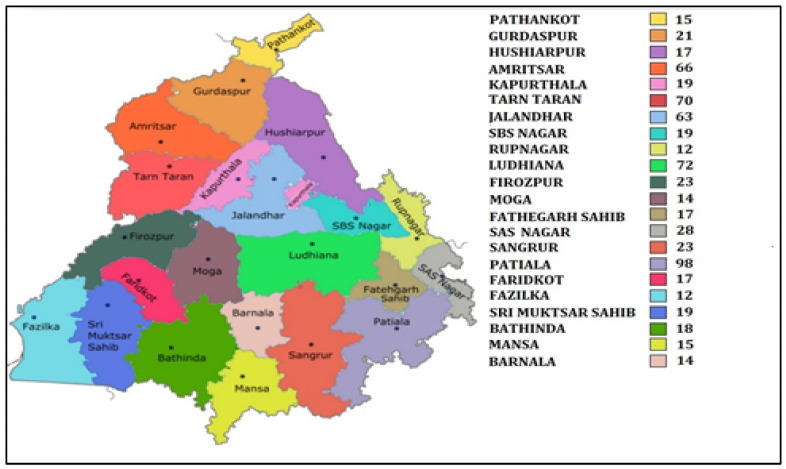
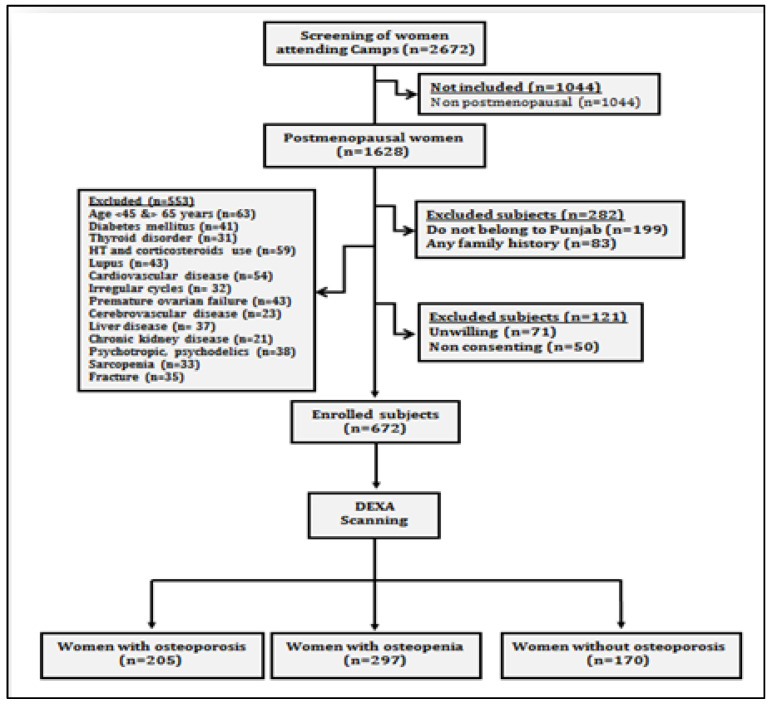
The prevalence and predictors of osteoporosis and osteopenia remain to be examined in the postmenopausal women of Punjab, India. The present cross-sectional study screened 1628 postmenopausal women during September 2019 to March 2020. Osteoporosis and osteopenia were confirmed on the basis of T-scores using dual energy X-ray absorptiometry (DXA) at the hip (femoral neck) and lumbar spine regions (L1−L4 vertebrae). The prevalence of osteoporosis and osteopenia was observed to be 30.50% and 44.20%, respectively, in postmenopausal women of Punjab. In univariable and multivariable regression analysis, variables independently influencing the risk of osteoporosis and osteopenia were: higher systolic blood pressure (95%CI: 1.22−3.11 & 1.08−2.49), triglyceride levels (95%CI: 1.21−3.10 & 1.42−2.51), poor sleep quality (95%CI: 1.91−2.47 & 1.76−3.47) and C-reactive protein levels (95%CI: 2.18−3.56 & 1.03−2.18). Years since menopause >10 years was observed to be an independent predictor for the risk of osteopenia but not for osteoporosis. Higher body mass index (>30 kg·m−2) was observed to be a significant protective factor against the risk of osteoporosis (95%CI: 0.26−0.68) and osteopenia (95%CI: 0.19−0.52). The higher prevalence rates of osteoporosis and osteopenia in postmenopausal women of Punjab are alarming, which solicits awareness and earlier testing of those women who are approaching menopause.
在印度旁遮普的绝经后女性中,骨质疏松症和骨量减少的流行率和预测因素仍需进一步研究。本横断面研究于 2019 年 9 月至 2020 年 3 月期间对 1628 名绝经后女性进行了筛查。使用双能 X 射线吸收法(DXA)在髋部(股骨颈)和腰椎区(L1-L4 椎体)基于 T 评分确定骨质疏松症和骨量减少。观察到旁遮普的绝经后女性骨质疏松症和骨量减少的患病率分别为 30.50%和 44.20%。在单变量和多变量回归分析中,独立影响骨质疏松症和骨量减少风险的变量为:较高的收缩压(95%CI:1.22-3.11 和 1.08-2.49)、甘油三酯水平(95%CI:1.21-3.10 和 1.42-2.51)、睡眠质量差(95%CI:1.91-2.47 和 1.76-3.47)和 C 反应蛋白水平(95%CI:2.18-3.56 和 1.03-2.18)。绝经后年数>10 年被观察为骨量减少的独立预测因素,但不是骨质疏松症的预测因素。较高的身体质量指数(>30 kg·m-2)被观察为骨质疏松症(95%CI:0.26-0.68)和骨量减少(95%CI:0.19-0.52)风险的显著保护因素。旁遮普的绝经后女性中骨质疏松症和骨量减少的较高患病率令人震惊,这需要提高对即将进入绝经期的女性的认识,并进行早期检测。