Bond Simon T, Calkin Anna C, Drew Brian G
Baker Heart and Diabetes Institute, Melbourne, VIC, Australia.
Central Clinical School, Monash University, Melbourne, VIC, Australia.
Front Physiol. 2022 Feb 23;13:837001. doi: 10.3389/fphys.2022.837001. eCollection 2022.
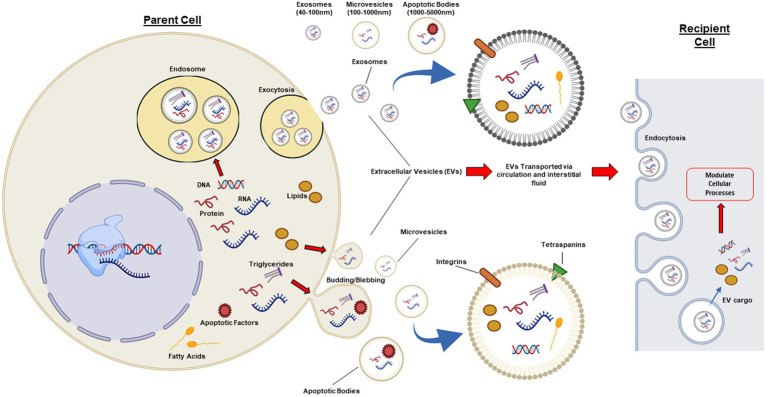
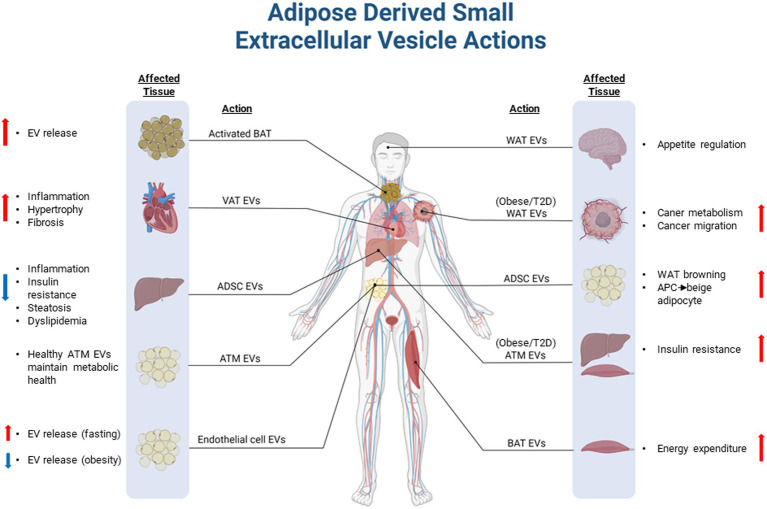
Adipose tissue is comprised of a heterogeneous population of cells that co-operate to perform diverse physiological roles including endocrine-related functions. The endocrine role of adipose tissue enables it to communicate nutritional and health cues to other organs, such as the liver, muscle, and brain, in order to regulate appetite and whole body metabolism. Adipose tissue dysfunction, which is often observed in obesity, is associated with changes in the adipose secretome, which can subsequently contribute to disease pathology. Indeed, secreted bioactive factors released from adipose tissue contribute to metabolic homeostasis and likely play a causal role in disease; however, what constitutes the entirety of the adipose tissue secretome is still poorly understood. Recent advances in nanotechnology have advanced this field substantially and have led to the identification of small, secreted particles known as extracellular vesicles (EVs). These small nano-sized lipid envelopes are released by most cell types and are capable of systemically delivering bioactive molecules, such as nucleic acids, proteins, and lipids. EVs interact with target cells to deliver specific cargo that can then elicit effects in various tissues throughout the body. Adipose tissue has recently been shown to secrete EVs that can communicate with the periphery to maintain metabolic homeostasis, or under certain pathological conditions, drive disease. In this review, we discuss the current landscape of adipose tissue-derived EVs, with a focus on their role in the regulation of metabolic homeostasis and disease pathology.
脂肪组织由多种细胞组成,这些细胞协同发挥多种生理作用,包括与内分泌相关的功能。脂肪组织的内分泌作用使其能够将营养和健康信号传递给其他器官,如肝脏、肌肉和大脑,从而调节食欲和全身代谢。肥胖时经常观察到的脂肪组织功能障碍与脂肪分泌组的变化有关,这随后可能导致疾病病理过程。事实上,脂肪组织释放的分泌性生物活性因子有助于代谢稳态,并且可能在疾病中起因果作用;然而,构成脂肪组织分泌组的整体情况仍知之甚少。纳米技术的最新进展极大地推动了这一领域,并导致了被称为细胞外囊泡(EVs)的小分泌颗粒的鉴定。这些小的纳米级脂质包膜由大多数细胞类型释放,能够全身递送生物活性分子,如核酸、蛋白质和脂质。细胞外囊泡与靶细胞相互作用以递送特定货物,然后这些货物可在全身各种组织中引发效应。最近的研究表明,脂肪组织分泌的细胞外囊泡可以与外周进行通讯以维持代谢稳态,或者在某些病理条件下引发疾病。在这篇综述中,我们讨论了脂肪组织来源的细胞外囊泡的当前情况,重点关注它们在调节代谢稳态和疾病病理过程中的作用。