Monash Biomedical Imaging, Monash University, Melbourne, Australia.
Department of Electrical and Computer Systems Engineering, Monash University, Melbourne, Australia.
Eur J Nucl Med Mol Imaging. 2022 Jul;49(9):3098-3118. doi: 10.1007/s00259-022-05746-4. Epub 2022 Mar 21.
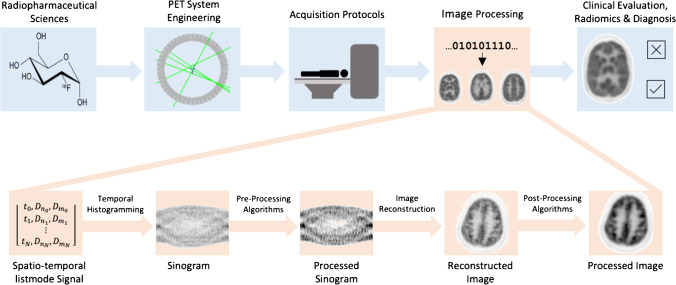
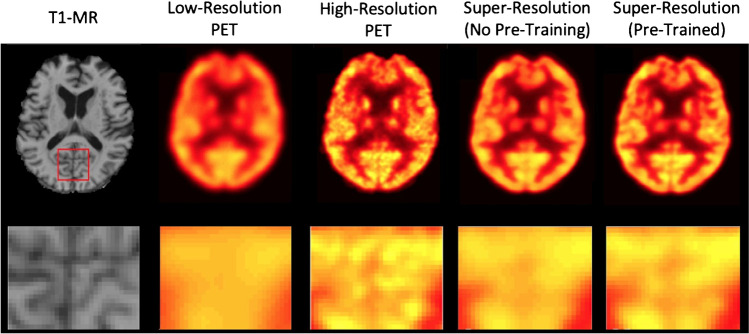
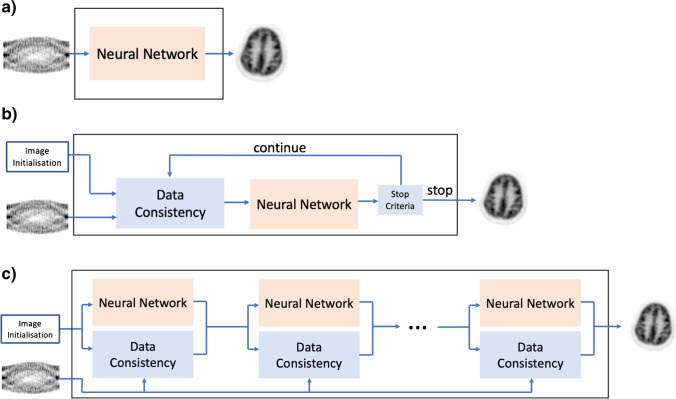
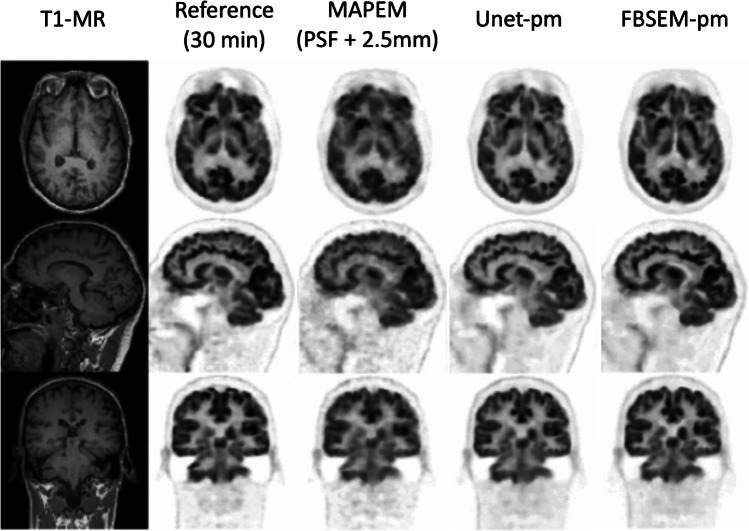
Image processing plays a crucial role in maximising diagnostic quality of positron emission tomography (PET) images. Recently, deep learning methods developed across many fields have shown tremendous potential when applied to medical image enhancement, resulting in a rich and rapidly advancing literature surrounding this subject. This review encapsulates methods for integrating deep learning into PET image reconstruction and post-processing for low-dose imaging and resolution enhancement. A brief introduction to conventional image processing techniques in PET is firstly presented. We then review methods which integrate deep learning into the image reconstruction framework as either deep learning-based regularisation or as a fully data-driven mapping from measured signal to images. Deep learning-based post-processing methods for low-dose imaging, temporal resolution enhancement and spatial resolution enhancement are also reviewed. Finally, the challenges associated with applying deep learning to enhance PET images in the clinical setting are discussed and future research directions to address these challenges are presented.
图像处理在最大限度地提高正电子发射断层扫描(PET)图像的诊断质量方面起着至关重要的作用。最近,在医学图像增强方面,跨多个领域开发的深度学习方法显示出了巨大的潜力,围绕这一主题的文献也在迅速丰富和发展。本综述总结了将深度学习集成到用于低剂量成像和分辨率增强的 PET 图像重建和后处理中的方法。首先简要介绍了 PET 中的常规图像处理技术。然后,我们回顾了将深度学习集成到图像重建框架中的方法,这些方法既可以作为基于深度学习的正则化方法,也可以作为从测量信号到图像的完全数据驱动映射方法。还回顾了用于低剂量成像、时间分辨率增强和空间分辨率增强的基于深度学习的后处理方法。最后,讨论了将深度学习应用于临床环境中增强 PET 图像所面临的挑战,并提出了应对这些挑战的未来研究方向。