Department of Computer Science, Yale University, New Haven, CT, USA.
Department of Computer Science & Engineering, Texas A&M University, College Station, TX, USA.
Nat Commun. 2022 Mar 24;13(1):1583. doi: 10.1038/s41467-022-29153-3.
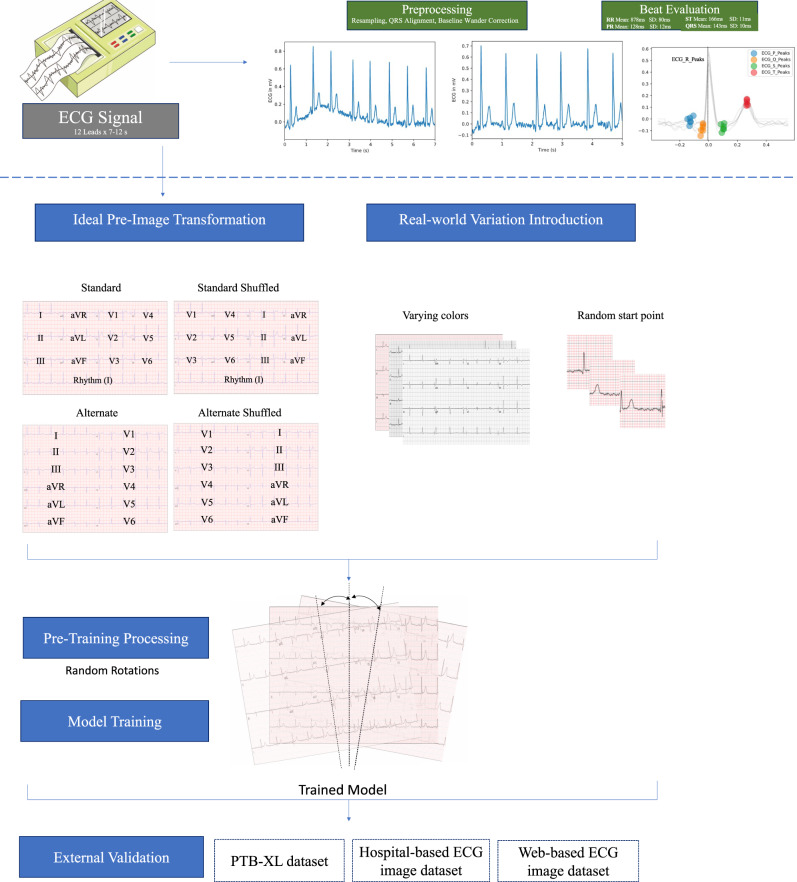
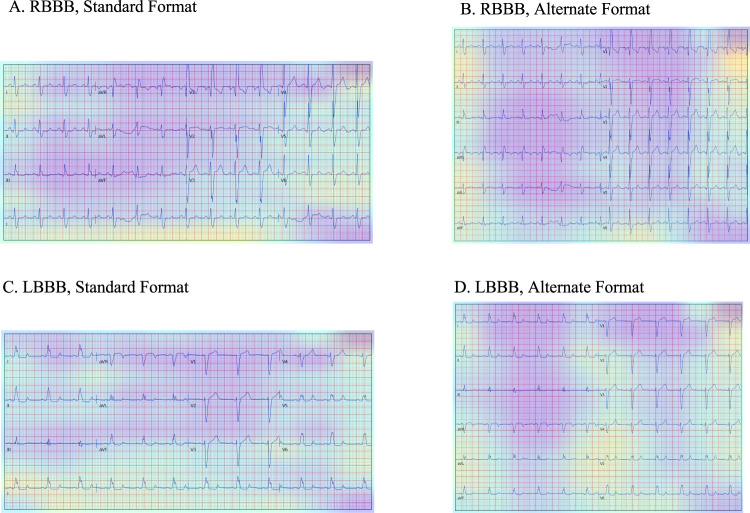
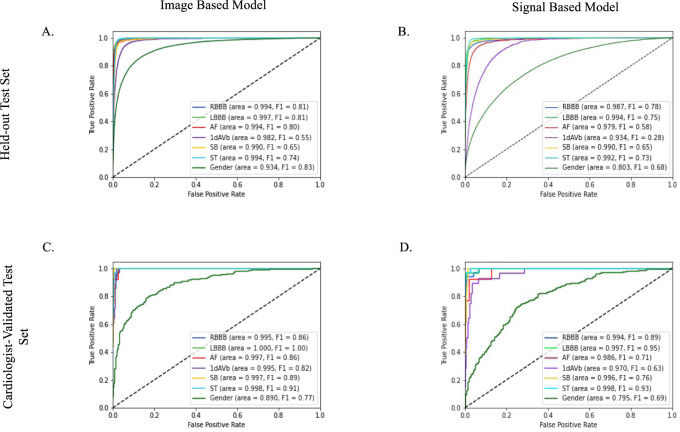
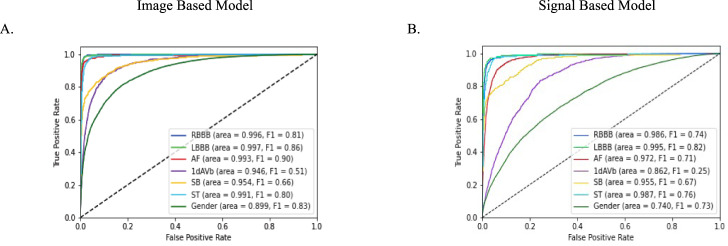
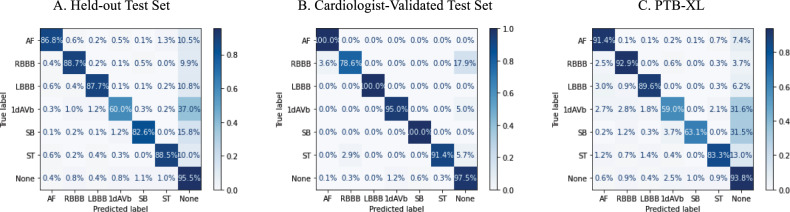
The application of artificial intelligence (AI) for automated diagnosis of electrocardiograms (ECGs) can improve care in remote settings but is limited by the reliance on infrequently available signal-based data. We report the development of a multilabel automated diagnosis model for electrocardiographic images, more suitable for broader use. A total of 2,228,236 12-lead ECGs signals from 811 municipalities in Brazil are transformed to ECG images in varying lead conformations to train a convolutional neural network (CNN) identifying 6 physician-defined clinical labels spanning rhythm and conduction disorders, and a hidden label for gender. The image-based model performs well on a distinct test set validated by at least two cardiologists (average AUROC 0.99, AUPRC 0.86), an external validation set of 21,785 ECGs from Germany (average AUROC 0.97, AUPRC 0.73), and printed ECGs, with performance superior to signal-based models, and learning clinically relevant cues based on Grad-CAM. The model allows the application of AI to ECGs across broad settings.
人工智能(AI)在心电图(ECG)自动诊断中的应用可以改善远程环境中的护理水平,但受到基于信号的罕见数据的限制。我们报告了一种适用于更广泛应用的心电图图像多标签自动诊断模型的开发。总共从巴西 811 个城市的 2,228,236 份 12 导联心电图信号转换为不同导联配置的心电图图像,以训练一种卷积神经网络(CNN),识别 6 个医生定义的临床标签,涵盖节律和传导障碍以及一个性别隐藏标签。基于图像的模型在由至少两名心脏病专家验证的独立测试集上表现良好(平均 AUROC 0.99,AUPRC 0.86),在来自德国的 21,785 份外部验证集 ECG 上(平均 AUROC 0.97,AUPRC 0.73),以及在打印的 ECG 上,性能优于基于信号的模型,并基于 Grad-CAM 学习临床相关线索。该模型允许在广泛的环境中应用 AI 进行心电图诊断。