Hossain Md Belal, Iqbal S M Hasan Sazzad, Islam Md Monirul, Akhtar Md Nasim, Sarker Iqbal H
Department of Computer Science and Engineering, Pabna University of Science and Technology, Pabna 6600, Bangladesh.
Department of Textile Engineering, Uttara University, Dhaka 1230, Bangladesh.
Inform Med Unlocked. 2022;30:100916. doi: 10.1016/j.imu.2022.100916. Epub 2022 Mar 19.
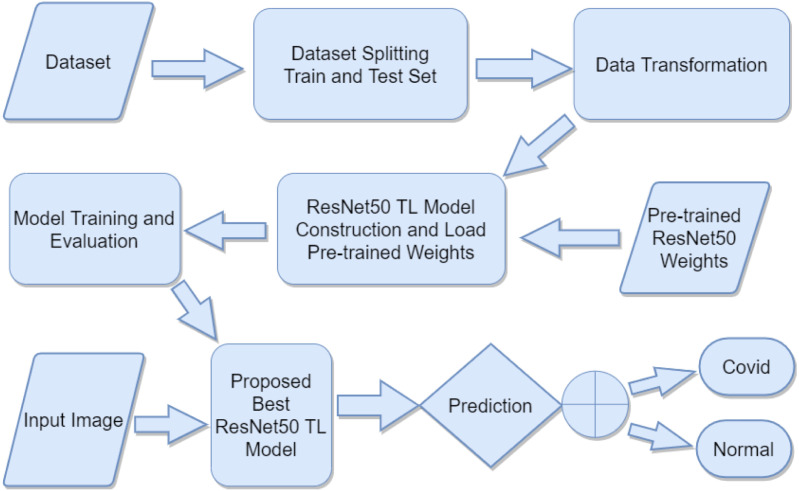
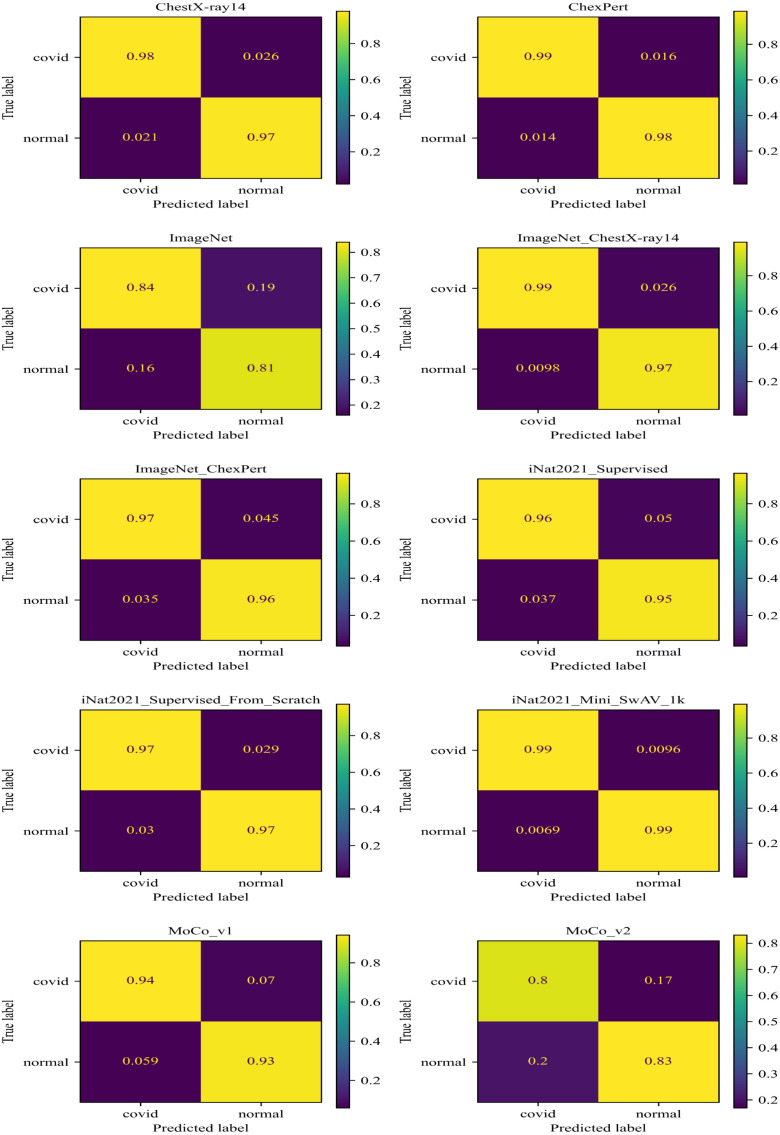
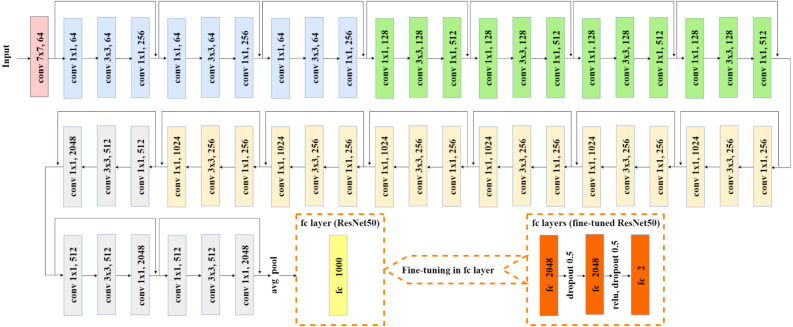
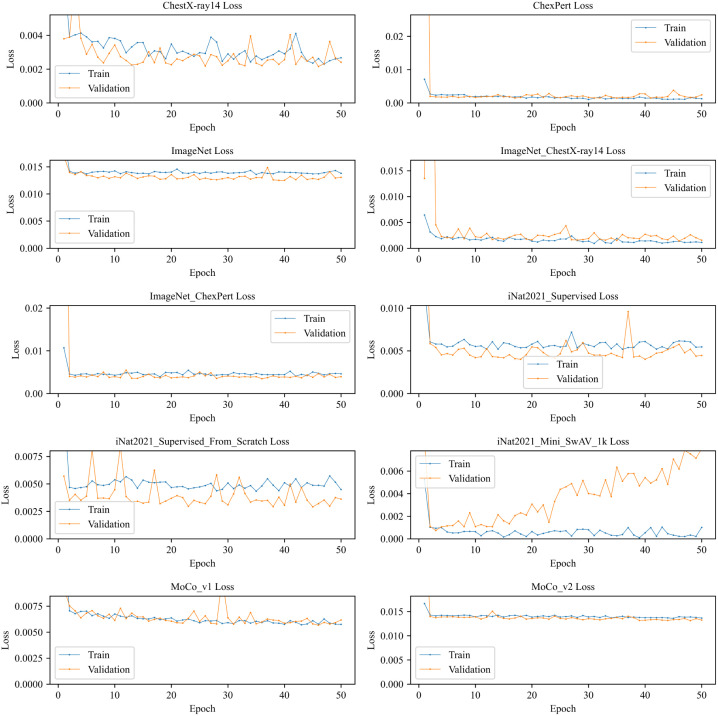
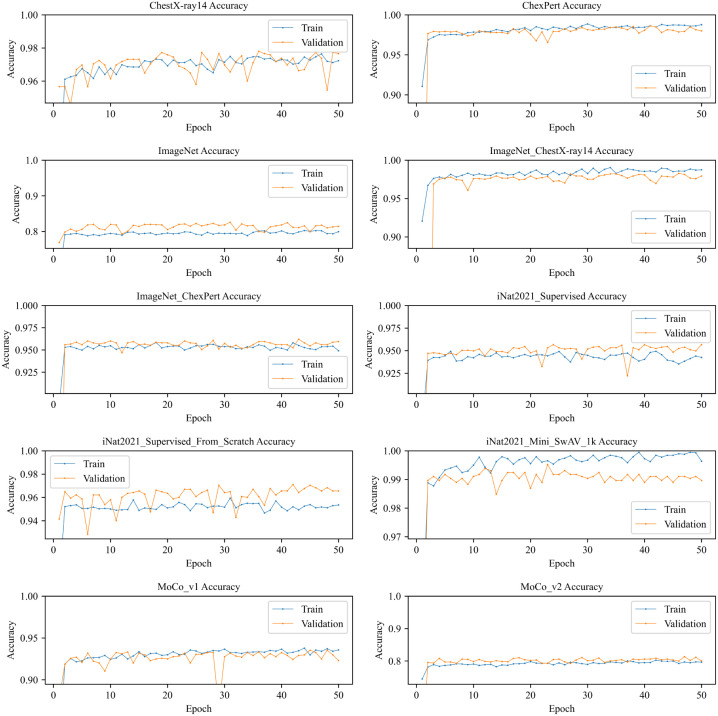
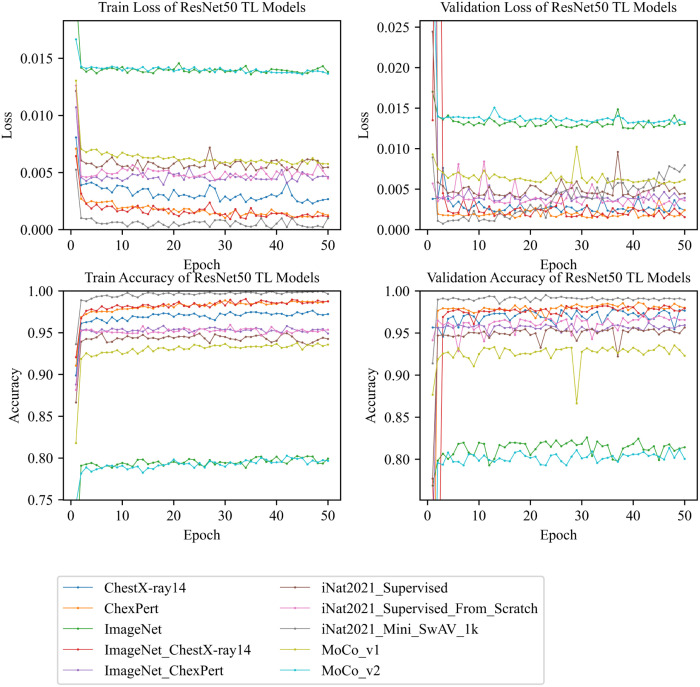
COVID-19 cases are putting pressure on healthcare systems all around the world. Due to the lack of available testing kits, it is impractical for screening every patient with a respiratory ailment using traditional methods (RT-PCR). In addition, the tests have a high turn-around time and low sensitivity. Detecting suspected COVID-19 infections from the chest X-ray might help isolate high-risk people before the RT-PCR test. Most healthcare systems already have X-ray equipment, and because most current X-ray systems have already been computerized, there is no need to transfer the samples. The use of a chest X-ray to prioritize the selection of patients for subsequent RT-PCR testing is the motivation of this work. Transfer learning (TL) with fine-tuning on deep convolutional neural network-based ResNet50 model has been proposed in this work to classify COVID-19 patients from the COVID-19 Radiography Database. Ten distinct pre-trained weights, trained on varieties of large-scale datasets using various approaches such as supervised learning, self-supervised learning, and others, have been utilized in this work. Our proposed model, pre-trained on the iNat2021 Mini dataset using the SwAV algorithm, outperforms the other ResNet50 TL models. For COVID instances in the two-class (Covid and Normal) classification, our work achieved 99.17% validation accuracy, 99.95% train accuracy, 99.31% precision, 99.03% sensitivity, and 99.17% F1-score. Some domain-adapted ( ) and in-domain (ChexPert, ChestX-ray14) models looked promising in medical image classification by scoring significantly higher than other models.
新冠病毒肺炎病例给全球医疗系统带来了压力。由于缺乏可用的检测试剂盒,使用传统方法(逆转录聚合酶链反应)对每一位患有呼吸道疾病的患者进行筛查是不切实际的。此外,这些检测周转时间长且灵敏度低。从胸部X光片中检测疑似新冠病毒肺炎感染可能有助于在逆转录聚合酶链反应检测之前隔离高危人群。大多数医疗系统已经配备了X光设备,而且由于目前大多数X光系统已经实现了计算机化,无需转移样本。利用胸部X光片来优先选择患者进行后续的逆转录聚合酶链反应检测是这项工作的动机。在这项工作中,提出了基于深度卷积神经网络的ResNet50模型进行微调的迁移学习,以从新冠病毒肺炎影像学数据库中对新冠病毒肺炎患者进行分类。在这项工作中,使用了十种不同的预训练权重,这些权重是通过监督学习、自监督学习等各种方法在各种大规模数据集上训练得到的。我们提出的模型使用SwAV算法在iNat2021迷你数据集上进行预训练,其性能优于其他ResNet50迁移学习模型。对于两类(新冠病毒肺炎和正常)分类中的新冠病毒肺炎实例,我们的工作在验证准确率方面达到了99.17%,训练准确率达到了99.95%,精确率达到了99.31%,灵敏度达到了99.03%,F1分数达到了99.17%。一些领域适应模型和领域内模型(ChexPert、ChestX-ray14)在医学图像分类中看起来很有前景,其得分显著高于其他模型。