Li Dawei, Tang Guoke, Yao Hui, Zhu Yuqi, Shi Changgui, Fu Qiang, Yang Fei, Wang Xing
Senior Department of Orthopedics, The Fourth Medical Center of PLA General Hospital, Beijing, 100091, China.
Beijing National Laboratory for Molecular Sciences, State Key Laboratory of Polymer Physics & Chemistry, Institute of Chemistry, Chinese Academy of Sciences, Beijing, 100190, China.
Bioact Mater. 2022 Feb 24;16:47-56. doi: 10.1016/j.bioactmat.2022.02.018. eCollection 2022 Oct.
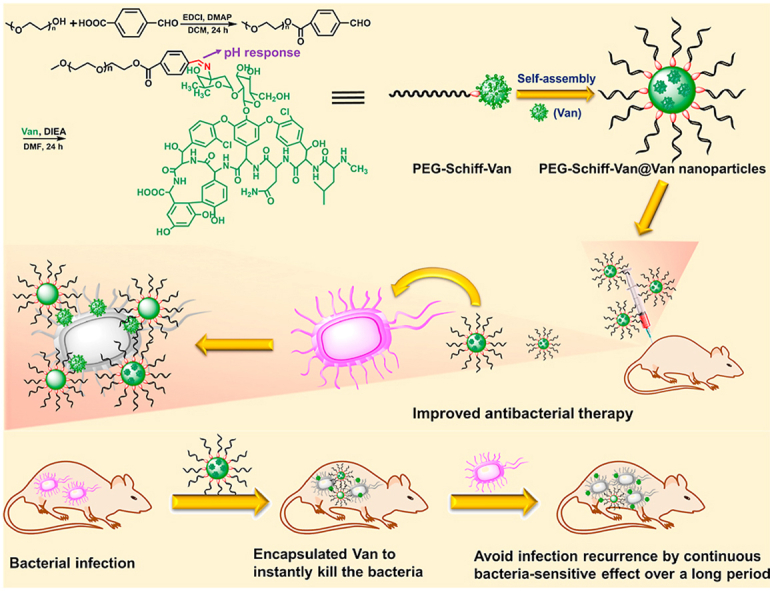
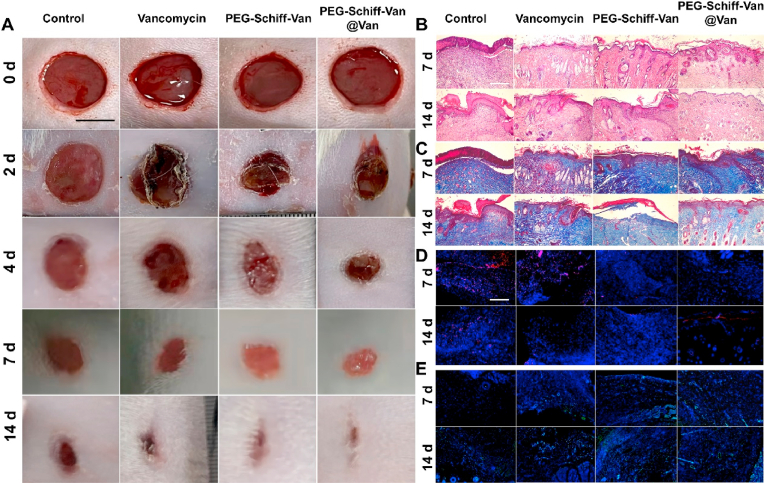
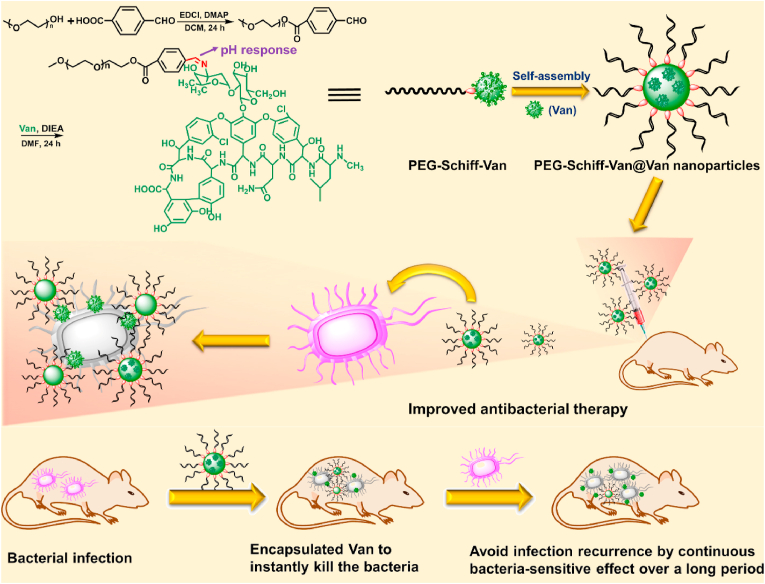
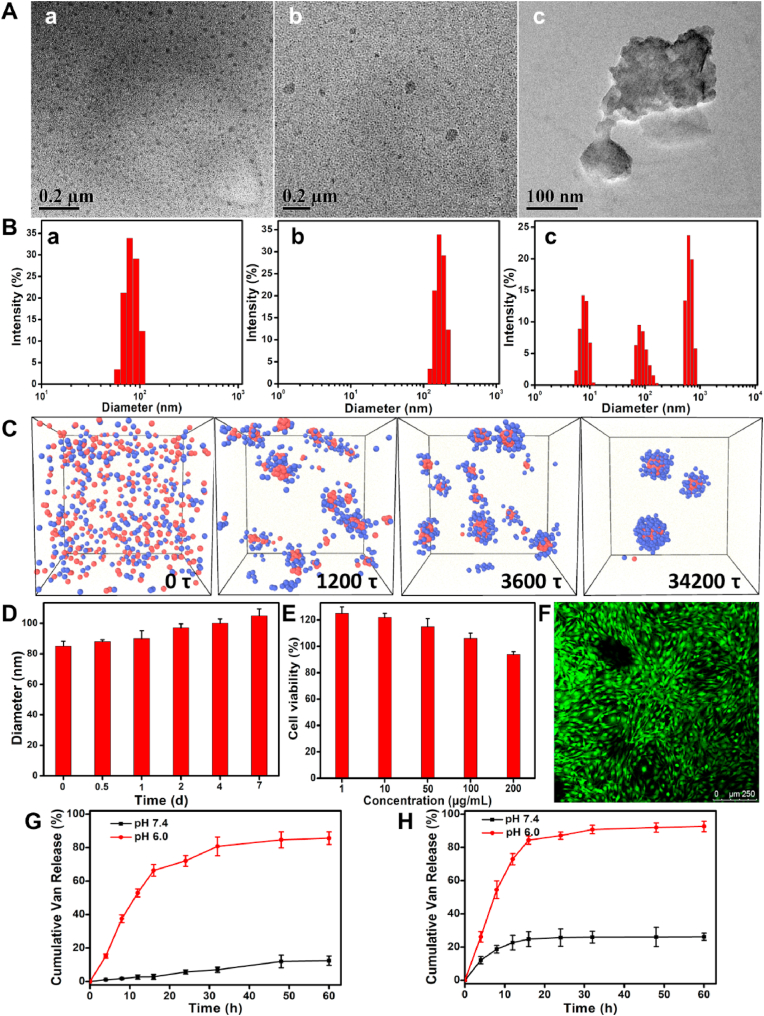
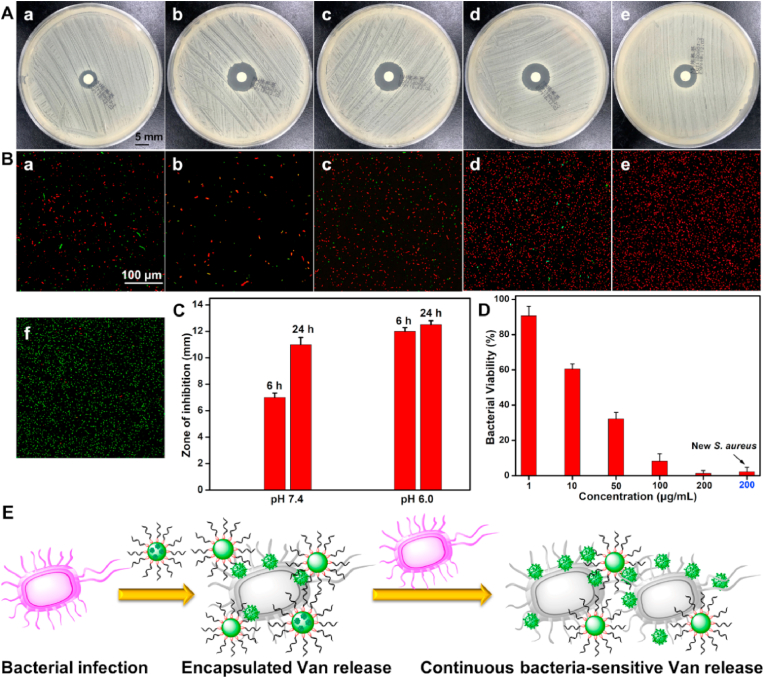
In the current global crisis of antibiotic resistance, delivery systems are emerging to combat resistant bacteria in a more efficient manner. Despite the significant advances of antibiotic nanocarriers, many challenges like poor biocompatibility, premature drug release, suboptimal targeting to infection sites and short blood circulation time are still challenging. To achieve targeted drug delivery and enhance antibacterial activity, here we reported a kind of pH-responsive nanoparticles by simply self-assembly of an amphiphilic poly(ethylene glycol)-Schiff-vancomycin (PEG-Schiff-Van) prodrug and free Van in one drug delivery system. The acid-liable Schiff base furnished the PEG-Schiff-Van@Van with good storage stability in the neutral environment and susceptible disassembly in response to faintly acidic condition. Notably, on account of the combination of physical encapsulation and chemical conjugation of vancomycin, these nanocarriers with favorable biocompatibility and high drug loading capacity displayed a programmed drug release behavior, which was capable of rapidly reaching high drug concentration to effectively kill the bacteria at an early period and continuously exerting an bacteria-sensitive effect whenever needed over a long period. In addition, more Schiff-base moieties within the PEG-Schiff-Van@Van nanocarriers may also make great contributions on promoting the antimicrobial activity. Using this strategy, this system was designed to have programmable structural destabilization and sequential drug release due to changes in pH that were synonymous with bacterial infection sites, thereby presenting prominent antibacterial therapy both and . This work represents a synergistic strategy on offering important guidance to rational design of multifunctional antimicrobial vehicles, which would be a promising class of antimicrobial materials for potential clinical translation.
在当前全球抗生素耐药性危机中,递送系统正在兴起,以更有效地对抗耐药细菌。尽管抗生素纳米载体取得了重大进展,但许多挑战,如生物相容性差、药物过早释放、对感染部位的靶向性欠佳以及血液循环时间短等,仍然具有挑战性。为了实现靶向药物递送并增强抗菌活性,在此我们报道了一种通过两亲性聚乙二醇 - 席夫 - 万古霉素(PEG - Schiff - Van)前药与游离万古霉素在单一药物递送系统中简单自组装而成的pH响应性纳米颗粒。酸敏感的席夫碱使PEG - Schiff - Van@Van在中性环境中具有良好的储存稳定性,并在微弱酸性条件下易于分解。值得注意的是,由于万古霉素的物理包封和化学偶联相结合,这些具有良好生物相容性和高载药量的纳米载体呈现出程序性药物释放行为,能够在早期迅速达到高药物浓度以有效杀灭细菌,并在需要时长期持续发挥细菌敏感效应。此外,PEG - Schiff - Van@Van纳米载体内更多的席夫碱部分也可能对促进抗菌活性有很大贡献。利用这一策略,该系统被设计为由于与细菌感染部位同义的pH变化而具有可编程的结构不稳定和顺序药物释放,从而在体内外均呈现出显著的抗菌治疗效果。这项工作代表了一种协同策略,为多功能抗菌载体的合理设计提供了重要指导,这将是一类有前途的抗菌材料,有望实现临床转化。