Meletiadis Arianna, Biolatti Cristina, Mugetti Davide, Zaccaria Teresa, Cipriani Raffaella, Pitti Monica, Decastelli Lucia, Cimino Francesca, Dondo Alessandro, Maurella Cristiana, Bozzetta Elena, Acutis Pier Luigi
Experimental Zooprophylactic Institute for Piedmont, Ligury and Valle d'Aosta, 10154 Turin, Italy.
Azienda Sanitaria Locale CN1, 12100 Cuneo, Italy.
Animals (Basel). 2022 Apr 1;12(7):906. doi: 10.3390/ani12070906.
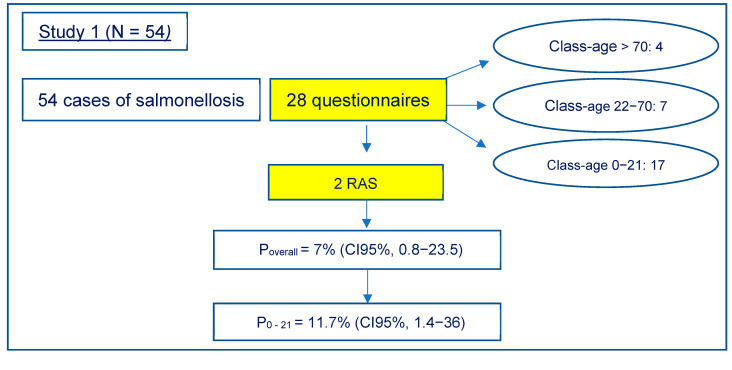
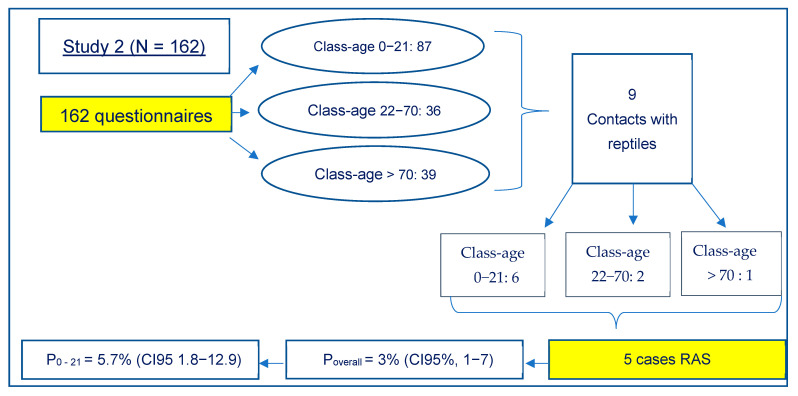
Reptile-associated salmonellosis (RAS), infection in humans, is acquired through contact with reptiles. Reptiles have become popular pet animals, and RAS is likely to be an underestimated but growing problem. No epidemiological data about RAS are routinely collected in Italy. In order to estimate the occurrence of RAS in the Italian human population and to investigate the exposure, two epidemiological studies on patients with sporadic salmonellosis were carried out in the Piedmont region, along with an evaluation of human exposure in public places displaying reptiles and with a survey on people awareness. RAS appeared make up 7% of sporadic salmonellosis in the first study and 3% in the second, more extensive study. A prevalence of 11.7% and 5.7%, respectively, were calculated for the age range of 0-21 years. It was observed that in public places displaying reptiles, it was possible to easily come into contact with the animals and their environment. Some knowledge about RAS emerged from the interviews with the general population, but preventive measures are not completely applied by reptile owners. In conclusion, RAS in Italy is present and constitutes a proportion of the human salmonellosis cases in line with the percentages reported in other countries. Exposure to reptiles should always be considered as a risk factor, and people should be more informed about RAS and the related preventive measures.
与爬行动物相关的沙门氏菌病(RAS)是一种人类感染疾病,通过与爬行动物接触而获得。爬行动物已成为受欢迎的宠物,而RAS可能是一个被低估但却在不断增加的问题。在意大利,没有常规收集关于RAS的流行病学数据。为了估计RAS在意大利人群中的发生率并调查暴露情况,在皮埃蒙特地区对散发性沙门氏菌病患者进行了两项流行病学研究,同时评估了展示爬行动物的公共场所中的人群暴露情况,并对人们的认知进行了调查。在第一项研究中,RAS占散发性沙门氏菌病的7%,在第二项更广泛的研究中占3%。在0至21岁年龄范围内,患病率分别计算为11.7%和5.7%。据观察,在展示爬行动物的公共场所,人们很容易接触到这些动物及其环境。通过对普通人群的访谈发现了一些关于RAS的知识,但爬行动物主人并未完全采取预防措施。总之,意大利存在RAS,并且在人类沙门氏菌病病例中占一定比例,与其他国家报告的百分比一致。接触爬行动物应始终被视为一个风险因素,人们应该更多地了解RAS及相关预防措施。