Laboratory of Applied Photonics Devices, School of Engineering, Ecole Polytechnique Fédérale de Lausanne, Lausanne, Switzerland.
Readily3D SA, EPFL Innovation Park, Building A, Lausanne, Switzerland.
Adv Sci (Weinh). 2022 Aug;9(22):e2105144. doi: 10.1002/advs.202105144. Epub 2022 May 18.
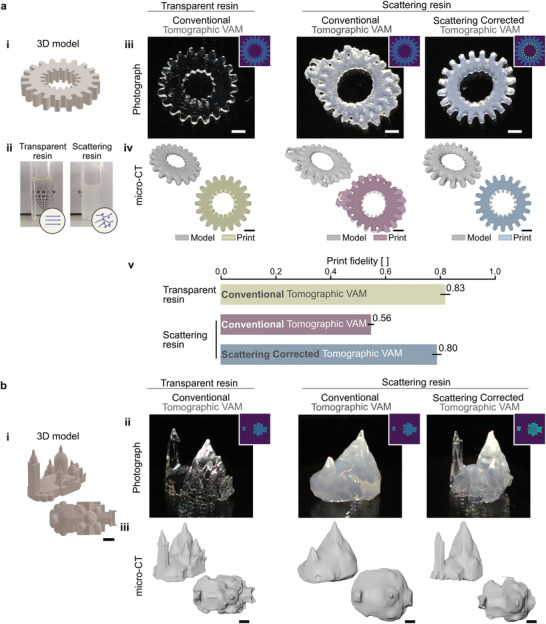
3D printing has revolutionized the manufacturing of volumetric components and structures in many areas. Several fully volumetric light-based techniques have been recently developed thanks to the advent of photocurable resins, promising to reach unprecedented short print time (down to a few tens of seconds) while keeping a good resolution (around 100 μm). However, these new approaches only work with homogeneous and relatively transparent resins so that the light patterns used for photo-polymerization are not scrambled along their propagation. Herein, a method that takes into account light scattering in the resin prior to computing projection patterns is proposed. Using a tomographic volumetric printer, it is experimentally demonstrated that implementation of this correction is critical when printing objects whose size exceeds the scattering mean free path. To show the broad applicability of the technique, functional objects of high print fidelity are fabricated in hard organic scattering acrylates and soft cell-laden hydrogels (at 4 million cells mL ). This opens up promising perspectives in printing inside turbid materials with particular interesting applications for bioprinting cell-laden constructs.
3D 打印技术已经彻底改变了许多领域中体积组件和结构的制造方式。由于光固化树脂的出现,最近已经开发出了几种完全基于体积的光技术,有望在保持良好分辨率(约 100μm)的同时,将打印时间缩短到前所未有的几十秒。然而,这些新方法仅适用于均匀且相对透明的树脂,以便用于光聚合的光图案在其传播过程中不会发生混乱。在此,提出了一种在计算投影图案之前考虑树脂中光散射的方法。通过使用层析体积打印机,实验证明,当打印尺寸超过散射平均自由程的物体时,实施这种校正非常关键。为了展示该技术的广泛适用性,在硬有机散射丙烯酸盐和软细胞负载水凝胶(400 万细胞/mL)中制造了高打印保真度的功能物体。这为在混浊材料内部打印开辟了有前途的前景,对于细胞负载构建体的生物打印具有特别有趣的应用。