Gao Siyao, Yu Ling, Yi Guozhong, Li Tong, Chen Zhenyin, Ding Jiawang
Department of Physical Education, Central South University, Changsha, 410083, Hunan, People's Republic of China.
Department of Internal Medicine, Beijing Chaoyang Hospital, Chaoyang, Beijing, 100020, People's Republic of China.
Diabetes Ther. 2022 Jul;13(7):1311-1325. doi: 10.1007/s13300-022-01275-3. Epub 2022 Jun 1.
Sarcopenia is defined as a progressive and generalized muscle disorder that involves accelerated loss of muscle mass and impaired function. It is believed to influence the ability to carry out daily activities, muscle strength, and physical capacity in the elderly. Studies have shown that sarcopenia has been implicated as both a cause and a consequence of diabetes mellitus. In this analysis, we aimed to systematically show the impact of exercise intervention as a therapy for patients with diabetes mellitus and sarcopenia.
Electronic databases, including PubMed, EMBASE, Web of Science, and the Cochrane database, were searched from November to December 2021 for publications based on exercise intervention in patients with sarcopenia. After the selection of studies for this analysis, patients with diabetes mellitus were retrieved. Since dichotomous data including mean and standard deviation were reported, weighted mean difference (MD) with 95% confidence intervals (CI) were used to represent the data following analysis.
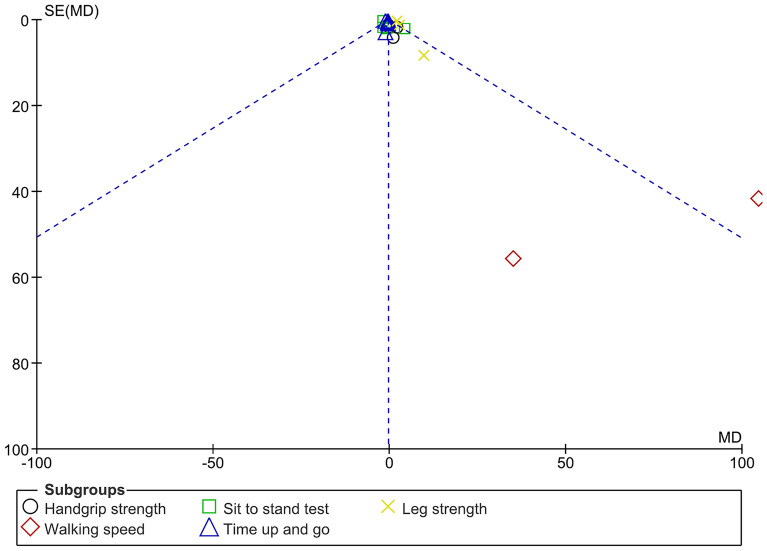
A total of 431 participants with diabetes mellitus and sarcopenia were included in this meta-analysis. A statistical analysis was carried out on patients with diabetes mellitus who were assigned to the exercise intervention group. Our analysis showed that "sit-to-stand test" and "timed up and go" were significantly in favor of exercise intervention: MD -1.57, 95% confidence interval (CI) -2.26 to -0.87 (P = 0.0001) versus MD -0.61, 95% CI -1.21 to -0.01 (P = 0.05), respectively. Handgrip strength, walking speed and leg strength were also assessed. Another statistical analysis was carried out, this time on patients with diabetes mellitus and sarcopenia who were not assigned to an exercise intervention. The results showed no significant difference among sit-to-stand test, timed up and go, handgrip strength, and leg strength.
Exercise intervention significantly improved the time taken to stand up from a sitting position, and to "stand up and go" in patients with diabetes mellitus and sarcopenia. Therefore, exercise intervention should be considered a relevant therapy for such patients.
肌肉减少症被定义为一种进行性全身性肌肉疾病,其特征是肌肉质量加速流失和功能受损。人们认为它会影响老年人进行日常活动的能力、肌肉力量和身体机能。研究表明,肌肉减少症既是糖尿病的一个病因,也是糖尿病的一个后果。在本分析中,我们旨在系统地展示运动干预作为糖尿病合并肌肉减少症患者治疗方法的效果。
2021年11月至12月,我们检索了包括PubMed、EMBASE、科学引文索引和考克兰数据库在内的电子数据库,以查找基于对肌肉减少症患者进行运动干预的出版物。在为该分析选择研究后,检索出了糖尿病患者。由于报告的数据包括均值和标准差,因此在分析后使用加权平均差(MD)及95%置信区间(CI)来表示数据。
本荟萃分析共纳入了431名糖尿病合并肌肉减少症患者。对被分配到运动干预组的糖尿病患者进行了统计分析。我们的分析表明,“从坐到站测试”和“计时起立行走测试”显著有利于运动干预:MD分别为-1.57,95%置信区间(CI)为-2.26至-0.87(P = 0.0001)和MD为-0.61,95% CI为-1.21至-0.01(P = 0.05)。还对手握力、步行速度和腿部力量进行了评估。对未被分配到运动干预组的糖尿病合并肌肉减少症患者进行了另一项统计分析。结果显示,在从坐到站测试、计时起立行走测试、手握力和腿部力量方面没有显著差异。
运动干预显著改善了糖尿病合并肌肉减少症患者从坐姿站立以及“起立行走”所需的时间。因此,运动干预应被视为这类患者的一种相关治疗方法。