Azizidoost Shirin, Ghaedrahmati Farhoodeh, Anbiyaee Omid, Ahmad Ali Riyadh, Cheraghzadeh Maryam, Farzaneh Maryam
Atherosclerosis Research Center, Ahvaz Jundishapur University of Medical Sciences, Ahvaz, Iran.
Department of Immunology, School of Medicine, Isfahan University of Medical Sciences, Isfahan, Iran.
Cancer Cell Int. 2022 Jun 8;22(1):209. doi: 10.1186/s12935-022-02627-6.
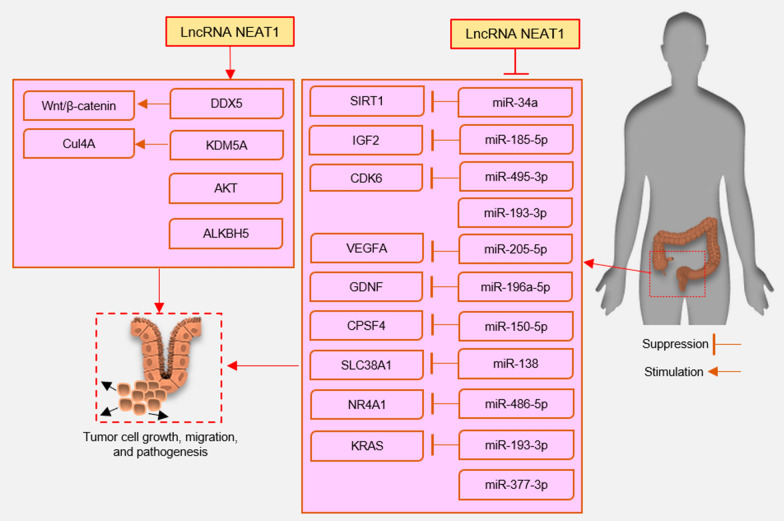
Colorectal cancer (CRC) is the third cause of cancer death in the world that arises from the glandular and epithelial cells of the large intestine, during a series of genetic or epigenetic alternations. Recently, long non-coding RNAs (lncRNAs) has opened a separate window of research in molecular and translational medicine. Emerging evidence has supported that lncRNAs can regulate cell cycle of CRC cells. LncRNA NEAT1 has been verified to participate in colon cancer development and progression. NEAT1 as a competing endogenous RNA could suppress the expression of miRNAs, and then regulate molecules downstream of these miRNAs. In this review, we summarized emerging roles of NEAT1 in CRC cells.
结直肠癌(CRC)是世界上癌症死亡的第三大原因,它起源于大肠的腺上皮细胞,是在一系列基因或表观遗传改变过程中产生的。最近,长链非编码RNA(lncRNAs)在分子和转化医学领域开启了一个独立的研究窗口。越来越多的证据支持lncRNAs可以调节CRC细胞的细胞周期。lncRNA NEAT1已被证实参与结肠癌的发生和发展。NEAT1作为一种竞争性内源RNA,可以抑制miRNAs的表达,进而调节这些miRNAs下游的分子。在本综述中,我们总结了NEAT1在CRC细胞中的新作用。