• 文献检索
  • 文档翻译
  • 深度研究
  • 学术资讯
  • Suppr Zotero 插件Zotero 插件
  • 邀请有礼
  • 套餐&价格
  • 历史记录
应用&插件
Suppr Zotero 插件Zotero 插件浏览器插件Mac 客户端Windows 客户端微信小程序
定价
高级版会员购买积分包购买API积分包
服务
文献检索文档翻译深度研究API 文档MCP 服务
关于我们
关于 Suppr公司介绍联系我们用户协议隐私条款
关注我们

Suppr 超能文献

核心技术专利:CN118964589B侵权必究
粤ICP备2023148730 号-1Suppr @ 2026

文献检索

告别复杂PubMed语法,用中文像聊天一样搜索,搜遍4000万医学文献。AI智能推荐,让科研检索更轻松。

立即免费搜索

文件翻译

保留排版,准确专业,支持PDF/Word/PPT等文件格式,支持 12+语言互译。

免费翻译文档

深度研究

AI帮你快速写综述,25分钟生成高质量综述,智能提取关键信息,辅助科研写作。

立即免费体验

菲律宾南部的气候变异性和伊蚊媒介指数:实证分析。

Climate variability and Aedes vector indices in the southern Philippines: An empirical analysis.

机构信息

School of Public Health and Social Work, Faculty of Health, Queensland University of Technology, Brisbane Australia.

Mosquito Control Laboratory, Department of Population Health, QIMR Berghofer Medical Research Institute, Brisbane, Australia.

出版信息

PLoS Negl Trop Dis. 2022 Jun 14;16(6):e0010478. doi: 10.1371/journal.pntd.0010478. eCollection 2022 Jun.

DOI:10.1371/journal.pntd.0010478
PMID:35700164
原文链接:https://pmc.ncbi.nlm.nih.gov/articles/PMC9197058/
Abstract

BACKGROUND

Vector surveillance is an essential public health tool to aid in the prediction and prevention of mosquito borne diseases. This study compared spatial and temporal trends of vector surveillance indices for Aedes vectors in the southern Philippines, and assessed potential links between vector indices and climate factors.

METHODS

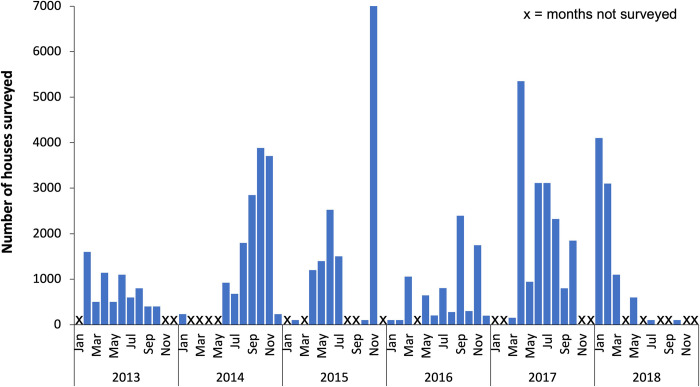
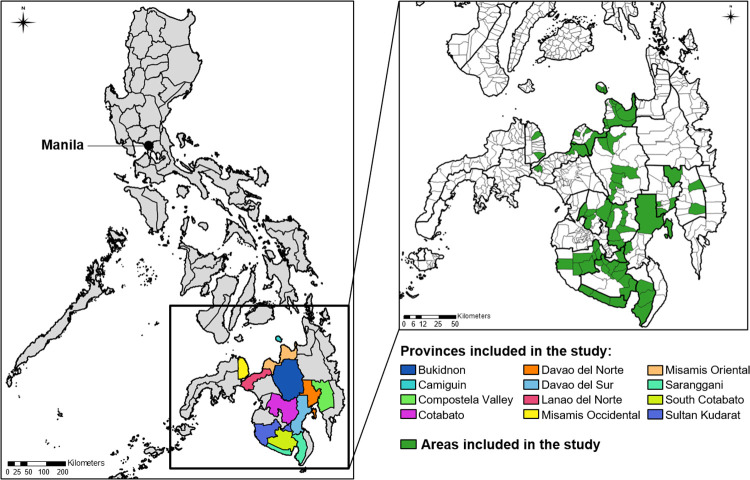
We analysed routinely collected larval and pupal surveillance data from residential areas of 14 cities and 51 municipalities during 2013-2018 (House, Container, Breteau and Pupal Indices), and used linear regression to explore potential relationships between vector indices and climate variables (minimum temperature, maximum temperature and precipitation).

RESULTS

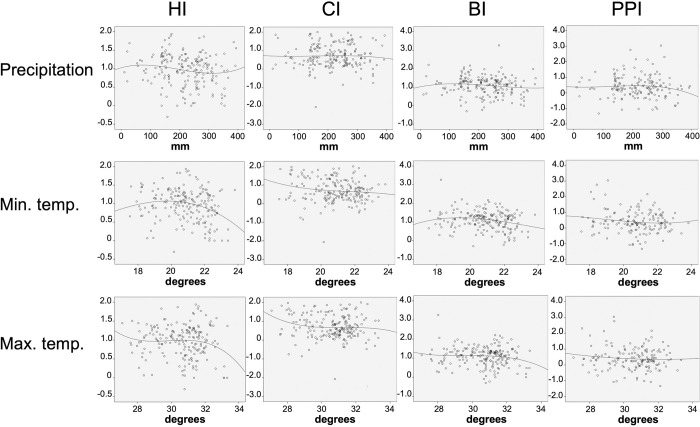
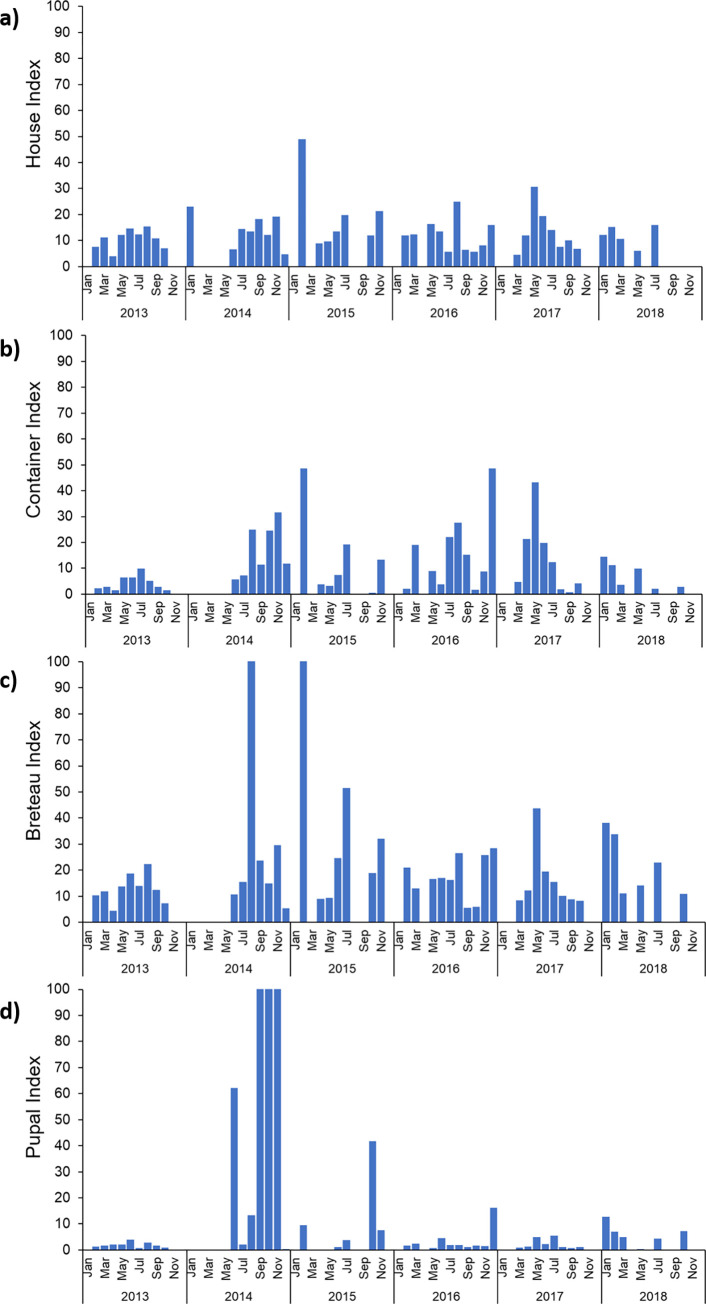
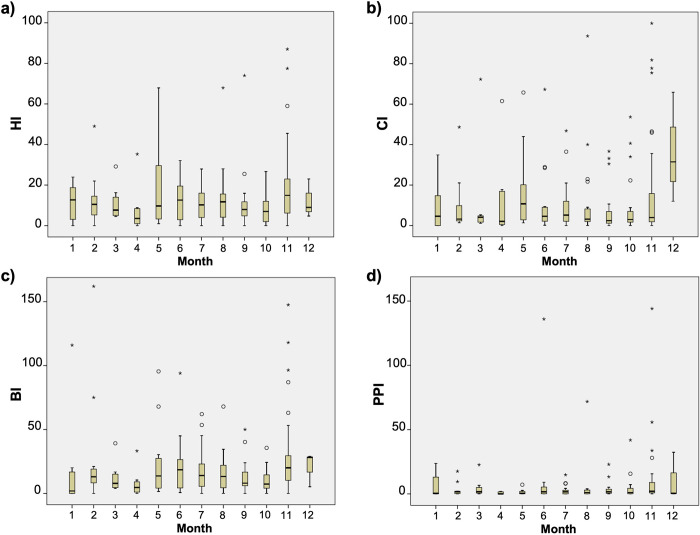
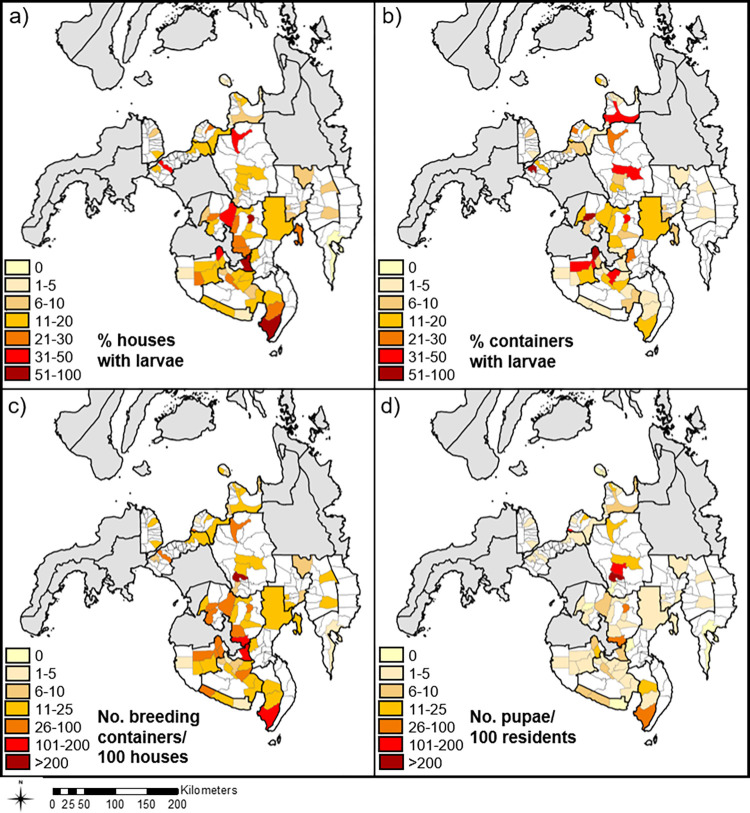
We found substantial spatial and temporal variation in monthly Aedes vector indices between cities during the study period, and no seasonal trend apparent. The House (HI), Container (CI) and Breteau (BI) Indices remained at comparable levels across most surveys (mean HI = 15, mean CI = 16, mean BI = 24), while the Pupal Productivity Index (PPI) was relatively lower in most months (usually below 5) except for two main peak periods (mean = 49 overall). A small proportion of locations recorded high values across all entomological indices in multiple surveys. Each of the vector indices were significantly correlated with one or more climate variables when matched to data from the same month or the previous 1 or 2 months, although the effect sizes were small. Significant associations were identified between minimum temperature and HI, CI and BI in the same month (R2 = 0.038, p = 0.007; R2 = 0.029, p = 0.018; and R2 = 0.034, p = 0.011, respectively), maximum temperature and PPI with a 2-month lag (R2 = 0.031, p = 0.032), and precipitation and HI in the same month (R2 = 0.023, p = 0.04).

CONCLUSIONS

Our findings indicated that larval and pupal surveillance indices were highly variable, were regularly above the threshold for triggering vector control responses, and that vector indices based on household surveys were weakly yet significantly correlated with city-level climate variables. We suggest that more detailed spatial and temporal analyses of entomological, climate, socio-environmental and Aedes-borne disease incidence data are necessary to ascertain the most effective use of entomological indices in guiding vector control responses, and reduction of human disease risk.

摘要

背景

媒介监测是辅助预测和预防蚊媒疾病的重要公共卫生工具。本研究比较了菲律宾南部伊蚊媒介监测指标的时空趋势,并评估了媒介指数与气候因素之间的潜在联系。

方法

我们分析了 2013-2018 年期间 14 个城市和 51 个城镇居民区的常规收集的幼虫和蛹监测数据(房屋、容器、布雷特豪和蛹指数),并使用线性回归来探索媒介指数与气候变量(最低温度、最高温度和降水)之间的潜在关系。

结果

我们发现,在研究期间,各城市之间的月度伊蚊媒介指数存在显著的时空差异,且无明显季节性趋势。房屋(HI)、容器(CI)和布雷特豪(BI)指数在大多数调查中保持相当水平(平均 HI = 15,平均 CI = 16,平均 BI = 24),而蛹生产率指数(PPI)在大多数月份相对较低(通常低于 5),除了两个主要高峰期(总体平均值为 49)。一小部分地点在多个调查中记录了所有昆虫学指数的高值。当与同月或前 1 或 2 个月的数据匹配时,每个媒介指数都与一个或多个气候变量显著相关,尽管效应大小较小。在同月,最低温度与 HI、CI 和 BI 显著相关(R2 = 0.038,p = 0.007;R2 = 0.029,p = 0.018;R2 = 0.034,p = 0.011),最大温度与 2 个月的滞后期 PPI 显著相关(R2 = 0.031,p = 0.032),同月降水与 HI 显著相关(R2 = 0.023,p = 0.04)。

结论

我们的研究结果表明,幼虫和蛹监测指数变化很大,经常高于触发媒介控制反应的阈值,基于家庭调查的媒介指数与城市层面的气候变量呈微弱但显著的相关性。我们建议,需要更详细的时空分析昆虫学、气候、社会环境和登革热发病率数据,以确定在指导媒介控制反应和降低人类疾病风险方面最有效地利用昆虫学指数。
https://cdn.ncbi.nlm.nih.gov/pmc/blobs/9d1e/9197058/a5c3dce61d28/pntd.0010478.g006.jpg
https://cdn.ncbi.nlm.nih.gov/pmc/blobs/9d1e/9197058/c890c26c9000/pntd.0010478.g001.jpg
https://cdn.ncbi.nlm.nih.gov/pmc/blobs/9d1e/9197058/7f4f65523400/pntd.0010478.g002.jpg
https://cdn.ncbi.nlm.nih.gov/pmc/blobs/9d1e/9197058/635a5c7c44c2/pntd.0010478.g003.jpg
https://cdn.ncbi.nlm.nih.gov/pmc/blobs/9d1e/9197058/6ac1ee73903e/pntd.0010478.g004.jpg
https://cdn.ncbi.nlm.nih.gov/pmc/blobs/9d1e/9197058/6a60dbab4f12/pntd.0010478.g005.jpg
https://cdn.ncbi.nlm.nih.gov/pmc/blobs/9d1e/9197058/a5c3dce61d28/pntd.0010478.g006.jpg
https://cdn.ncbi.nlm.nih.gov/pmc/blobs/9d1e/9197058/c890c26c9000/pntd.0010478.g001.jpg
https://cdn.ncbi.nlm.nih.gov/pmc/blobs/9d1e/9197058/7f4f65523400/pntd.0010478.g002.jpg
https://cdn.ncbi.nlm.nih.gov/pmc/blobs/9d1e/9197058/635a5c7c44c2/pntd.0010478.g003.jpg
https://cdn.ncbi.nlm.nih.gov/pmc/blobs/9d1e/9197058/6ac1ee73903e/pntd.0010478.g004.jpg
https://cdn.ncbi.nlm.nih.gov/pmc/blobs/9d1e/9197058/6a60dbab4f12/pntd.0010478.g005.jpg
https://cdn.ncbi.nlm.nih.gov/pmc/blobs/9d1e/9197058/a5c3dce61d28/pntd.0010478.g006.jpg

相似文献

1
Climate variability and Aedes vector indices in the southern Philippines: An empirical analysis.菲律宾南部的气候变异性和伊蚊媒介指数:实证分析。
PLoS Negl Trop Dis. 2022 Jun 14;16(6):e0010478. doi: 10.1371/journal.pntd.0010478. eCollection 2022 Jun.
2
Larval Indices of Vector Mosquitoes as Predictors of Dengue Epidemics: An Approach to Manage Dengue Outbreaks Based on Entomological Parameters in the Districts of Colombo and Kandy, Sri Lanka.蚊虫幼虫指数作为登革热流行的预测指标:基于斯里兰卡科伦坡和康堤地区昆虫学参数的登革热暴发管理方法。
Biomed Res Int. 2020 Jun 16;2020:6386952. doi: 10.1155/2020/6386952. eCollection 2020.
3
Empirical optimization of risk thresholds for dengue: an approach towards entomological management of Aedes mosquitoes based on larval indices in the Kandy District of Sri Lanka.基于斯里兰卡康堤地区幼虫指数的伊蚊蚊虫管理的风险阈值经验优化:一种登革热的方法。
Parasit Vectors. 2018 Jun 28;11(1):368. doi: 10.1186/s13071-018-2961-y.
4
Ecological, Social, and Other Environmental Determinants of Dengue Vector Abundance in Urban and Rural Areas of Northeastern Thailand.泰国东北部城乡登革热媒介丰度的生态、社会和其他环境决定因素。
Int J Environ Res Public Health. 2021 Jun 2;18(11):5971. doi: 10.3390/ijerph18115971.
5
Relationships between traditional larval indices and meteorological factors with the adult density of Aedes albopictus captured by BG-mosquito trap.应用 BG-诱蚊诱卵器法监测白纹伊蚊成蚊密度与气象因素及传统幼虫指标的关系
PLoS One. 2020 Jun 11;15(6):e0234555. doi: 10.1371/journal.pone.0234555. eCollection 2020.
6
Re-assess Vector Indices Threshold as an Early Warning Tool for Predicting Dengue Epidemic in a Dengue Non-endemic Country.重新评估病媒指数阈值作为预测登革热非流行国家登革热疫情的早期预警工具。
PLoS Negl Trop Dis. 2015 Sep 14;9(9):e0004043. doi: 10.1371/journal.pntd.0004043. eCollection 2015.
7
Seasonal variations of dengue vector mosquitoes in rural settings of Thiruvarur district in Tamil Nadu, India.印度泰米尔纳德邦蒂鲁瓦鲁尔区农村地区登革热媒介蚊虫的季节性变化。
J Vector Borne Dis. 2020 Jan-Mar;57(1):63-70. doi: 10.4103/0972-9062.308803.
8
Risk factors for Aedes aegypti household pupal persistence in longitudinal entomological household surveys in urban and rural Kenya.肯尼亚城乡纵向蚊虫家庭调查中埃及伊蚊家庭蛹持续存在的风险因素。
Parasit Vectors. 2020 Oct 1;13(1):499. doi: 10.1186/s13071-020-04378-7.
9
Assessing the associations between Aedes larval indices and dengue risk in Kalutara district, Sri Lanka: a hierarchical time series analysis from 2010 to 2019.评估斯里兰卡卡卢特勒地区伊蚊幼虫指数与登革热风险之间的关联:2010 年至 2019 年的分层时间序列分析。
Parasit Vectors. 2022 Aug 3;15(1):277. doi: 10.1186/s13071-022-05377-6.
10
Evaluation of the Effects of Vector Indices and Climatic Factors on Dengue Incidence in Gampaha District, Sri Lanka.评估矢量指数和气候因素对斯里兰卡甘帕哈区登革热发病率的影响。
Biomed Res Int. 2019 Jan 31;2019:2950216. doi: 10.1155/2019/2950216. eCollection 2019.

引用本文的文献

1
School and home-based educational intervention in urban Kenya: Sustained improvements in knowledge, attitudes, and practices for Aedes aegypti control.肯尼亚城市地区基于学校和家庭的教育干预措施:埃及伊蚊控制知识、态度和实践的持续改善。
PLOS Glob Public Health. 2025 Jun 4;5(6):e0004567. doi: 10.1371/journal.pgph.0004567. eCollection 2025.
2
A State-of-the-Science Review of Long-Term Predictions of Climate Change Impacts on Dengue Transmission Risk.气候变化对登革热传播风险影响的长期预测的科学现状综述
Environ Health Perspect. 2025 May;133(5):56002. doi: 10.1289/EHP14463. Epub 2025 May 16.
3
Assessing and correcting neighborhood socioeconomic spatial sampling biases in citizen science mosquito data collection.

本文引用的文献

1
Spatio-temporal analysis of the main dengue vector populations in Singapore.新加坡主要登革热媒介种群的时空分析。
Parasit Vectors. 2021 Jan 11;14(1):41. doi: 10.1186/s13071-020-04554-9.
2
The TIRS trial: protocol for a cluster randomized controlled trial assessing the efficacy of preventive targeted indoor residual spraying to reduce Aedes-borne viral illnesses in Merida, Mexico.TIRS 试验:评估在墨西哥梅里达采用预防性靶向室内滞留喷洒以减少基孔肯雅热和登革热等蚊媒病毒病的有效性的整群随机对照试验方案。
Trials. 2020 Oct 8;21(1):839. doi: 10.1186/s13063-020-04780-7.
3
Socio-Economic Impacts of COVID-19 on Household Consumption and Poverty.
评估和纠正公民科学蚊虫数据收集过程中邻里社会经济空间抽样偏差。
Sci Rep. 2024 Sep 28;14(1):22462. doi: 10.1038/s41598-024-73416-6.
4
Climate change, environmental extremes, and human health in Australia: challenges, adaptation strategies, and policy gaps.澳大利亚的气候变化、极端环境与人类健康:挑战、适应策略及政策差距
Lancet Reg Health West Pac. 2023 Nov 15;40:100936. doi: 10.1016/j.lanwpc.2023.100936. eCollection 2023 Nov.
5
Dengue in Cebu City, Philippines: A Pilot Study of Predictive Models and Visualizations for Public Health.菲律宾宿务市的登革热:公共卫生预测模型和可视化的试点研究。
Am J Trop Med Hyg. 2023 Dec 11;110(1):179-187. doi: 10.4269/ajtmh.23-0250. Print 2024 Jan 3.
6
The relative importance of key meteorological factors affecting numbers of mosquito vectors of dengue fever.影响登革热蚊媒数量的关键气象因素的相对重要性。
PLoS Negl Trop Dis. 2023 Apr 13;17(4):e0011247. doi: 10.1371/journal.pntd.0011247. eCollection 2023 Apr.
新冠疫情对家庭消费和贫困的社会经济影响
Econ Disaster Clim Chang. 2020;4(3):453-479. doi: 10.1007/s41885-020-00070-3. Epub 2020 Jul 23.
4
Zika Virus Infection, Philippines, 2012.2012年,菲律宾寨卡病毒感染
Emerg Infect Dis. 2020 Sep;26(9):2300-2301. doi: 10.3201/eid2609.190896.
5
Indices and Risk of Dengue Transmission: A Lack of Correlation.指数与登革热传播风险:缺乏相关性。
Front Public Health. 2020 Jul 24;8:328. doi: 10.3389/fpubh.2020.00328. eCollection 2020.
6
High relative humidity might trigger the occurrence of the second seasonal peak of dengue in the Philippines.高相对湿度可能引发菲律宾登革热的第二个季节性高峰。
Sci Total Environ. 2020 Mar 15;708:134849. doi: 10.1016/j.scitotenv.2019.134849. Epub 2019 Nov 26.
7
The Global Expansion of Dengue: How Mosquitoes Enabled the First Pandemic Arbovirus.登革热的全球蔓延:蚊子如何促成了首个虫媒病毒大流行
Annu Rev Entomol. 2020 Jan 7;65:191-208. doi: 10.1146/annurev-ento-011019-024918. Epub 2019 Oct 8.
8
Location, seasonal and functional characteristics of water-holding containers with juvenile Aedes albopictus in urban southern Taiwan: a cross-sectional study.台湾南部城市白纹伊蚊幼虫孳生积水容器的分布、季节性及功能特征:一项横断面研究
Trans R Soc Trop Med Hyg. 2019 Nov 1;113(11):685-692. doi: 10.1093/trstmh/trz060.
9
Thermal biology of mosquito-borne disease.蚊媒疾病的热生物学
Ecol Lett. 2019 Oct;22(10):1690-1708. doi: 10.1111/ele.13335. Epub 2019 Jul 8.
10
Impact of past and on-going changes on climate and weather on vector-borne diseases transmission: a look at the evidence.气候变化和天气对虫媒传染病传播的过去和正在发生的变化的影响:证据回顾。
Infect Dis Poverty. 2019 Jun 13;8(1):51. doi: 10.1186/s40249-019-0565-1.