Key Laboratory of OptoElectronic Science and Technology for Medicine of Ministry of Education, Fujian Provincial Key Laboratory of Photonics Technology, Fujian Normal University, Fuzhou, 350007, China.
College of Physics and Electronic Information Engineering, Minjiang University, Fuzhou, 350108, China.
Nat Commun. 2022 Jul 22;13(1):4250. doi: 10.1038/s41467-022-31771-w.
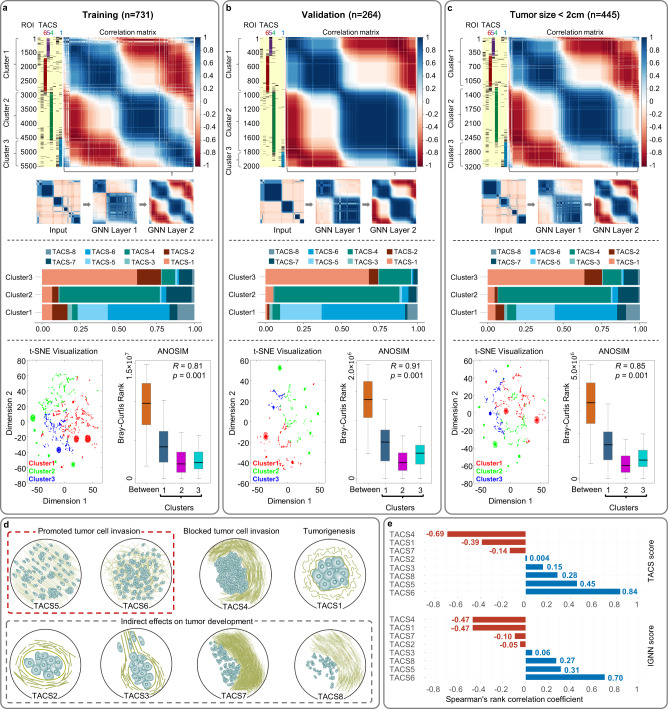
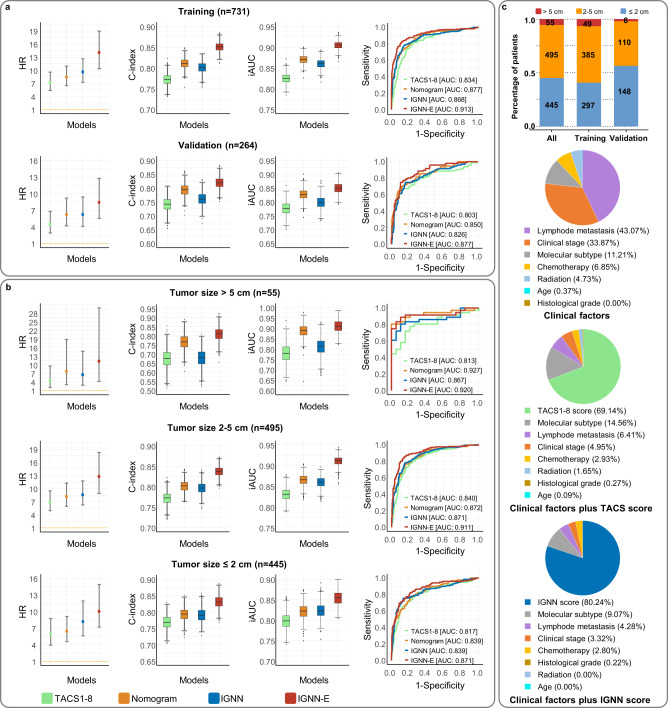
Biomarkers are indispensable for precision medicine. However, focused single-biomarker development using human tissue has been complicated by sample spatial heterogeneity. To address this challenge, we tested a representation of primary tumor that synergistically integrated multiple in situ biomarkers of extracellular matrix from multiple sampling regions into an intratumor graph neural network. Surprisingly, the differential prognostic value of this computational model over its conventional non-graph counterpart approximated that of combined routine prognostic biomarkers (tumor size, nodal status, histologic grade, molecular subtype, etc.) for 995 breast cancer patients under a retrospective study. This large prognostic value, originated from implicit but interpretable regional interactions among the graphically integrated in situ biomarkers, would otherwise be lost if they were separately developed into single conventional (spatially homogenized) biomarkers. Our study demonstrates an alternative route to cancer prognosis by taping the regional interactions among existing biomarkers rather than developing novel biomarkers.
生物标志物对于精准医学来说是不可或缺的。然而,使用人体组织进行集中的单一生物标志物开发受到了样本空间异质性的阻碍。为了解决这一挑战,我们测试了一种代表原发性肿瘤的方法,它将来自多个采样区域的细胞外基质的多个原位生物标志物协同整合到一个肿瘤内图神经网络中。令人惊讶的是,在回顾性研究中,对于 995 名乳腺癌患者,该计算模型相对于其传统的非图模型的差异预后价值与组合常规预后生物标志物(肿瘤大小、淋巴结状态、组织学分级、分子亚型等)的预后价值相当。如果这些原位生物标志物分别开发成单一的常规(空间均化)生物标志物,那么这种来自图形整合的原位生物标志物之间隐含但可解释的区域相互作用的巨大预后价值将会丢失。我们的研究通过利用现有生物标志物之间的区域相互作用,而不是开发新的生物标志物,为癌症预后提供了一种替代途径。