Interdisciplinary Sleep Medicine Center, Charité-Universitätsmedizin Berlin, Berlin, Germany.
The Federal State Autonomous Educational Institution of Higher Education I.M. Sechenov First Moscow State Medical University of the Ministry of Health of the Russian Federation, Moscow, Russia.
Front Public Health. 2022 Jul 7;10:866750. doi: 10.3389/fpubh.2022.866750. eCollection 2022.
Sleep disorders can arise from work. Employees who experience work overload are more likely to develop sleep problems. Poor sleep leads to decreased performance, sick leave, and accidents. Therefore, sleep disorders may be linked to workplace hazards as well as decreased occupational health, however, the relationship remains unknown.
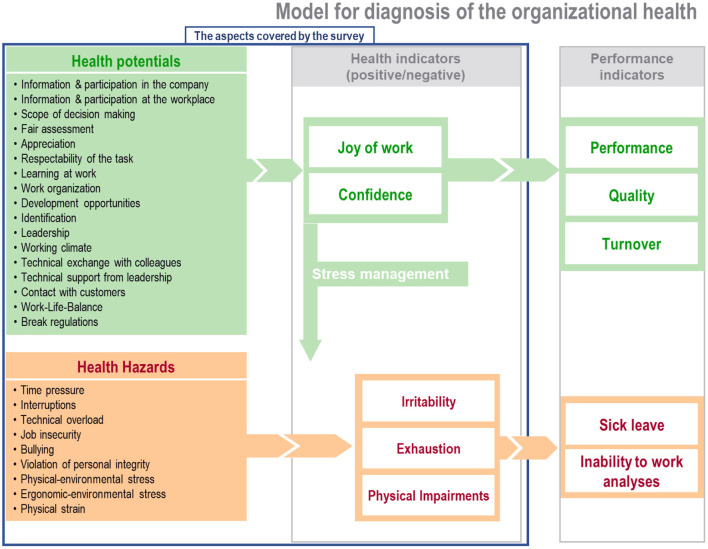
This relationship was examined using secondary data analysis of aggregated survey data from 97 companies based in Germany between 2003 and 2020 as part of Workplace Health Management project. Two extreme groups with respect to sleep problems were analyzed ( = 4,865 + 9,795). The survey "Diagnosis of corporate health" contained 137 individual questions which recorded all relevant working conditions, aspects of health, and one question relating to insomnia traits. A one-way analysis of variance was used to examine whether and to what extent the potentials, hazards, and health aspects differed between employees depending on their perceived sleep problems. In addition, multiple linear regressions were used to determine whether and to what extent work characteristics affect various health aspects for both good and poor sleepers.
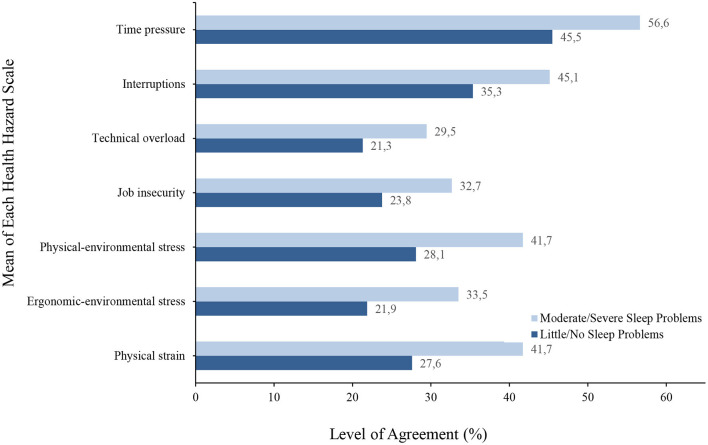
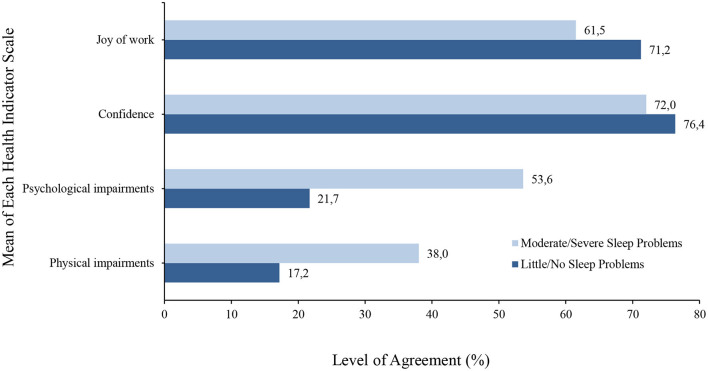
In total, 49.7% of staff reported moderate difficulty falling and/or remaining asleep. These poor sleepers perceived all health potentials worse than good sleepers, especially on scales such as fair assessment, work climate, and learning at work. Furthermore, poor sleepers perceived health hazards (physical environmental stress, job insecurity, and time pressure) more whilst positive health indicators (joy of work and confidence) were perceived less.
Overall, the determination of sleep difficulties could be used as a substantial health indicator. Also, these sleep problems are reported more frequently in certain occupations compared to others, which could mean that the perception of sleep health varies between professions. Therefore, it is important to implement specific recommendations for each industry in order to improve working conditions for poor sleepers which in turn, improves their health.
睡眠障碍可能源于工作。经历工作超负荷的员工更有可能出现睡眠问题。睡眠质量差会导致工作表现下降、请病假和发生事故。因此,睡眠障碍可能与工作场所危害以及职业健康状况下降有关,但这种关系尚不清楚。
本研究使用了德国 97 家公司 2003 年至 2020 年期间作为 Workplace Health Management 项目一部分的汇总调查数据的二次数据分析来检验这种关系。对睡眠问题两个极端群体(=4865+9795)进行了分析。调查“企业健康诊断”包含了 137 个个人问题,记录了所有相关的工作条件、健康方面和一个与失眠特征有关的问题。采用单因素方差分析来检验员工的睡眠问题感知是否以及在何种程度上影响了潜在风险、危害和健康方面。此外,还使用多元线性回归来确定工作特征对良好和较差睡眠者的各种健康方面的影响程度。
总体而言,49.7%的员工报告入睡和/或保持睡眠困难。与良好睡眠者相比,这些睡眠质量差的人对所有健康潜力的感知更差,尤其是在公平评估、工作氛围和工作中学习等方面。此外,睡眠质量差的人感知到更多的健康危害(物理环境压力、工作不稳定和时间压力),而感知到更少的积极健康指标(工作乐趣和信心)。
总的来说,确定睡眠困难可以作为一个重要的健康指标。此外,与其他职业相比,某些职业报告的睡眠问题更为频繁,这可能意味着不同职业对睡眠健康的感知存在差异。因此,为了改善较差睡眠者的工作条件,从而改善他们的健康,为每个行业实施具体建议非常重要。