Department of Chemistry, Government College Women University, Faisalabad 38000, Pakistan.
Department of Pathology, University of Agriculture, Faisalabad 38040, Pakistan.
Toxins (Basel). 2022 Aug 11;14(8):547. doi: 10.3390/toxins14080547.
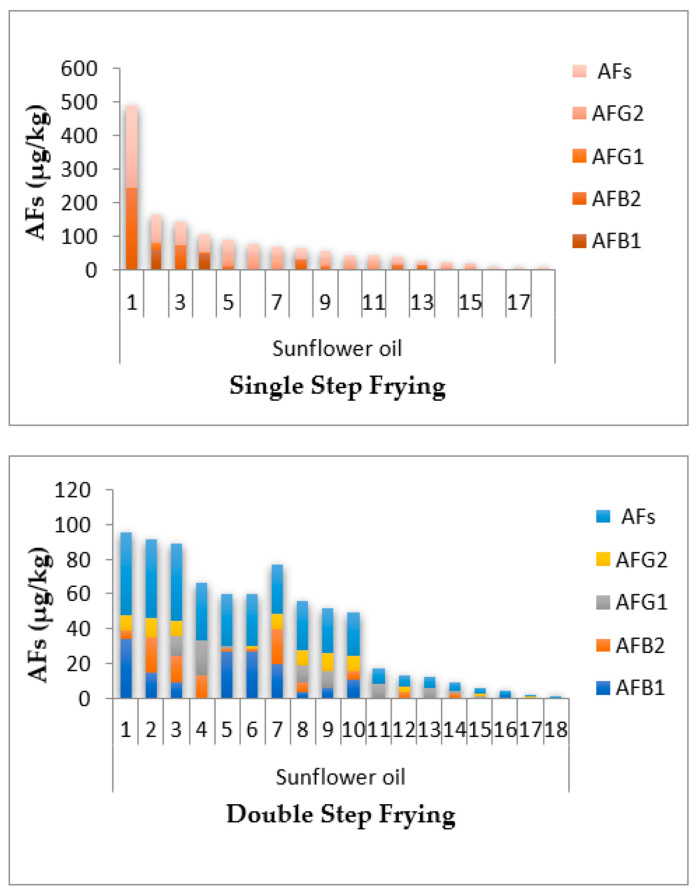
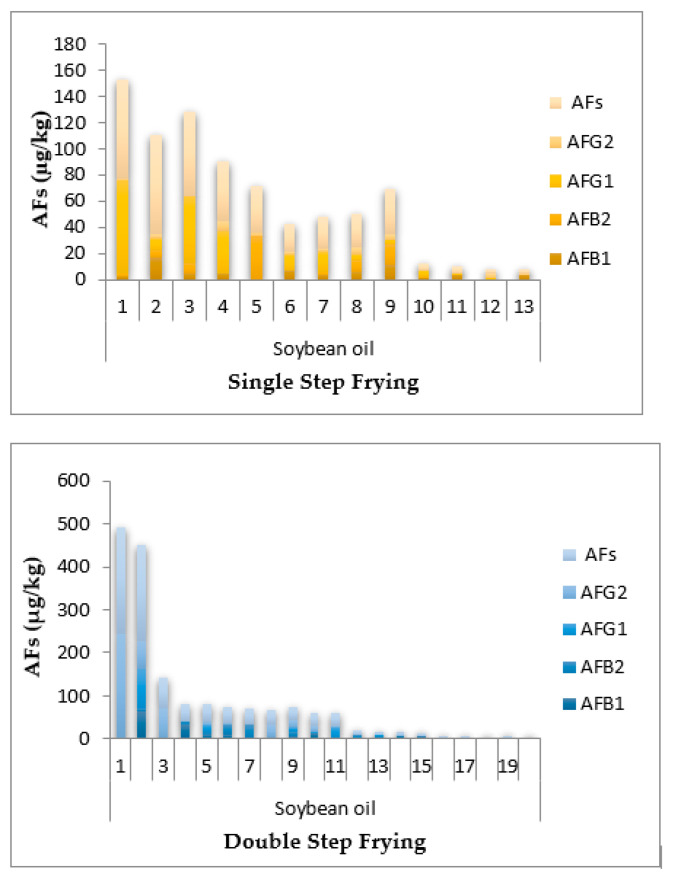
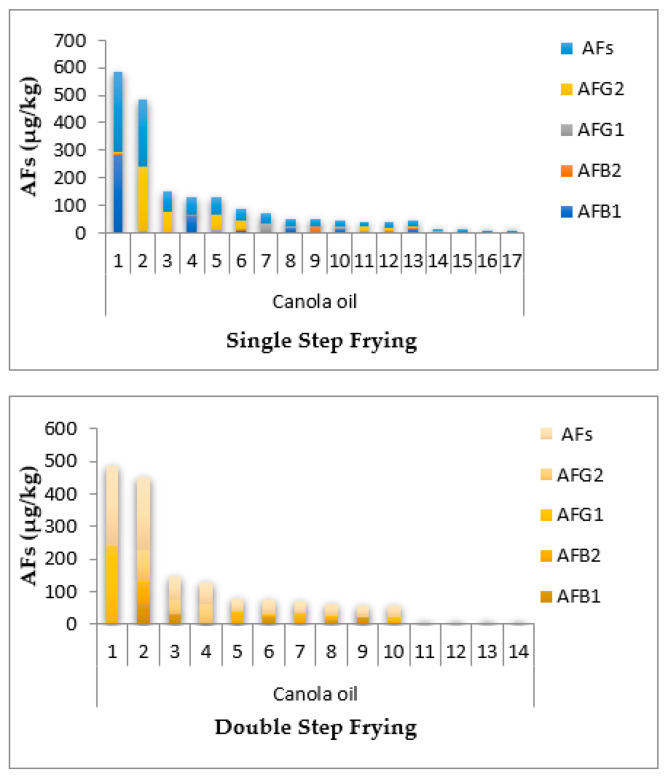
Contamination of edible oils with aflatoxins (AFs) is a universal issue due to the detrimental effects of aflatoxins on human health and the fact that edible oils are a major source of fungal growth, particularly storage fungi ( sp.). The objective of this study was to assess aflatoxin B (AFB) in edible oil used in fried food in order to determine the risk of cancer from AFB exposure through cooked food using the FAO/WHO's and EFSA's margin of exposure (MOE) quantitative liver cancer risk approaches. Using Mycosep 226 columns and HPLC-FLD, 100 samples of cooking oils (soybean, canola, and sunflower oil) from different food points were analyzed for contamination with aflatoxins. Of all the samples tested, 89% were positive for total aflatoxins and AFB, with 65% indicating AF concentrations beyond permitted levels. Canola oil was found to contain higher levels of AFB and AFs than soybean and sunflower oil. Almost 71 percent of canola oil samples (range of 54.4-281.1 µg/kg) were contaminated with AF levels higher than the proposed limits of the European Union (20 µg/kg). The consumption of canola oil samples used in fried foods had MOE values that were significantly lower as compared to sunflower and soybean oils, indicating that risk reduction is feasible. Additionally, compared to soybean and sunflower oil, canola oil exhibited a greater threat of liver cancer cases linked to AFB exposure (17.13 per 100,000 males over 35 and 10.93 per 100,000 females over 35). Using a quantitative liver cancer approach, health risk valuation demonstrated that males and females over the age of 35 are at significant risk of developing liver cancer. The health risk assessment exposed that the males and female over the age of 35 are at considerable risk of liver cancer by using a quantitative liver cancer approach. The innovation of this study lies in the fact that no such study is reported related to liver cancer risk evaluation accompanied with AFB exposure from consumed edible oil. As a result, a national strategy must be developed to solve this problem so that edible oil products are subjected to severe regulatory examination.
食用油受到黄曲霉毒素(AFs)污染是一个普遍存在的问题,因为黄曲霉毒素对人类健康有不良影响,而且食用油是真菌生长的主要来源,尤其是储存真菌(sp.)。本研究的目的是评估用于油炸食品的食用油中的黄曲霉毒素 B(AFB),以通过食用烹饪食品来确定 FAO/WHO 和 EFSA 的暴露量(MOE)定量肝癌风险方法中来自 AFB 暴露的癌症风险。使用 Mycosep 226 柱和 HPLC-FLD,对来自不同食品点的 100 种烹饪油(大豆油、菜籽油和葵花籽油)样品进行了黄曲霉毒素污染分析。在所测试的所有样品中,89%的样品总黄曲霉毒素和 AFB 呈阳性,65%的样品表明 AF 浓度超过允许水平。菜籽油中 AFB 和 AFs 的含量高于大豆油和葵花籽油。近 71%的菜籽油样品(范围为 54.4-281.1µg/kg)受到高于欧盟规定限值(20µg/kg)的 AF 水平的污染。与葵花籽油和大豆油相比,用于油炸食品的菜籽油样品的 MOE 值明显较低,表明降低风险是可行的。此外,与大豆油和葵花籽油相比,菜籽油显示出与 AFB 暴露相关的肝癌病例更大的威胁(35 岁以上男性每 10 万人中有 17.13 例,35 岁以上女性每 10 万人中有 10.93 例)。使用定量肝癌方法进行健康风险评估表明,35 岁以上的男性和女性患肝癌的风险显著增加。健康风险评估暴露了 35 岁以上的男性和女性通过使用定量肝癌方法患肝癌的风险相当高。本研究的创新之处在于,没有报告与食用油中摄入的 AFB 暴露相关的肝癌风险评估相关的此类研究。因此,必须制定国家战略来解决这个问题,以使食用油产品受到严格的监管审查。