Department of Cardiology, The Second Affiliated Hospital, Zhejiang University School of Medicine, Hangzhou, Zhejiang, 310009, People's Republic of China.
Int J Nanomedicine. 2022 Oct 4;17:4699-4719. doi: 10.2147/IJN.S377479. eCollection 2022.
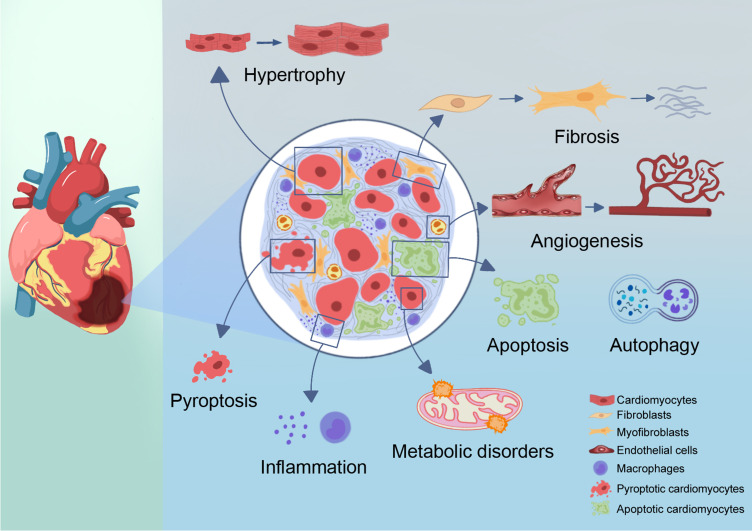
Exosomes are a pluripotent group of extracellular nanovesicles secreted by all cells that mediate intercellular communications. The effective information within exosomes is primarily reflected in exosomal cargos, including proteins, lipids, DNAs, and non-coding RNAs (ncRNAs), the most intensively studied molecules. Cardiac resident cells (cardiomyocytes, fibroblasts, and endothelial cells) and foreign cells (infiltrated immune cells, cardiac progenitor cells, cardiosphere-derived cells, and mesenchymal stem cells) are involved in the progress of ventricular remodeling (VR) following myocardial infarction (MI) via transferring exosomes into target cells. Here, we summarize the pathological mechanisms of VR following MI, including cardiac myocyte hypertrophy, cardiac fibrosis, inflammation, pyroptosis, apoptosis, autophagy, angiogenesis, and metabolic disorders, and the roles of exosomal cargos in these processes, with a focus on proteins and ncRNAs. Continued research in this field reveals a novel diagnostic and therapeutic strategy for VR.
外泌体是一类由所有细胞分泌的具有多能性的细胞外纳米囊泡,介导细胞间通讯。外泌体中的有效信息主要体现在其囊泡 cargo 中,包括蛋白质、脂质、DNAs 和非编码 RNAs(ncRNAs),其中 ncRNAs 是研究最深入的分子。心肌梗死(MI)后心室重构(VR)的进展涉及心脏驻留细胞(心肌细胞、成纤维细胞和内皮细胞)和外来细胞(浸润的免疫细胞、心脏祖细胞、心脏球体衍生细胞和间充质干细胞)通过将外泌体转移到靶细胞中。在这里,我们总结了 MI 后 VR 的病理机制,包括心肌细胞肥大、心脏纤维化、炎症、细胞焦亡、细胞凋亡、自噬、血管生成和代谢紊乱,以及外泌体 cargo 在这些过程中的作用,重点关注蛋白质和 ncRNAs。该领域的持续研究为 VR 提供了一种新的诊断和治疗策略。