Song Wanli, Jia Pengfei, Ren Yaping, Xue Junmiao, Zhou Bingqian, Xu Xinkai, Shan Yansheng, Deng Jing, Zhou Qihui
Department of Stomatology, Institute for Translational Medicine, The Affiliated Hospital of Qingdao University, Qingdao University, Qingdao, 266003, China.
Zhejiang Engineering Research Center for Tissue Repair Materials, Wenzhou Institute, University of Chinese Academy of Sciences, Wenzhou, Zhejiang 325000, China.
Bioact Mater. 2022 Nov 9;23:80-100. doi: 10.1016/j.bioactmat.2022.10.026. eCollection 2023 May.
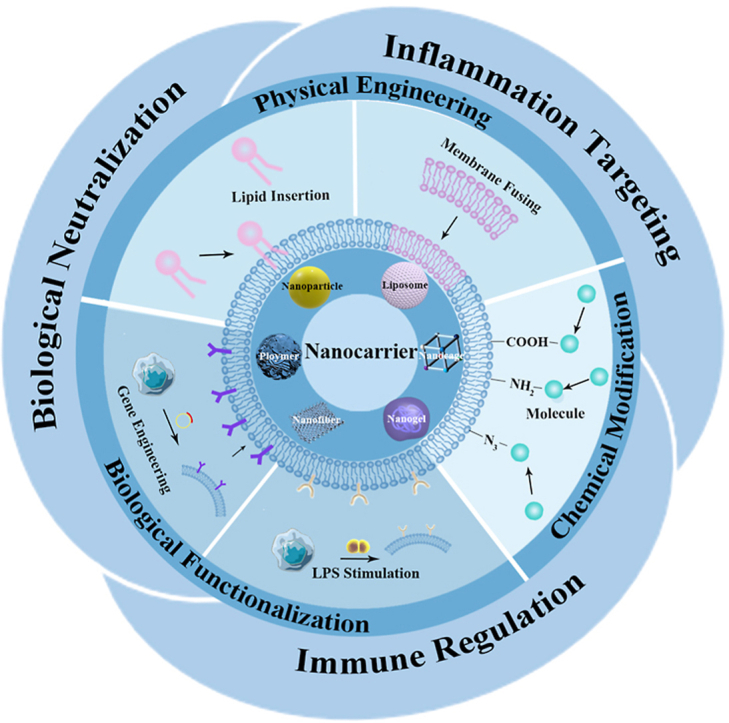
White blood cells (WBCs) play essential roles against inflammatory disorders, bacterial infections, and cancers. Inspired by nature, WBC membrane-camouflaged nanocarriers (WBC-NCs) have been developed to mimic the "dynamic" functions of WBCs, such as transendothelial migration, adhesion to injured blood vessels, , which make them promising for diverse medical applications. WBC-NCs inherit the cell membrane antigens of WBCs, while still exhibiting the robust inflammation-related therapeutic potential of synthetic nanocarriers with excellent (bio)physicochemical performance. This review summarizes the proposed concept of cell membrane engineering, which utilizes physical engineering, chemical modification, and biological functionalization technologies to endow the natural cell membrane with abundant functionalities. In addition, it highlights the recent progress and applications of WBC-NCs for inflammation targeting, biological neutralization, and immune modulation. Finally, the challenges and opportunities in realizing the full potential of WBC-NCs for the manipulation of inflammation-related therapeutics are discussed.
白细胞在对抗炎症性疾病、细菌感染和癌症方面发挥着重要作用。受自然启发,人们开发了白细胞膜伪装纳米载体(WBC-NCs)来模拟白细胞的“动态”功能,如跨内皮迁移、黏附于受损血管等,这使其在多种医学应用中具有广阔前景。WBC-NCs继承了白细胞的细胞膜抗原,同时仍展现出具有出色(生物)物理化学性能的合成纳米载体强大的炎症相关治疗潜力。本文综述了细胞膜工程的提出概念,该概念利用物理工程、化学修饰和生物功能化技术赋予天然细胞膜丰富的功能。此外,还重点介绍了WBC-NCs在炎症靶向、生物中和及免疫调节方面的最新进展和应用。最后,讨论了在充分发挥WBC-NCs在炎症相关治疗调控方面的全部潜力时所面临的挑战和机遇。