
二维黑磷杂化纳米结构用于乳腺癌诊疗一体化:技术进展
2D Hetero-Nanoconstructs of Black Phosphorus for Breast Cancer Theragnosis: Technological Advancements.
机构信息
Department of Pharmaceutics, Manipal College of Pharmaceutical Sciences, Manipal Academy of Higher Education, Manipal 576104, Karnataka, India.
Radiopharmaceuticals Division, Bhabha Atomic Research Centre, Mumbai 400085, Maharashtra, India.
出版信息
Biosensors (Basel). 2022 Nov 11;12(11):1009. doi: 10.3390/bios12111009.
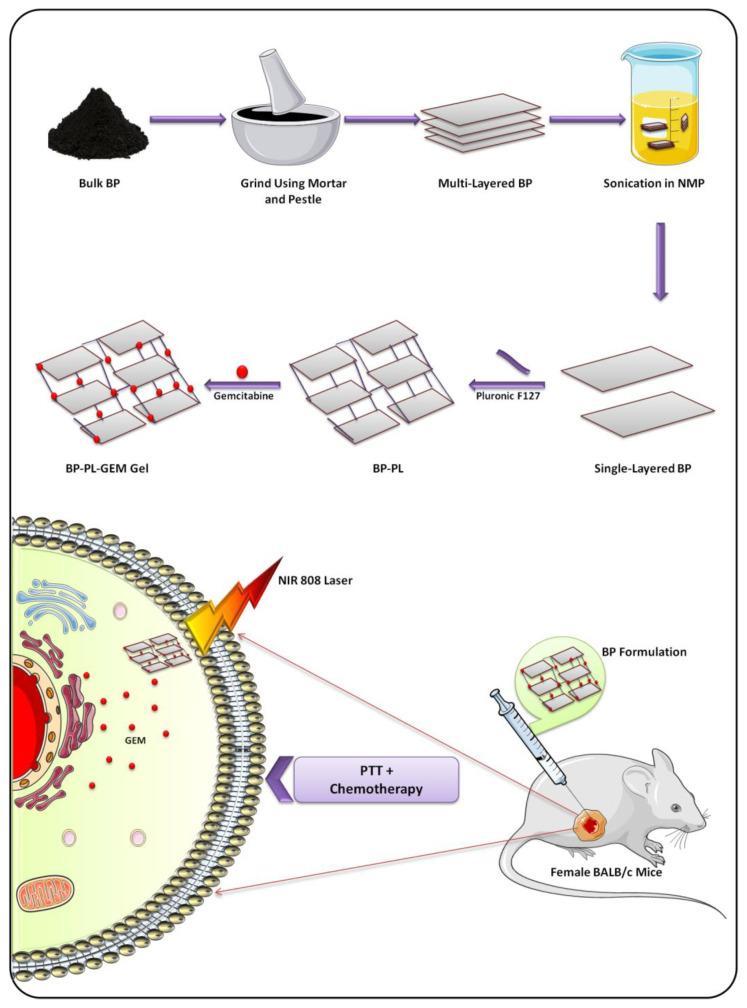
As per global cancer statistics of 2020, female breast cancer is the most commonly diagnosed cancer and also the foremost cause of cancer death in women. Traditional treatments include a number of negative effects, making it necessary to investigate novel smart drug delivery methods and identify new therapeutic approaches. Efforts for developing novel strategies for breast cancer therapy are being devised worldwide by various research groups. Currently, two-dimensional black phosphorus nanosheets (BPNSs) have attracted considerable attention and are best suited for theranostic nanomedicine. Particularly, their characteristics, including drug loading efficacy, biocompatibility, optical, thermal, electrical, and phototherapeutic characteristics, support their growing demand as a potential substitute for graphene-based nanomaterials in biomedical applications. In this review, we have explained different platforms of BP nanomaterials for breast cancer management, their structures, functionalization approaches, and general methods of synthesis. Various characteristics of BP nanomaterials that make them suitable for cancer therapy and diagnosis, such as large surface area, nontoxicity, solubility, biodegradability, and excellent near-infrared (NIR) absorption capability, are discussed in the later sections. Next, we summarize targeting approaches using various strategies for effective therapy with BP nanoplatforms. Then, we describe applications of BP nanomaterials for breast cancer treatment, which include drug delivery, codelivery of drugs, photodynamic therapy, photothermal therapy, combined therapy, gene therapy, immunotherapy, and multidrug resistance reversal strategy. Finally, the present challenges and future aspects of BP nanomaterials are discussed.
根据 2020 年全球癌症统计数据,女性乳腺癌是最常见的癌症,也是女性癌症死亡的首要原因。传统的治疗方法包括许多副作用,因此有必要研究新的智能药物输送方法,并寻找新的治疗方法。世界各地的各种研究小组都在努力开发治疗乳腺癌的新策略。目前,二维黑磷纳米片(BPNSs)引起了广泛关注,是最适合治疗和诊断的纳米药物。特别是,其药物负载效率、生物相容性、光学、热学、电学和光疗特性等特点,支持它们作为基于石墨烯的纳米材料在生物医学应用中的潜在替代品的需求不断增长。在这篇综述中,我们解释了 BP 纳米材料在乳腺癌管理方面的不同平台、它们的结构、功能化方法和一般的合成方法。BP 纳米材料的各种特性,如大的表面积、无毒、可溶、可生物降解和优异的近红外(NIR)吸收能力,使其适合癌症治疗和诊断,在后几节中进行了讨论。接下来,我们总结了使用各种策略的靶向方法,以实现 BP 纳米平台的有效治疗。然后,我们描述了 BP 纳米材料在乳腺癌治疗中的应用,包括药物输送、药物共输送、光动力治疗、光热治疗、联合治疗、基因治疗、免疫治疗和多药耐药逆转策略。最后,讨论了 BP 纳米材料的当前挑战和未来前景。


 Zotero 插件