Department of Radiology, Montefiore Medical Center and Albert Einstein College of Medicine, Bronx, New York, United States of America.
PLoS One. 2023 Jan 6;18(1):e0280148. doi: 10.1371/journal.pone.0280148. eCollection 2023.
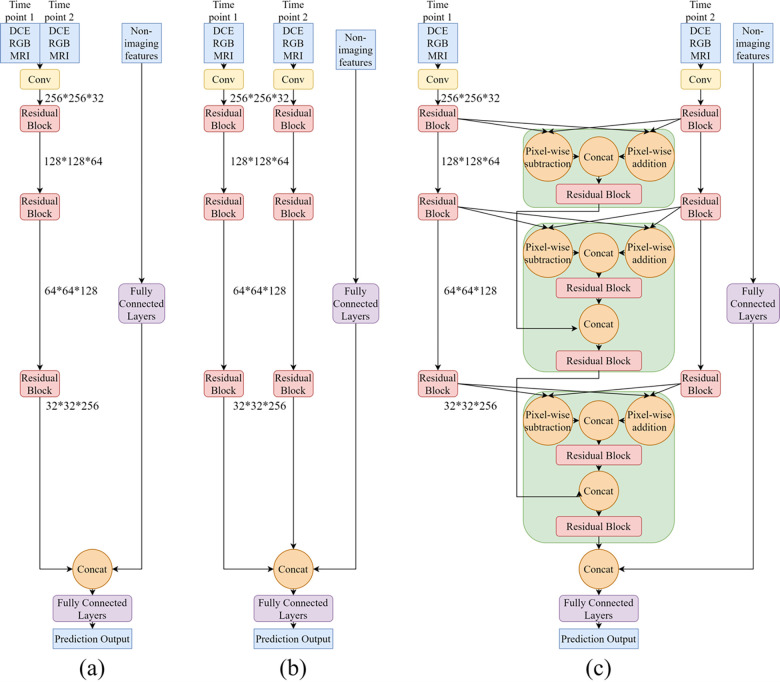
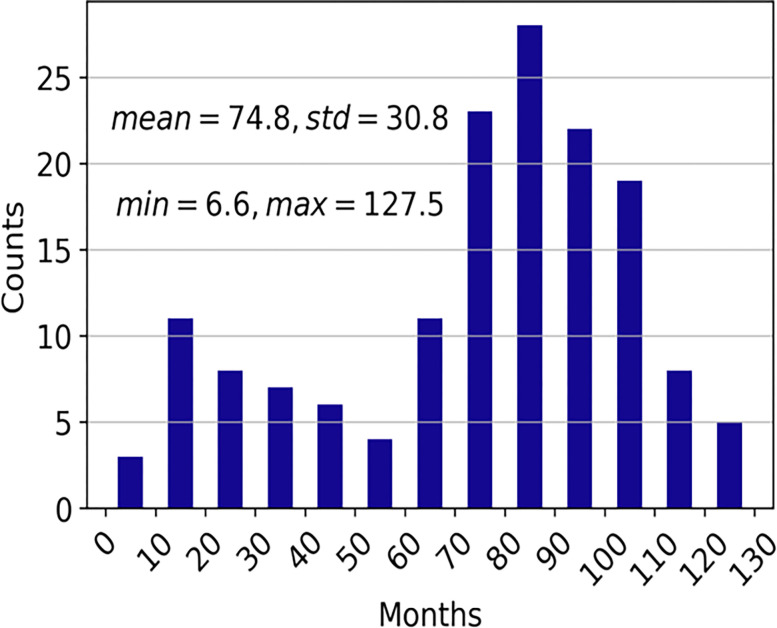
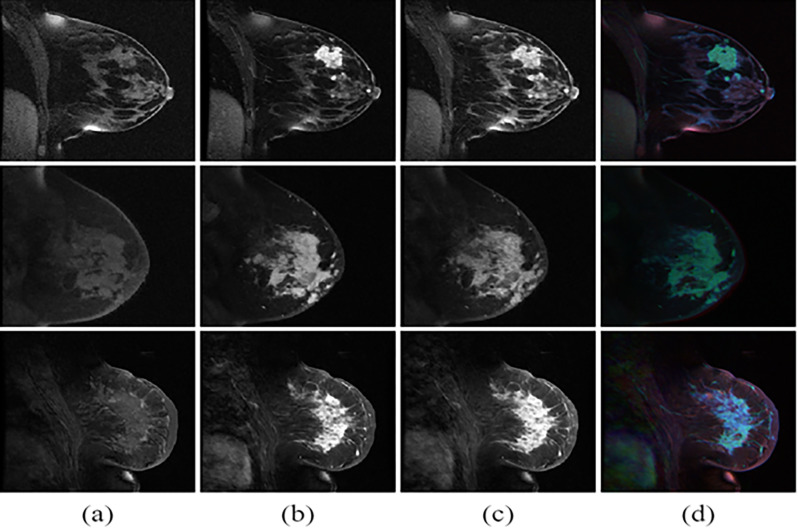
The goal of this study was to employ novel deep-learning convolutional-neural-network (CNN) to predict pathological complete response (PCR), residual cancer burden (RCB), and progression-free survival (PFS) in breast cancer patients treated with neoadjuvant chemotherapy using longitudinal multiparametric MRI, demographics, and molecular subtypes as inputs. In the I-SPY-1 TRIAL, 155 patients with stage 2 or 3 breast cancer with breast tumors underwent neoadjuvant chemotherapy met the inclusion/exclusion criteria. The inputs were dynamic-contrast-enhanced (DCE) MRI, and T2- weighted MRI as three-dimensional whole-images without the tumor segmentation, as well as molecular subtypes and demographics. The outcomes were PCR, RCB, and PFS. Three ("Integrated", "Stack" and "Concatenation") CNN were evaluated using receiver-operating characteristics and mean absolute errors. The Integrated approach outperformed the "Stack" or "Concatenation" CNN. Inclusion of both MRI and non-MRI data outperformed either alone. The combined pre- and post-neoadjuvant chemotherapy data outperformed either alone. Using the best model and data combination, PCR prediction yielded an accuracy of 0.81±0.03 and AUC of 0.83±0.03; RCB prediction yielded an accuracy of 0.80±0.02 and Cohen's κ of 0.73±0.03; PFS prediction yielded a mean absolute error of 24.6±0.7 months (survival ranged from 6.6 to 127.5 months). Deep learning using longitudinal multiparametric MRI, demographics, and molecular subtypes accurately predicts PCR, RCB, and PFS in breast cancer patients. This approach may prove useful for treatment selection, planning, execution, and mid-treatment adjustment.
本研究旨在利用新型深度学习卷积神经网络(CNN),通过输入纵向多参数 MRI、人口统计学和分子亚型,预测接受新辅助化疗的乳腺癌患者的病理完全缓解(PCR)、残留癌负担(RCB)和无进展生存期(PFS)。在 I-SPY-1 试验中,155 名患有 2 期或 3 期乳腺癌且乳房肿瘤的患者接受了新辅助化疗,符合纳入/排除标准。输入数据包括动态对比增强(DCE)MRI 和 T2 加权 MRI 的三维全图像,而无需对肿瘤进行分割,以及分子亚型和人口统计学信息。结局是 PCR、RCB 和 PFS。使用接收者操作特征和平均绝对误差评估了三种 CNN(“集成”、“堆叠”和“串联”)。集成方法优于“堆叠”或“串联”CNN。同时包含 MRI 和非 MRI 数据的效果优于单独使用任何一种。新辅助化疗前后的数据组合效果优于单独使用任何一种。使用最佳模型和数据组合,PCR 预测的准确率为 0.81±0.03,AUC 为 0.83±0.03;RCB 预测的准确率为 0.80±0.02,Cohen's κ 为 0.73±0.03;PFS 预测的平均绝对误差为 24.6±0.7 个月(生存时间从 6.6 到 127.5 个月)。使用纵向多参数 MRI、人口统计学和分子亚型的深度学习可以准确预测乳腺癌患者的 PCR、RCB 和 PFS。这种方法可能对治疗选择、计划、执行和治疗中期调整有用。