Faculty of Science, The University of Hong Kong, Hong Kong, Hong Kong, China.
Centre for Translational Stem Cell Biology, Hong Kong, Hong Kong, China.
Cells Tissues Organs. 2023;212(5):369-382. doi: 10.1159/000529431. Epub 2023 Jan 30.
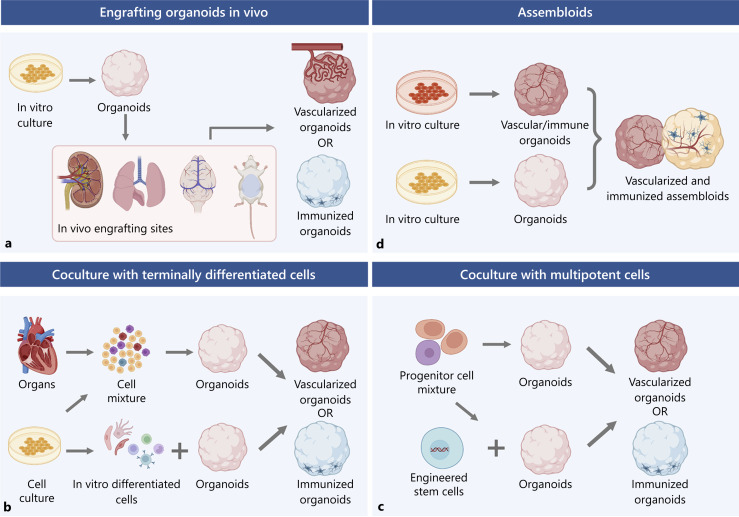
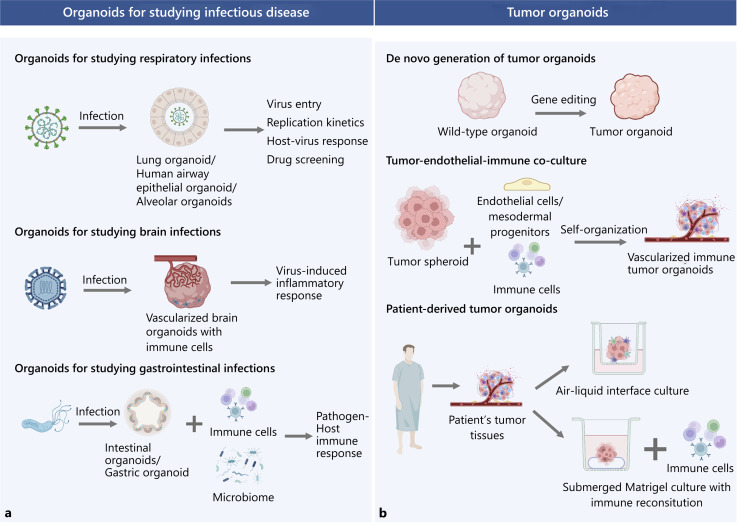
Valid and relevant models are critical for research to have biological relevance or to proceed in the right path. As well-established two-dimensional cell cultures lack niches and cues and rodent models differ in species, three-dimensional organoids emerged as a powerful platform for research. Cultured in vitro from stem cells, organoids are heterogeneous in cells and closely resemble the in vivo settings. Organoids also recapitulate the unique human features if cultured from a human source and are subjected to genetic modification. However, one type of organoid possesses only a limited selection of cells. In particular, the absence of vasculature and immune cells restricts the organoids from nutrition, cues, or critical interactions, undermining the validity of organoids as physiological or pathological models. To fill the current gap, there is an urgent need to provide organoids with vasculature and immune cells. In this paper, we review the methods to generate physiological and pathological organoid models and summarize ways to vascularize or immunize them. Our discussion continues with some advantages and disadvantages of each method and some emerging solutions to current problems.
有效的、相关的模型对于具有生物学相关性或正确方向的研究至关重要。由于成熟的二维细胞培养缺乏生态位和线索,而啮齿动物模型在物种上存在差异,因此三维类器官作为一种强大的研究平台应运而生。类器官是从干细胞体外培养而来的,细胞具有异质性,与体内环境非常相似。如果从人类来源培养并进行基因修饰,类器官也能再现独特的人类特征。然而,有一种类型的类器官只包含有限的细胞选择。特别是缺乏脉管系统和免疫细胞,限制了类器官的营养、线索或关键相互作用,从而降低了类器官作为生理或病理模型的有效性。为了填补当前的空白,迫切需要为类器官提供脉管系统和免疫细胞。本文综述了生成生理和病理类器官模型的方法,并总结了使它们血管化或免疫化的方法。我们的讨论接着介绍了每种方法的一些优缺点,以及一些针对当前问题的新兴解决方案。