Department of Gynecology, Women's Hospital of Nanjing Medical University, Nanjing Maternity and Child Health Care Hospital, No.123 Mochou Road, Nanjing, 210004, People's Republic of China.
J Ovarian Res. 2023 Feb 9;16(1):37. doi: 10.1186/s13048-023-01106-4.
The mortality rate of ovarian cancer ranks first among three common gynecological malignant tumors due to insidious onset and lack of effective early diagnosis methods. Borderline epithelial ovarian tumor (BEOT) is a type of low malignant potential tumor that is typically associated with better outcomes than ovarian cancer. However, BEOTs are easily confused with benign and malignant epithelial ovarian tumors (EOTs) due to similar clinical symptoms and lack of specific tumor biomarkers and imaging examinations. Notably, a small subset of BEOTs will transform into low-grade serous ovarian carcinoma with a poor prognosis. Therefore, searching for potential biomarkers that can be easily obtained and accurately identify malignant epithelial ovarian tumors (MEOTs) as well as BEOTs is essential for the clinician. Cancer antigen 125 (CA125) is a commonly used biomarker for the diagnosis of EOTs in the preoperative scenario but has low sensitivity and specificity. Nowadays, inflammatory biomarkers including inflammatory cell counts and derived ratios such as neutrophil/lymphocyte ratio (NLR) and platelet/lymphocyte ratio (PLR) have been proved to be associated with tumor progression and poor prognosis, and were considered to be the most economically potential surrogate biomarkers for various malignancies. The purpose of this study was to find appropriate combinations of inflammatory and tumor biomarkers to improve the diagnostic efficiency of EOTs, especially the BEOTs.
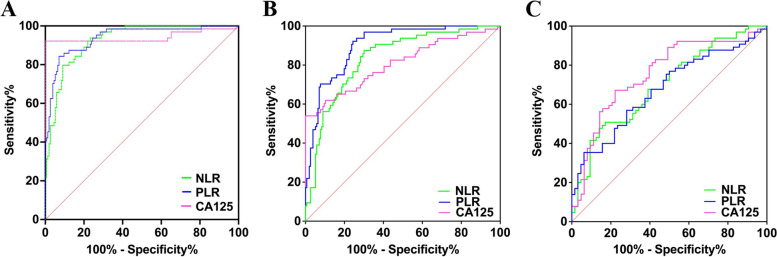
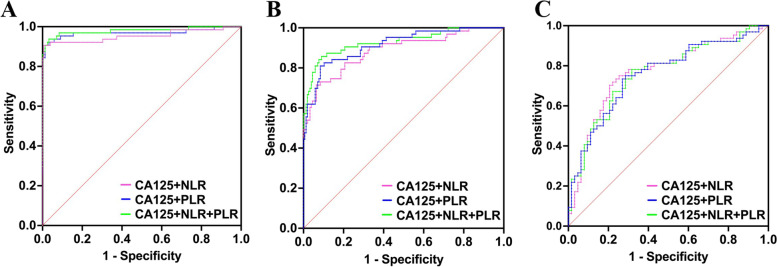
CA125, NLR and PLR increased steadily among benign, borderline and malignant EOTs and tended to be higher in advanced (stage III-IV) and lymph node metastasis MEOT groups than in early stage (stage I-II) and non-lymph node metastasis MEOT groups. CA125, NLR and PLR could be used separately in the differentiation of EOTs but could not take into account both sensitivity and specificity. The combined use of CA125, NLR and PLR was evaluated to be more efficient, especially in the identification of BEOTs, with both high sensitivity and high specificity.
The levels of CA125, NLR and PLR were closely related to the nature of EOTs and malignant progression of MEOTs. The combination of CA125, NLR and PLR was more accurate in identifying the nature of EOTs than either alone or double combination, especially for BEOTs.
卵巢癌的死亡率在三种常见妇科恶性肿瘤中位居首位,这是由于其起病隐匿,缺乏有效的早期诊断方法。交界性卵巢上皮肿瘤(BEOT)是一种低度恶性潜能肿瘤,其预后通常优于卵巢癌。然而,由于临床症状相似,且缺乏特定的肿瘤标志物和影像学检查,BEOT 很容易与良性和恶性上皮性卵巢肿瘤(EOT)混淆。值得注意的是,一小部分 BEOT 会恶变为低级别浆液性卵巢癌,预后较差。因此,寻找易于获取且能够准确识别恶性上皮性卵巢肿瘤(MEOT)和 BEOT 的潜在生物标志物对临床医生至关重要。癌抗原 125(CA125)是术前诊断 EOT 的常用生物标志物,但灵敏度和特异性均较低。如今,炎症标志物,包括炎症细胞计数及其衍生比值,如中性粒细胞/淋巴细胞比值(NLR)和血小板/淋巴细胞比值(PLR),已被证明与肿瘤进展和不良预后相关,被认为是各种恶性肿瘤最具经济潜力的替代生物标志物。本研究旨在寻找合适的炎症和肿瘤生物标志物组合,以提高 EOT 特别是 BEOT 的诊断效率。
CA125、NLR 和 PLR 在良性、交界性和恶性 EOT 中呈逐渐升高趋势,且在晚期(III-IV 期)和有淋巴结转移的 MEOT 组中高于早期(I-II 期)和无淋巴结转移的 MEOT 组。CA125、NLR 和 PLR 可单独用于 EOT 的鉴别,但不能兼顾灵敏度和特异性。CA125、NLR 和 PLR 的联合使用被评估为更有效,特别是在识别 BEOT 方面,具有较高的灵敏度和特异性。
CA125、NLR 和 PLR 的水平与 EOT 的性质和 MEOT 的恶性进展密切相关。CA125、NLR 和 PLR 的联合使用在识别 EOT 的性质方面比单独使用或双组合使用更准确,尤其是对 BEOT。