Department of Biochemistry and Molecular Biology, Shahjalal University of Science and Technology, Sylhet, 3114, Bangladesh.
BMC Endocr Disord. 2023 Feb 21;23(1):45. doi: 10.1186/s12902-023-01304-7.
Chronic kidney disease (CKD) is a public health concern worldwide and has been recognized as a significant risk factor for cardiovascular disease. The elevated level of uric acid (hyperuricemia) has been suggested to be associated with obesity, hypertension, cardiovascular disease and diabetes. However, there is limited information on the relationship between hyperuricemia and CKD. Therefore, this study aimed to estimate the prevalence of CKD and assess its relationship with hyperuricemia in Bangladeshi adults.
In this study, blood samples were collected from 545 participants (398 males and 147 females) aged ≥ 18 years. Biochemical parameters such as serum uric acid (SUA), lipid profile markers, glucose, creatinine and urea were measured by colorimetric methods. The estimated glomerular filtration rate (eGFR) and CKD were determined based on serum creatinine levels with existed formula. Multivariate logistic regression analysis was performed to evaluate the association between SUA and CKD.
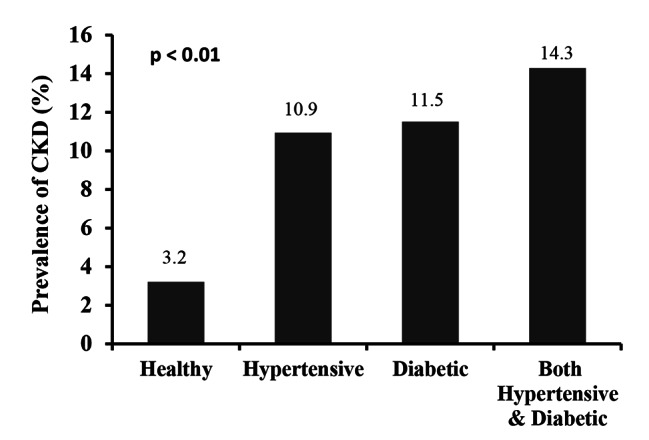
The overall prevalence of CKD was 5.9% with 6.1% in males and 5.2% in females. Hyperuricemia was prevalent in 18.7% of participants with 23.2% in males and 14.6% in females. An increasing trend of CKD prevalence was observed with increasing age in the groups. The mean eGFR level was significantly lower in male (95.1 ± 31.8 ml/min/1.73m) than in female (109.3 ± 77.4 ml/min/1.73m) subjects (p < 0.01). The mean level of SUA was significantly higher (p < 0.01) in participants having CKD (7.1 ± 1.9 mg/dL) than in participants without CKD (5.7 ± 1.6 mg/dL). A decreasing trend for eGFR concentration and an increasing trend for CKD prevalence was observed across the SUA quartiles (p < 0.001). In regression analysis, a significant positive association was found between hyperuricemia and CKD.
This study showed an independent association between hyperuricemia and CKD in Bangladeshi adults. Further mechanistic studies are needed to explore the potential link between hyperuricemia and CKD.
慢性肾脏病(CKD)是一个全球性的公共卫生问题,已被认为是心血管疾病的一个重要危险因素。尿酸水平升高(高尿酸血症)与肥胖、高血压、心血管疾病和糖尿病有关。然而,关于高尿酸血症与 CKD 之间的关系,信息有限。因此,本研究旨在评估孟加拉国成年人 CKD 的患病率,并评估其与高尿酸血症之间的关系。
本研究采集了 545 名年龄≥18 岁的参与者(398 名男性和 147 名女性)的血样。通过比色法测量血清尿酸(SUA)、血脂谱标志物、血糖、肌酐和尿素等生化参数。根据血清肌酐水平和现有的公式确定估算肾小球滤过率(eGFR)和 CKD。采用多变量 logistic 回归分析评估 SUA 与 CKD 之间的关系。
CKD 的总患病率为 5.9%,男性为 6.1%,女性为 5.2%。高尿酸血症的患病率为 18.7%,男性为 23.2%,女性为 14.6%。随着年龄的增长,CKD 的患病率呈上升趋势。男性的平均 eGFR 水平明显低于女性(95.1±31.8 ml/min/1.73m 比 109.3±77.4 ml/min/1.73m,p<0.01)。患有 CKD 的参与者的平均 SUA 水平明显较高(p<0.01)(7.1±1.9 mg/dL),而无 CKD 的参与者的平均 SUA 水平较低(5.7±1.6 mg/dL)。随着 SUA 四分位数的增加,eGFR 浓度呈下降趋势,CKD 的患病率呈上升趋势(p<0.001)。在回归分析中,发现高尿酸血症与 CKD 之间存在显著的正相关关系。
本研究表明,在孟加拉国成年人中,高尿酸血症与 CKD 之间存在独立的关联。需要进一步的机制研究来探讨高尿酸血症与 CKD 之间的潜在联系。