Department of Medical Epidemiology and Biostatistics, Karolinska Institutet, Stockholm, Sweden.
Mayo Clinic College of Medicine, Rochester, MN.
J Clin Oncol. 2023 May 10;41(14):2536-2545. doi: 10.1200/JCO.22.01564. Epub 2023 Mar 17.
Image-derived artificial intelligence-based short-term risk models for breast cancer have shown high discriminatory performance compared with traditional lifestyle/familial-based risk models. The long-term performance of image-derived risk models has not been investigated.
We performed a case-cohort study of 8,604 randomly selected women within a mammography screening cohort initiated in 2010 in Sweden for women age 40-74 years. Mammograms, age, lifestyle, and familial risk factors were collected at study entry. In all, 2,028 incident breast cancers were identified through register matching in May 2022 (206 incident breast cancers were found in the subcohort). The image-based model extracted mammographic features (density, microcalcifications, masses, and left-right breast asymmetries of these features) and age from study entry mammograms. The Tyrer-Cuzick v8 risk model incorporates self-reported lifestyle and familial risk factors and mammographic density to estimate risk. Absolute risks were estimated, and age-adjusted AUC model performances (aAUCs) were compared across the 10-year period.
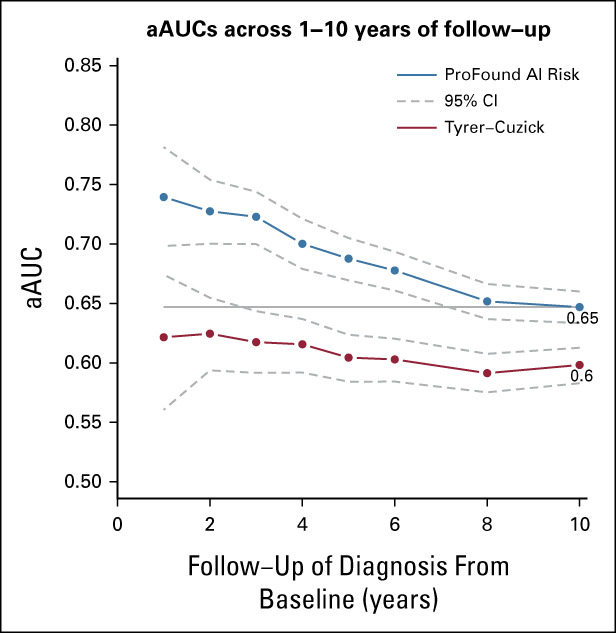
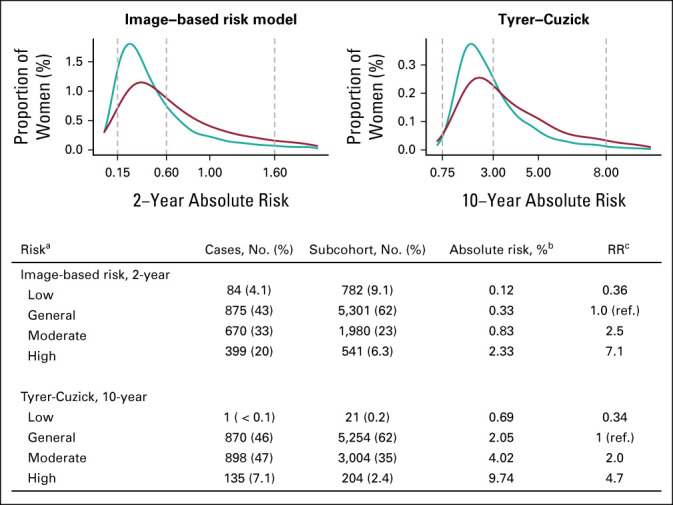
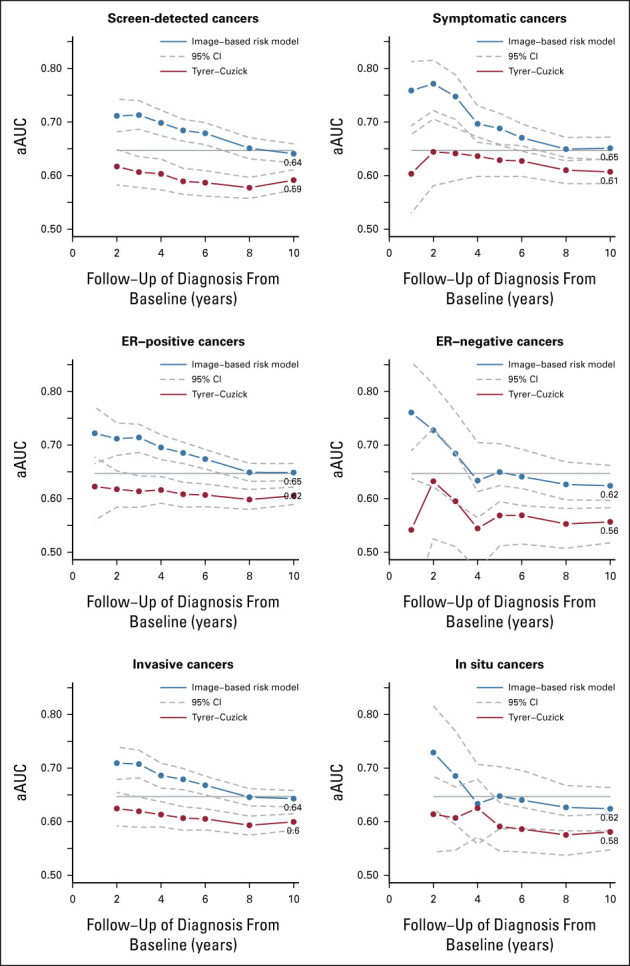
The aAUCs of the image-based risk model ranged from 0.74 (95% CI, 0.70 to 0.78) to 0.65 (95% CI, 0.63 to 0.66) for breast cancers developed 1-10 years after study entry; the corresponding Tyrer-Cuzick aAUCs were 0.62 (95% CI, 0.56 to 0.67) to 0.60 (95% CI, 0.58 to 0.61). For symptomatic cancers, the aAUCs for the image-based model were ≥0.75 during the first 3 years. Women with high and low mammographic density showed similar aAUCs. Throughout the 10-year follow-up, 20% of all women with breast cancers were deemed high-risk at study entry by the image-based risk model compared with 7.1% using the lifestyle familial-based model ( < .01).
The image-based risk model outperformed the Tyrer-Cuzick v8 model for both short-term and long-term risk assessment and could be used to identify women who may benefit from supplemental screening and risk reduction strategies.
与传统的基于生活方式/家族的风险模型相比,基于图像的人工智能短期乳腺癌风险模型显示出了较高的区分性能。但是,尚未对基于图像的风险模型的长期性能进行研究。
我们对 2010 年在瑞典开始的一项针对 40-74 岁女性的乳房 X 线筛查队列中的 8604 名随机选择的女性进行了病例-队列研究。在研究开始时收集了乳房 X 光片、年龄、生活方式和家族风险因素。通过 2022 年 5 月的登记匹配共发现了 2028 例新发乳腺癌(在子队列中发现了 206 例新发乳腺癌)。基于图像的模型从研究开始时的乳房 X 光片中提取了乳房特征(密度、微钙化、肿块和这些特征的左右乳房不对称)和年龄。Tyrer-Cuzick v8 风险模型结合了自我报告的生活方式和家族风险因素以及乳房 X 线密度来估计风险。估计了绝对风险,并比较了 10 年期间的年龄调整 AUC 模型表现(aAUC)。
基于图像的风险模型的 aAUC 范围为 0.74(95%CI,0.70 至 0.78)至 0.65(95%CI,0.63 至 0.66),用于研究后 1-10 年内发生的乳腺癌;相应的 Tyrer-Cuzick aAUC 为 0.62(95%CI,0.56 至 0.67)至 0.60(95%CI,0.58 至 0.61)。对于有症状的癌症,在最初的 3 年内,基于图像的模型的 aAUC 均≥0.75。高和低乳房密度的女性具有相似的 aAUC。在整个 10 年随访期间,与基于生活方式和家族的模型相比,20%的患有乳腺癌的女性在研究开始时被认为是高危风险,而基于生活方式和家族的模型为 7.1%(<0.01)。
基于图像的风险模型在短期和长期风险评估方面均优于 Tyrer-Cuzick v8 模型,可用于识别可能受益于补充筛查和风险降低策略的女性。