Department of Clinical Studies, Ontario Veterinary College, University of Guelph, Guelph, Ontario, Canada.
Department of Production Animal Health, Faculty of Veterinary Medicine, University of Calgary, Calgary, Alberta, Canada.
PLoS One. 2023 Apr 13;18(4):e0284193. doi: 10.1371/journal.pone.0284193. eCollection 2023.
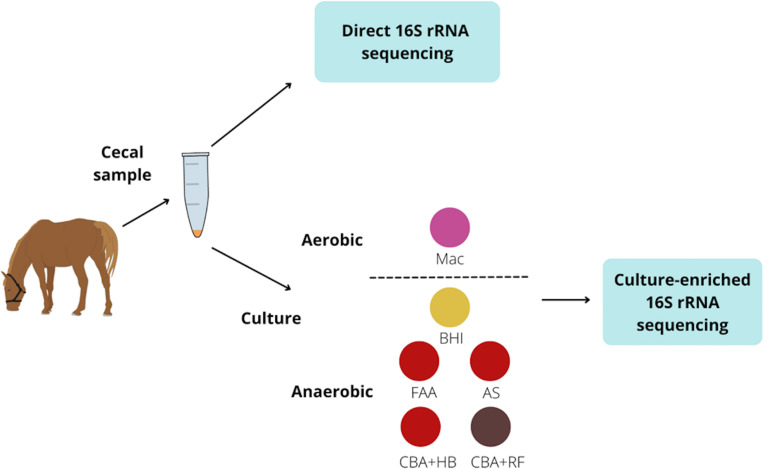
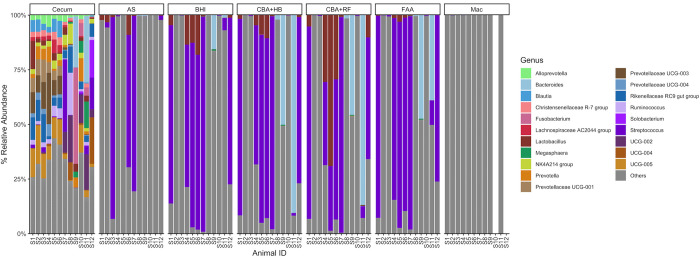
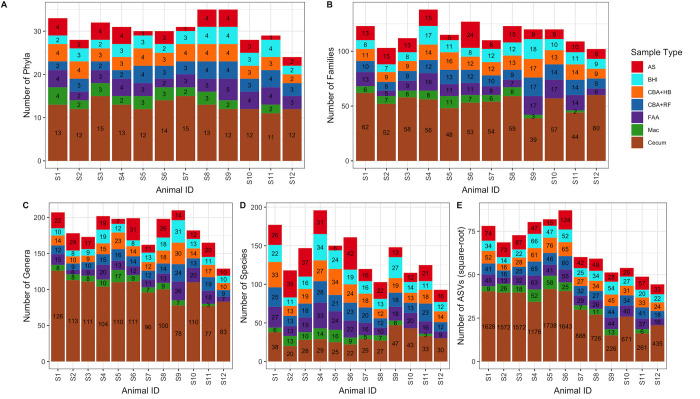
Next generation sequencing has demonstrated that alpha diversity of the fecal microbiota is significantly altered in horses with typhlocolitis. The objective of this study was to evaluate the bacterial composition of the cecum content of horses with and without typhlocolitis through direct and culture-enriched 16S gene sequencing of six healthy horses and six horses with acute typhlocolitis; a case-control study design. Cecal content was collected after euthanasia. An aliquot was used for direct 16S gene sequencing. Another was serially diluted with brain heart infusion (BHI) and plated onto five different agar media. All culture medias, except for MacConkey, were incubated anaerobically. Bacterial colonies were harvested in bulk and used for DNA extraction, 16S PCR amplification, and sequenced using the Illumina MiSeq platform. Predominant phyla in healthy and diseased horses were Firmicutes, followed by Bacteroidetes in all cultured medias, except for MacConkey agar, in which Proteobacteria was the dominant phylum. Greater bacterial richness was identified in sequenced cecal contents as compared to cultured plates (P < 0.05). Culture-enriched molecular profiling combined with 16S rRNA gene sequencing offer an alternative method for the study of the gut microbiota of horses. For direct cecum content 16S gene amplification, the alpha diversity indices were lower in diarrheic horses compared to healthy horses (P < 0.05). A higher relative abundance of Fusobacteriota was found in 2/6 samples from diarrheic horses. The role of Fusobacteriota in equine colitis deserves investigation.
下一代测序技术表明,粪便微生物群的α多样性在患有 typhlocolitis 的马中显著改变。本研究的目的是通过对 6 匹健康马和 6 匹患有急性 typhlocolitis 的马的盲肠内容物进行直接和培养富集的 16S 基因测序,来评估盲肠内容物的细菌组成;这是一项病例对照研究设计。安乐死后收集盲肠内容物。取一部分用于直接 16S 基因测序。另一部分用脑心浸液(BHI)连续稀释,并接种于五种不同的琼脂培养基上。除了 MacConkey 琼脂外,所有的培养介质都在厌氧条件下孵育。将细菌菌落整块收集并用于 DNA 提取、16S PCR 扩增,然后使用 Illumina MiSeq 平台进行测序。在所有培养介质中,健康和患病马的主要菌群都是厚壁菌门,其次是拟杆菌门,除了 MacConkey 琼脂,其优势菌群是变形菌门。与培养平板相比,测序盲肠内容物中的细菌丰富度更高(P < 0.05)。培养富集的分子分析与 16S rRNA 基因测序相结合,为研究马的肠道微生物群提供了一种替代方法。对于直接盲肠内容物 16S 基因扩增,与健康马相比,腹泻马的α多样性指数较低(P < 0.05)。在腹泻马的 2/6 样本中发现了更多的 Fusobacteriota。Fusobacteriota 在马结肠炎中的作用值得研究。