Wu Jie, Liu Hong, Chen Weiwei, Ma Biao, Ju Huangxian
State Key Laboratory of Analytical Chemistry for Life Science, School of Chemistry and Chemical Engineering, Nanjing University, Nanjing, China.
State Key Laboratory of Bioelectronics, School of Biological Science and Medical Engineering, Southeast University, Nanjing, China.
Nat Rev Bioeng. 2023;1(5):346-360. doi: 10.1038/s44222-023-00032-w. Epub 2023 Feb 24.
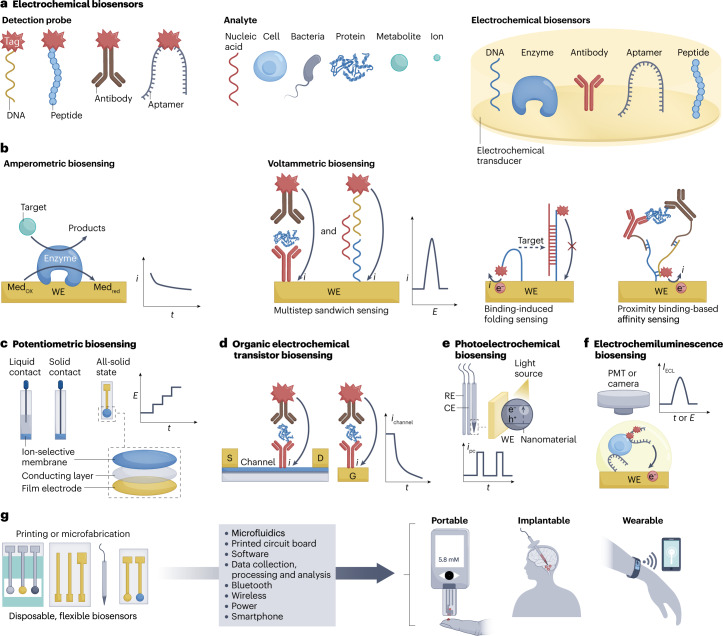
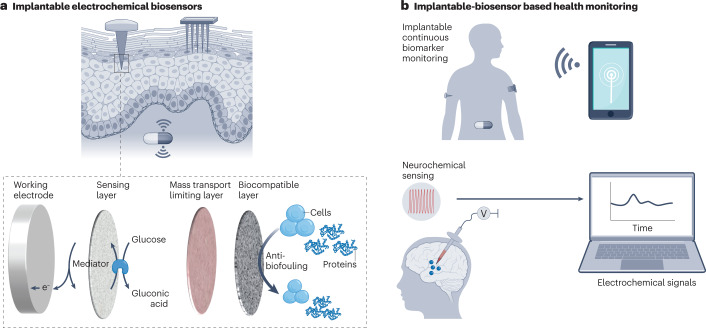
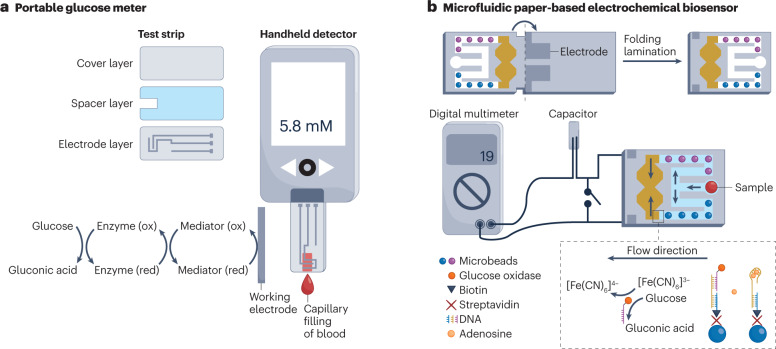
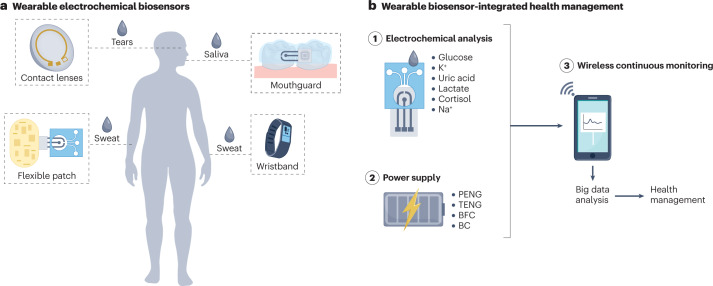
Electrochemical biosensors incorporate a recognition element and an electronic transducer for the highly sensitive detection of analytes in body fluids. Importantly, they can provide rapid readouts and they can be integrated into portable, wearable and implantable devices for point-of-care diagnostics; for example, the personal glucose meter enables at-home assessment of blood glucose levels, greatly improving the management of diabetes. In this Review, we discuss the principles of electrochemical biosensing and the design of electrochemical biosensor devices for health monitoring and disease diagnostics, with a particular focus on device integration into wearable, portable and implantable systems. Finally, we outline the key engineering challenges that need to be addressed to improve sensing accuracy, enable multiplexing and one-step processes, and integrate electrochemical biosensing devices in digital health-care pathways.
电化学生物传感器包含一个识别元件和一个电子换能器,用于高灵敏度检测体液中的分析物。重要的是,它们可以提供快速读数,并且可以集成到便携式、可穿戴和植入式设备中用于即时诊断;例如,个人血糖仪能够在家中评估血糖水平,极大地改善了糖尿病的管理。在本综述中,我们讨论电化学生物传感的原理以及用于健康监测和疾病诊断的电化学生物传感器设备的设计,特别关注将设备集成到可穿戴、便携式和植入式系统中。最后,我们概述了为提高传感准确性、实现多重检测和一步法工艺以及将电化学生物传感设备集成到数字医疗保健途径中而需要解决的关键工程挑战。