Department of Genetics, Stanford University School of Medicine, Stanford, California, United States of America.
Department of Microbiology and Immunology, Stanford University School of Medicine, Stanford, California, United States of America.
PLoS Genet. 2023 May 16;19(5):e1010747. doi: 10.1371/journal.pgen.1010747. eCollection 2023 May.
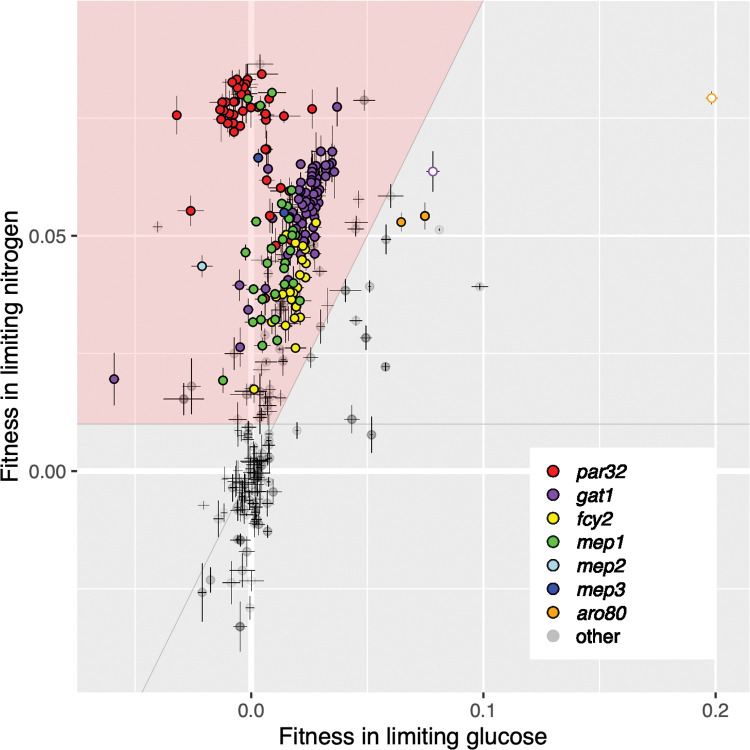
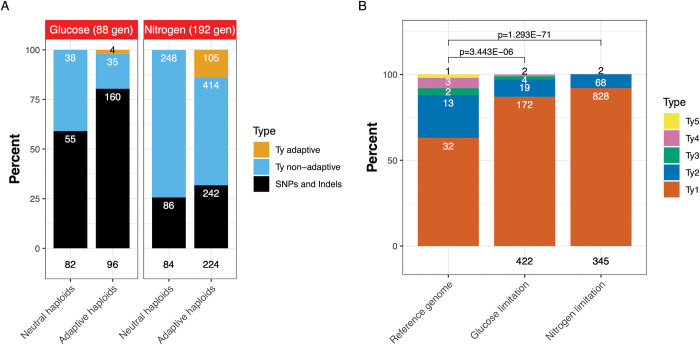
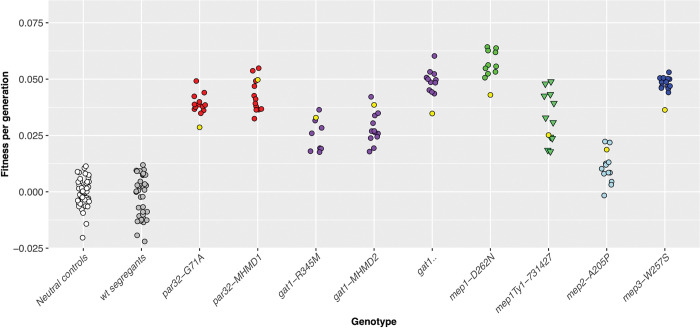
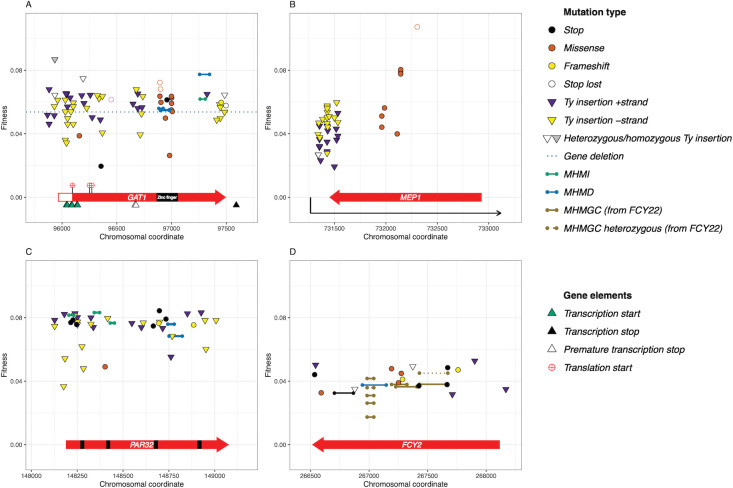
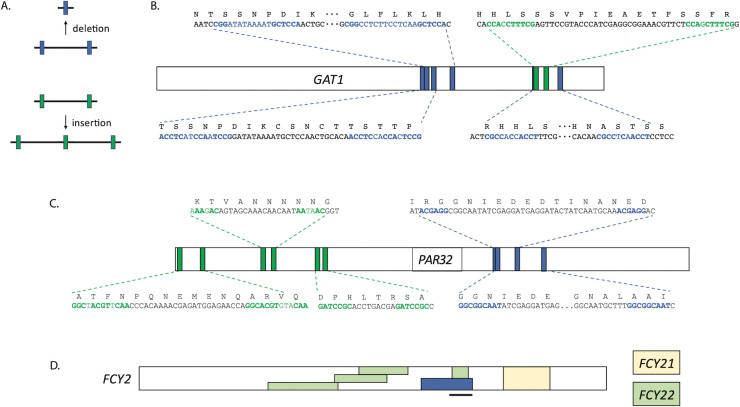
There are many mechanisms that give rise to genomic change: while point mutations are often emphasized in genomic analyses, evolution acts upon many other types of genetic changes that can result in less subtle perturbations. Changes in chromosome structure, DNA copy number, and novel transposon insertions all create large genomic changes, which can have correspondingly large impacts on phenotypes and fitness. In this study we investigate the spectrum of adaptive mutations that arise in a population under consistently fluctuating nitrogen conditions. We specifically contrast these adaptive alleles and the mutational mechanisms that create them, with mechanisms of adaptation under batch glucose limitation and constant selection in low, non-fluctuating nitrogen conditions to address if and how selection dynamics influence the molecular mechanisms of evolutionary adaptation. We observe that retrotransposon activity accounts for a substantial number of adaptive events, along with microhomology-mediated mechanisms of insertion, deletion, and gene conversion. In addition to loss of function alleles, which are often exploited in genetic screens, we identify putative gain of function alleles and alleles acting through as-of-yet unclear mechanisms. Taken together, our findings emphasize that how selection (fluctuating vs. non-fluctuating) is applied also shapes adaptation, just as the selective pressure (nitrogen vs. glucose) does itself. Fluctuating environments can activate different mutational mechanisms, shaping adaptive events accordingly. Experimental evolution, which allows a wider array of adaptive events to be assessed, is thus a complementary approach to both classical genetic screens and natural variation studies to characterize the genotype-to-phenotype-to-fitness map.
虽然点突变在基因组分析中经常被强调,但进化还会作用于许多其他类型的遗传变化,这些变化可能导致不太微妙的干扰。染色体结构、DNA 拷贝数和新转座子插入的变化都会导致基因组的重大变化,从而对表型和适应性产生相应的重大影响。在这项研究中,我们研究了在氮源不断波动的条件下,种群中出现的适应性突变的范围。我们特别对比了这些适应性等位基因和产生它们的突变机制,以及在低氮、非波动条件下分批葡萄糖限制和恒定位点选择下的适应机制,以确定选择动态是否以及如何影响进化适应的分子机制。我们观察到,逆转录转座子的活性导致了大量的适应性事件,同时还存在微同源介导的插入、缺失和基因转换机制。除了在遗传筛选中经常利用的功能丧失等位基因外,我们还鉴定了可能的功能获得等位基因和通过尚未明确的机制起作用的等位基因。总之,我们的研究结果强调,选择(波动与非波动)的方式也会影响适应性,就像选择压力(氮与葡萄糖)本身一样。波动的环境可以激活不同的突变机制,从而相应地塑造适应性事件。因此,实验进化是一种补充方法,既可以与经典遗传筛选,也可以与自然变异研究相结合,以描述基因型-表型-适应性图谱。