Turrina Chiara, Klassen Anna, Milani Davide, Rojas-González Diana M, Ledinski Gerhard, Auer Doris, Sartori Barbara, Cvirn Gerhard, Mela Petra, Berensmeier Sonja, Schwaminger Sebastian P
Chair of Bioseparation Engineering, TUM School of Engineering and Design, Technical University of Munich, Germany.
Chair of Medical Materials and Implants, TUM School of Engineering and Design, Munich Institute of Biomedical Engineering, Technical University of Munich, Germany.
Heliyon. 2023 May 25;9(6):e16487. doi: 10.1016/j.heliyon.2023.e16487. eCollection 2023 Jun.
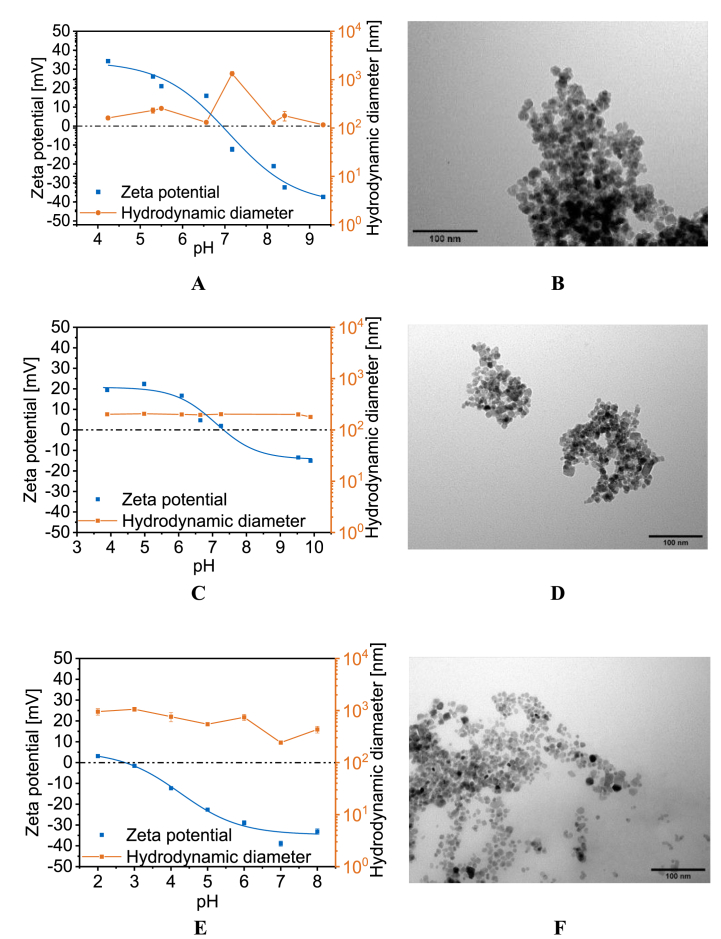
Iron oxide nanoparticles (IONs) are of great interest in nanomedicine for imaging, drug delivery, or for hyperthermia treatment. Although many research groups have focused on the synthesis and application of IONs in nanomedicine, little is known about the influence of the surface properties on the particles' behavior in the human body. This study analyzes the impact of surface coatings (dextran, polyvinyl alcohol, polylactide-co-glycolide) on the nanoparticles' cytocompatibility, agglomeration, degradation, and the resulting oxidative stress induced by the particle degradation. All particles, including bare IONs (BIONs), are highly cytocompatible (>70%) and show no significant toxicity towards smooth muscle cells. Small-angle X-ray scattering profiles visualize the aggregation behavior of nanoparticles and yield primary particle sizes of around 20 nm for the investigated nanoparticles. A combined experimental setup of dynamic light scattering and phenanthroline assay was used to analyze the long-term agglomeration and degradation profile of IONs in simulated body fluids, allowing fast screening of multiple candidates. All particles degraded in simulated endosomal and lysosomal fluid, confirming the pH-dependent dissolution. The degradation rate decreased with the shrinking size of particles leading to a plateau. The fastest Fe release could be measured for the polyvinyl-coated IONs. The analytical setup is ideal for a quick preclinical study of IONs, giving often neglected yet crucial information about the behavior and toxicity of nanoparticles in the human body. Moreover, this study allows for the development and evaluation of novel ferroptosis-inducing agents.
氧化铁纳米颗粒(IONs)在纳米医学领域具有重要意义,可用于成像、药物递送或热疗。尽管许多研究小组专注于IONs在纳米医学中的合成与应用,但对于其表面性质对人体中颗粒行为的影响却知之甚少。本研究分析了表面涂层(葡聚糖、聚乙烯醇、聚乳酸-羟基乙酸共聚物)对纳米颗粒的细胞相容性、团聚、降解以及颗粒降解所导致的氧化应激的影响。所有颗粒,包括裸IONs(BIONs),都具有高度的细胞相容性(>70%),并且对平滑肌细胞无明显毒性。小角X射线散射图谱可视化了纳米颗粒的聚集行为,并得出所研究纳米颗粒的初级粒径约为20纳米。采用动态光散射和菲罗啉测定法的组合实验装置来分析IONs在模拟体液中的长期团聚和降解情况,从而能够快速筛选多个候选物。所有颗粒在模拟的内体和溶酶体液中均发生降解,证实了pH依赖性溶解。降解速率随着颗粒尺寸的减小而降低,最终趋于平稳。聚乙烯涂层IONs的铁释放速率最快。该分析装置非常适合对IONs进行快速的临床前研究,能够提供有关纳米颗粒在人体中的行为和毒性的重要信息,而这些信息往往被忽视。此外,本研究有助于新型铁死亡诱导剂的开发和评估。