Pitarch Carla, Ribas Vicent, Vellido Alfredo
Computer Science Department, Universitat Politècnica de Catalunya (UPC), 08034 Barcelona, Spain.
Eurecat, Technology Centre of Catalonia, Digital Health Unit, 08005 Barcelona, Spain.
Cancers (Basel). 2023 Jun 27;15(13):3369. doi: 10.3390/cancers15133369.
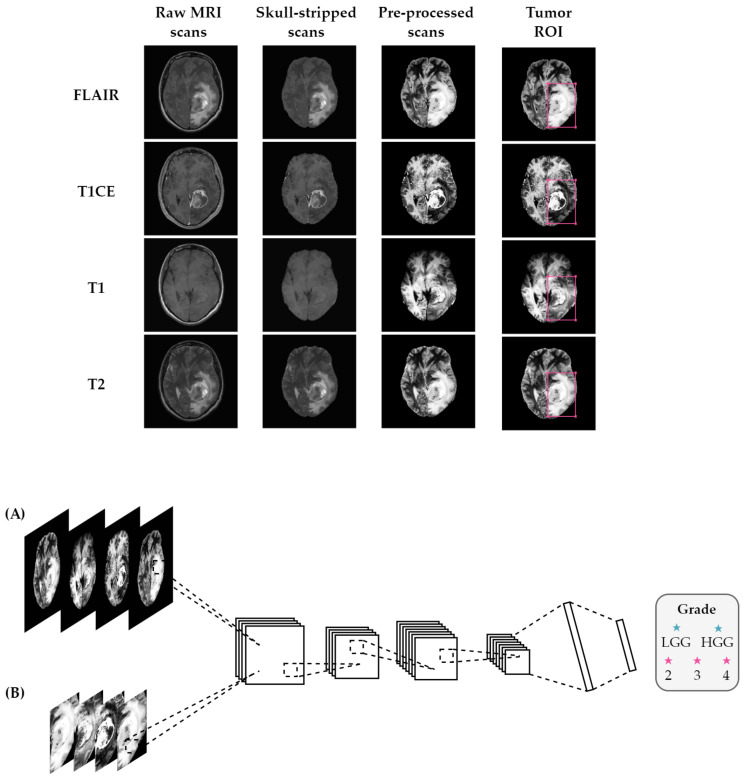
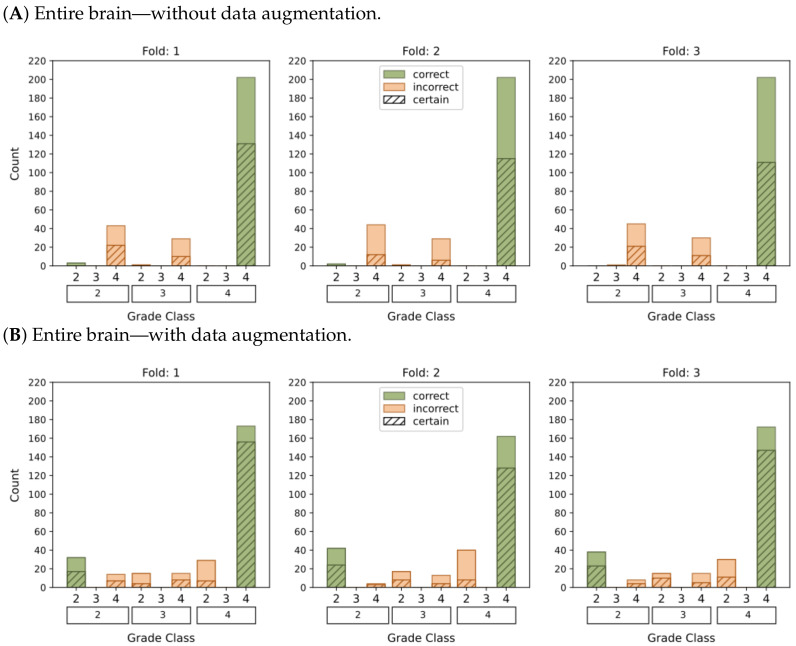
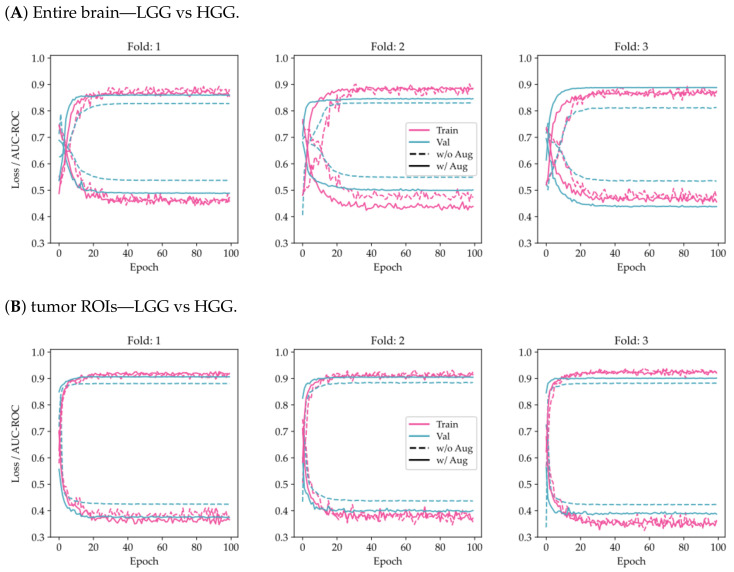
Glioma is the most common type of tumor in humans originating in the brain. According to the World Health Organization, gliomas can be graded on a four-stage scale, ranging from the most benign to the most malignant. The grading of these tumors from image information is a far from trivial task for radiologists and one in which they could be assisted by machine-learning-based decision support. However, the machine learning analytical pipeline is also fraught with perils stemming from different sources, such as inadvertent data leakage, adequacy of 2D image sampling, or classifier assessment biases. In this paper, we analyze a glioma database sourced from multiple datasets using a simple classifier, aiming to obtain a reliable tumor grading and, on the way, we provide a few guidelines to ensure such reliability. Our results reveal that by focusing on the tumor region of interest and using data augmentation techniques we significantly enhanced the accuracy and confidence in tumor classifications. Evaluation on an independent test set resulted in an AUC-ROC of 0.932 in the discrimination of low-grade gliomas from high-grade gliomas, and an AUC-ROC of 0.893 in the classification of grades 2, 3, and 4. The study also highlights the importance of providing, beyond generic classification performance, measures of how reliable and trustworthy the model's output is, thus assessing the model's certainty and robustness.
神经胶质瘤是人类起源于大脑的最常见肿瘤类型。根据世界卫生组织的分类,神经胶质瘤可分为四个等级,从最良性到最恶性。从图像信息中对这些肿瘤进行分级,对于放射科医生来说绝非易事,而基于机器学习的决策支持可以为他们提供帮助。然而,机器学习分析流程也充满了来自不同来源的风险,如无意的数据泄露、二维图像采样的充分性或分类器评估偏差。在本文中,我们使用一个简单的分类器分析了一个源自多个数据集的神经胶质瘤数据库,旨在获得可靠的肿瘤分级,在此过程中,我们提供了一些指导方针以确保这种可靠性。我们的结果表明,通过关注感兴趣的肿瘤区域并使用数据增强技术,我们显著提高了肿瘤分类的准确性和可信度。在独立测试集上的评估结果显示,在区分低级别神经胶质瘤和高级别神经胶质瘤时,曲线下面积(AUC-ROC)为0.932,在对2级、3级和4级进行分类时,AUC-ROC为0.893。该研究还强调了除了提供一般的分类性能外,还需提供模型输出的可靠性和可信度的衡量标准的重要性,从而评估模型的确定性和稳健性。