Yang Xinyue, Sun Jiayi, Zhang Wenjuan
Department of Cardiovascular Medicine, Tianjin Medical University General Hospital, Tianjin, China.
Front Endocrinol (Lausanne). 2024 Feb 26;15:1343002. doi: 10.3389/fendo.2024.1343002. eCollection 2024.
To promote a comprehensive understanding of global trends and burden of type 2 diabetes attributable to physical inactivity.
We utilized data regarding mortality, disability-adjusted life years (DALYs), as well as age-standardized mortality rates (ASMR) and DALYs rates (ASDR) derived from the global burden of disease study 2019 to evaluate the impact of physical inactivity on the prevalence of type 2 diabetes in 204 countries and territories over the period from 1990 to 2019. This method facilitated the analysis of the diabetes burden across different ages, genders, and regions. To determine the long-term progression of type 2 diabetes prevalence, we computed the estimated annual percentage change (EAPC) in burden rates.
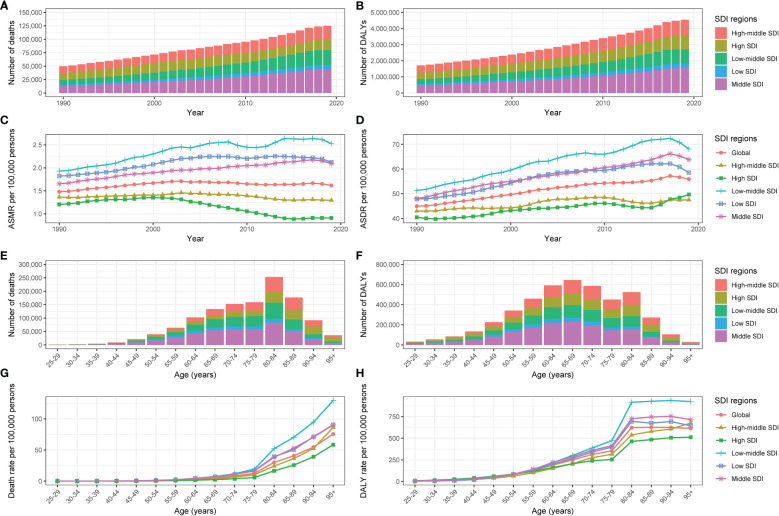
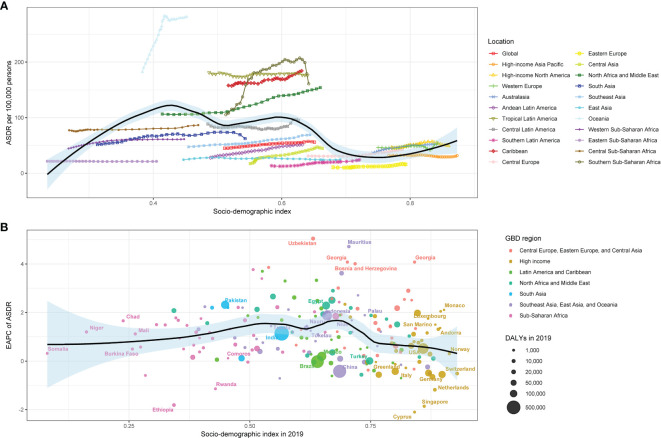
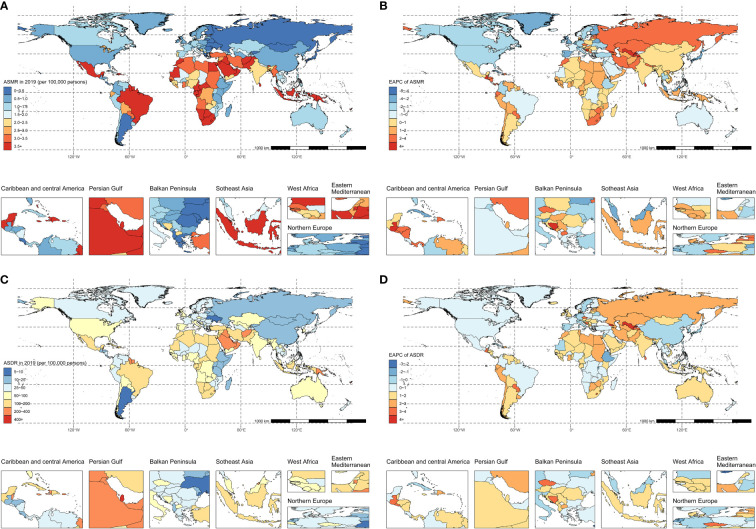
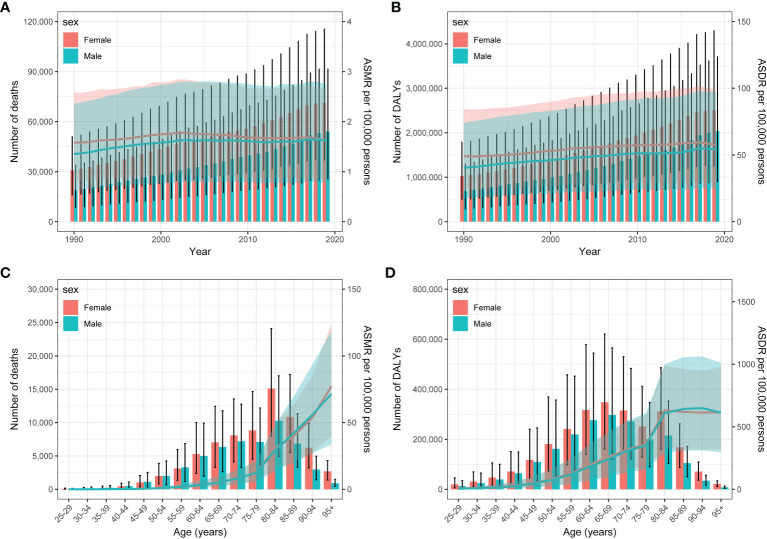
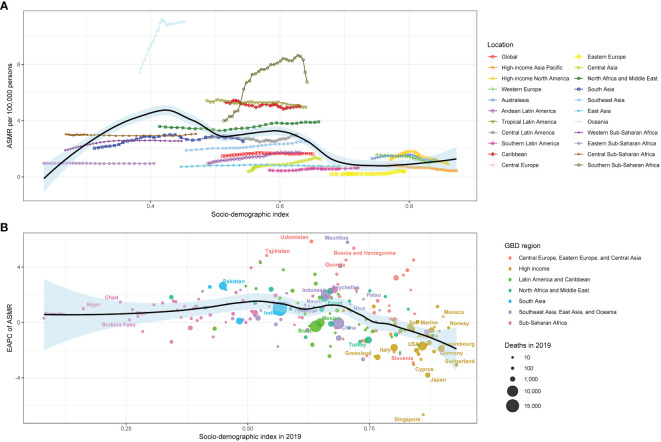
Globally, the number of deaths and DALYs from type 2 diabetes due to physical inactivity more than doubled between 1990 and 2019. Concurrently, there was an increase in the ASMR and ASDR, with EAPC of 0.26 (95% CI: 0.13-0.39) and 0.84 (95% CI: 0.78-0.89), respectively. As of 2019, the global ASMR and ASDR for physical inactivity stood at 1.6 (95% UI: 0.8-2.7) per 100 000 and 55.9 (95% UI: 27.2-97.6) per 100 000, respectively. Notable disparities were observed in the type 2 diabetes burden associated with physical inactivity worldwide, with higher sociodemographic index (SDI) countries experiencing lower ASDR and ASMR compared to lower SDI countries. Initially, females exhibited higher ASMR and ASDR than males, but this gender disparity in ASMR and ASDR has lessened in recent years. The mortality and DALYs rates associated with physical inactivity exhibit an inverted V-shaped pattern across various age groups, predominantly affecting the elderly population.
Between 1990 and 2019, there was a marked rise in the worldwide burden of type 2 diabetes associated with physical inactivity, underscoring the role of physical inactivity as a key changeable risk factor in the global landscape of this disease. This necessitates additional research to explore the variables contributing to the varying levels of disease burden across different countries and between sexes. Furthermore, it calls for the formulation of public health policies aimed at guiding prevention tactics, promoting early detection, and enhancing the management of type 2 diabetes.
促进对因缺乏身体活动导致的2型糖尿病的全球趋势和负担的全面理解。
我们利用了来自《2019年全球疾病负担研究》的死亡率、伤残调整生命年(DALYs)以及年龄标准化死亡率(ASMR)和DALYs率(ASDR)数据,以评估1990年至2019年期间缺乏身体活动对204个国家和地区2型糖尿病患病率的影响。这种方法有助于分析不同年龄、性别和地区的糖尿病负担。为了确定2型糖尿病患病率的长期变化趋势,我们计算了负担率的估计年度百分比变化(EAPC)。
在全球范围内,1990年至2019年期间,因缺乏身体活动导致的2型糖尿病死亡人数和伤残调整生命年增加了一倍多。与此同时,年龄标准化死亡率和DALYs率有所上升,EAPC分别为0.26(95%CI:0.13 - 0.39)和0.84(95%CI:0.78 - 0.89)。截至2019年,全球因缺乏身体活动导致的年龄标准化死亡率和DALYs率分别为每10万人1.6(95%UI:0.8 - 2.7)和每10万人55.9(95%UI:27.2 - 97.6)。在全球范围内,与缺乏身体活动相关的2型糖尿病负担存在显著差异,社会人口学指数(SDI)较高的国家与SDI较低的国家相比,年龄标准化死亡率和DALYs率较低。最初,女性的年龄标准化死亡率和DALYs率高于男性,但近年来这种性别差异有所减小。在各个年龄组中,与缺乏身体活动相关的死亡率和伤残调整生命年率呈现倒V形模式,主要影响老年人群。
1990年至2019年期间,全球因缺乏身体活动导致的2型糖尿病负担显著上升,凸显了缺乏身体活动作为该疾病全球格局中一个关键可变风险因素的作用。这需要进一步研究,以探索导致不同国家和不同性别之间疾病负担水平差异的变量。此外,这还需要制定公共卫生政策,以指导预防策略、促进早期发现并加强2型糖尿病的管理。