He Shaobin, Ma Long, Zheng Qionghua, Wang Zhuoran, Chen Wei, Yu Zihang, Yan Xiyun, Fan Kelong
CAS Engineering Laboratory for Nanozyme, Key Laboratory of Biomacromolecules (CAS), CAS Center for Excellence in Biomacromolecules, Institute of Biophysics, Chinese Academy of Sciences, Beijing, 100101, China.
Laboratory of Clinical Pharmacy, Department of Pharmacy, The Second Affiliated Hospital of Fujian Medical University, Quanzhou, 362000, China.
Bioact Mater. 2024 Sep 4;42:284-298. doi: 10.1016/j.bioactmat.2024.08.033. eCollection 2024 Dec.
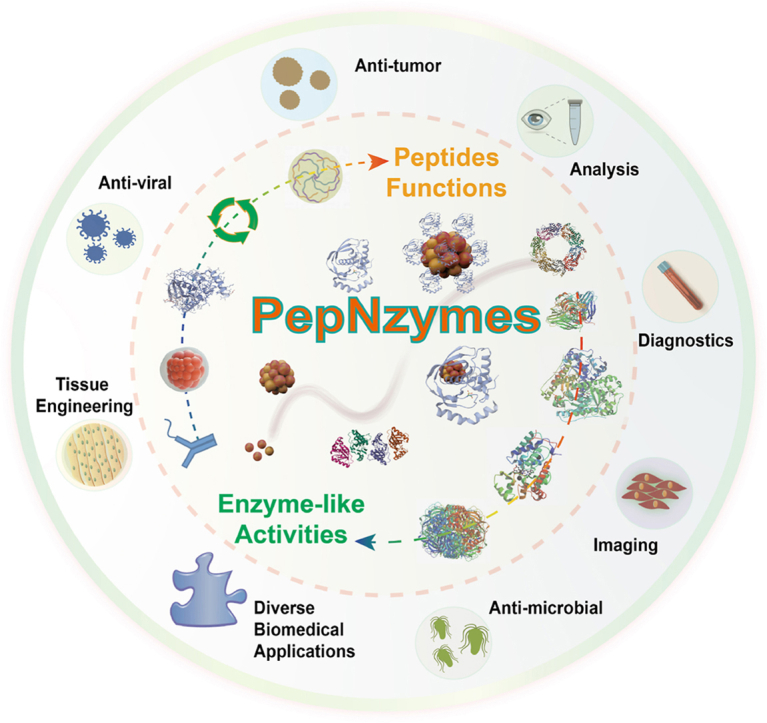
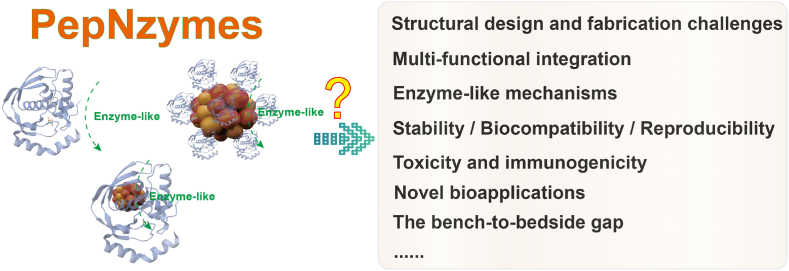
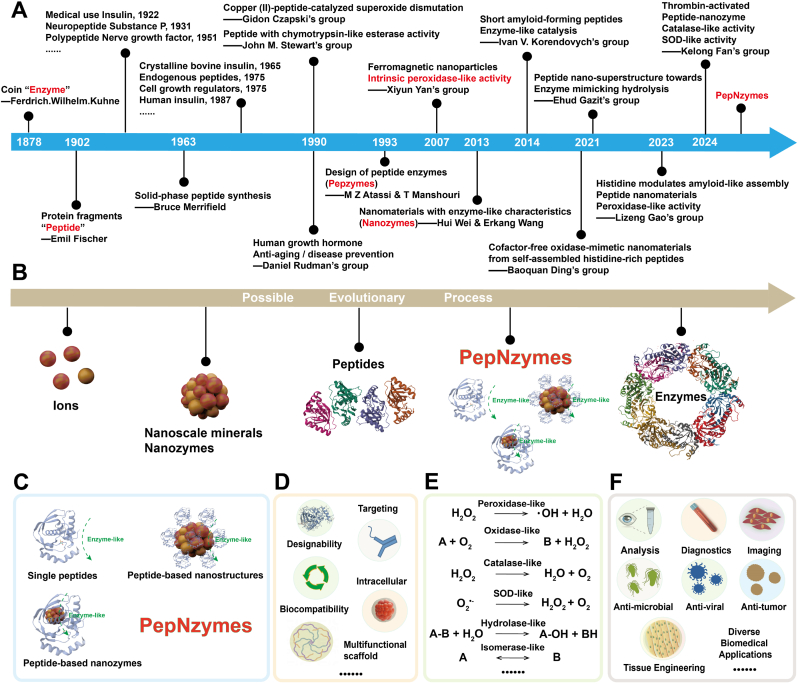
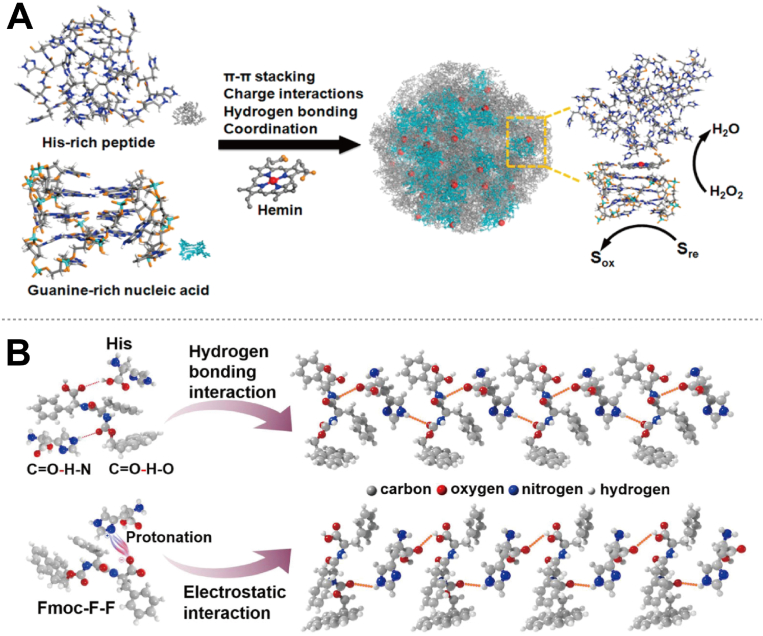
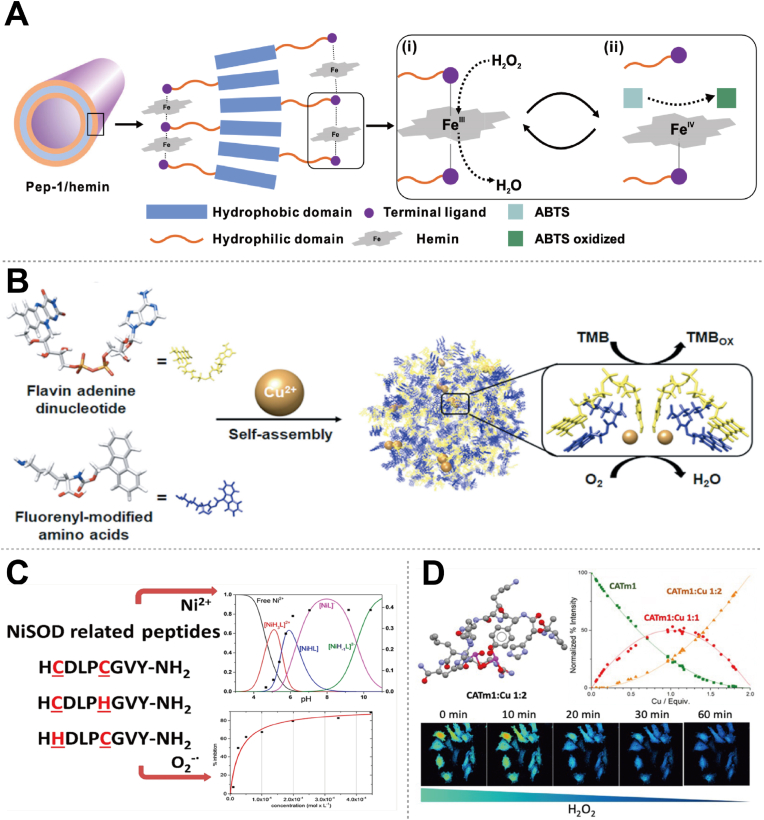
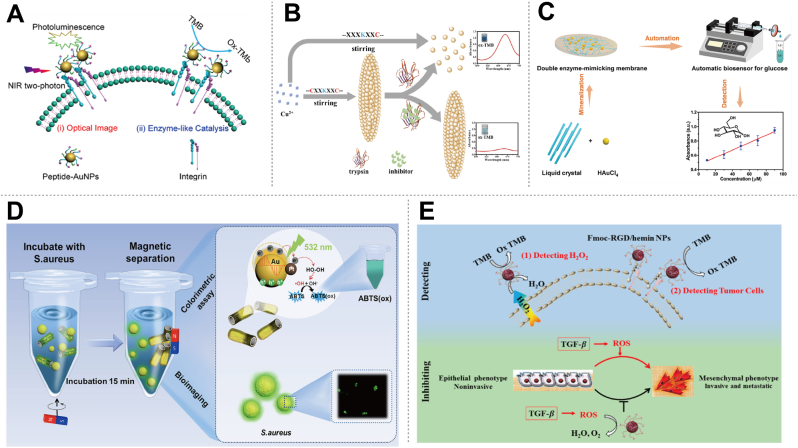
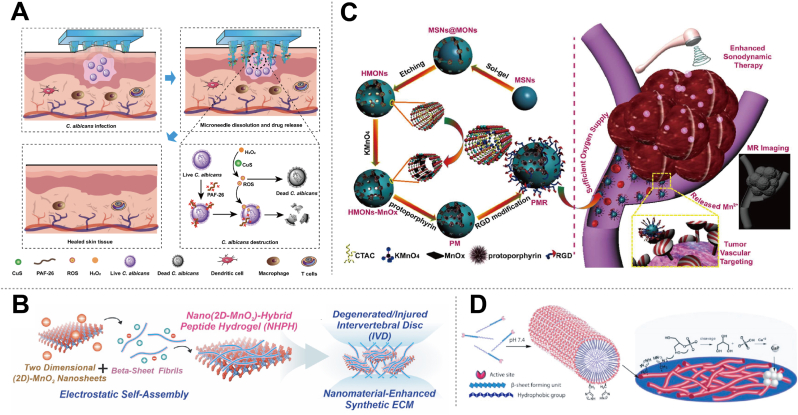
The abundance of molecules on early Earth likely enabled a wide range of prebiotic chemistry, with peptides playing a key role in the development of early life forms and the evolution of metabolic pathways. Among peptides, those with enzyme-like activities occupy a unique position between peptides and enzymes, combining both structural flexibility and catalytic functionality. However, their full potential remains largely untapped. Further exploration of these enzyme-like peptides at the nanoscale could provide valuable insights into modern nanotechnology, biomedicine, and even the origins of life. Hence, this review introduces the groundbreaking concept of "peptide nanozymes (PepNzymes)", which includes single peptides exhibiting enzyme-like activities, peptide-based nanostructures with enzyme-like activities, and peptide-based nanozymes, thus enabling the investigation of biological phenomena at nanoscale dimensions. Through the rational design of enzyme-like peptides or their assembly with nanostructures and nanozymes, researchers have found or created PepNzymes capable of catalyzing a wide range of reactions. By scrutinizing the interactions between the structures and enzyme-like activities of PepNzymes, we have gained valuable insights into the underlying mechanisms governing enzyme-like activities. Generally, PepNzymes play a crucial role in biological processes by facilitating small-scale enzyme-like reactions, speeding up molecular oxidation-reduction, cleavage, and synthesis reactions, leveraging the functional properties of peptides, and creating a stable microenvironment, among other functions. These discoveries make PepNzymes useful for diagnostics, cellular imaging, antimicrobial therapy, tissue engineering, anti-tumor treatments, and more while pointing out opportunities. Overall, this research provides a significant journey of PepNzymes' potential in various biomedical applications, pushing them towards new advancements.
早期地球上丰富的分子可能促成了广泛的前生物化学过程,其中肽在早期生命形式的发展和代谢途径的进化中发挥了关键作用。在肽类中,具有类酶活性的肽在肽和酶之间占据独特地位,兼具结构灵活性和催化功能。然而,它们的全部潜力在很大程度上仍未被挖掘。在纳米尺度上进一步探索这些类酶肽,可为现代纳米技术、生物医学乃至生命起源提供有价值的见解。因此,本综述引入了“肽纳米酶(PepNzymes)”这一开创性概念,它包括具有类酶活性的单个肽、具有类酶活性的基于肽的纳米结构以及基于肽的纳米酶,从而能够在纳米尺度上研究生物现象。通过对类酶肽进行合理设计,或使其与纳米结构和纳米酶组装,研究人员发现或创造出了能够催化多种反应的肽纳米酶。通过仔细研究肽纳米酶的结构与类酶活性之间的相互作用,我们对控制类酶活性的潜在机制有了宝贵的认识。一般来说,肽纳米酶通过促进小规模的类酶反应、加速分子氧化还原、裂解和合成反应、利用肽的功能特性以及创造稳定的微环境等方式,在生物过程中发挥关键作用。这些发现使肽纳米酶在诊断、细胞成像、抗菌治疗、组织工程、抗肿瘤治疗等方面具有应用价值,同时也指出了存在的机遇。总体而言,这项研究为肽纳米酶在各种生物医学应用中的潜力提供了重要进展,推动它们迈向新的高度。