Zahran Samah, Visser Carson, Ross-White Amanda, Janssen Ian
School of Kinesiology and Health Studies, Queen's University, Kingston, ON, Canada.
Health Sciences Library, Queen's University, Kingston, ON, Canada.
J Act Sedentary Sleep Behav. 2023 Feb 1;2(1):1. doi: 10.1186/s44167-022-00012-2.
This systematic review examined if the composition of time spent in sleep, sedentary behaviour, and physical activity of different intensities is associated with health and developmental indicators in children aged 0-5 years.
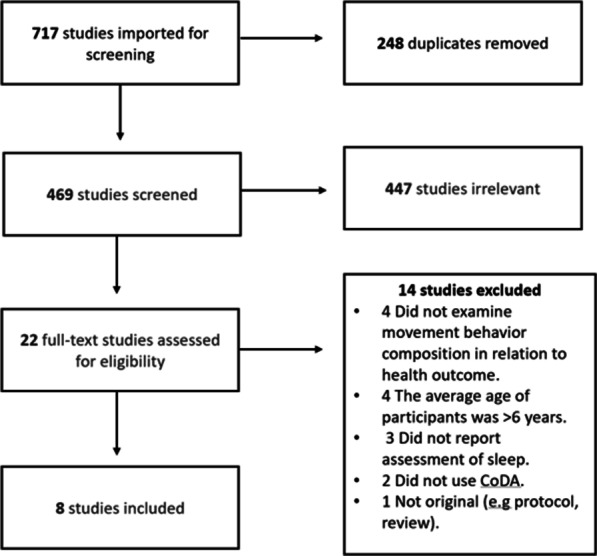
Four electronic databases (MEDLINE, EMBASE, PsycINFO, and SPORTDiscus) were searched in January 2022. Studies were eligible for inclusion if they were peer-reviewed, the average age of participants was < 6 years, and compositional data analysis was used to examine the associations between the composition of time spent in movement behaviours and health and developmental indicators.
Eight studies (7 cross-sectional, 1 prospective cohort) of < 2070 unique participants were included. Only a single study included children < 3 years old and 37% of the associations examined in the literature were based on indicators of body composition. The 24-h movement behaviour composition was associated with mental health indicators (3 of 4 associations examined in the literature), motor skills and development (6 of 7 associations), and physical fitness (3 of 3 associations). Reallocating time from light physical activity into moderate-to-vigorous physical activity was favourable for motor skills and development. Reallocating time from light physical activity into sleep was unfavourable for mental health. Reallocating time from light physical activity into sedentary behaviour or sleep was favourable for motor skills and development.
This review provides some evidence that the composition of movement behaviours is important for the health of young children. Future research should consider including infants and toddlers, larger sample size, and measures of health and development other than body composition. (PROSPERO registration no.: CRD42022298370.).
本系统评价旨在探讨0至5岁儿童睡眠、久坐行为以及不同强度身体活动的时间构成是否与健康和发育指标相关。
2022年1月检索了四个电子数据库(MEDLINE、EMBASE、PsycINFO和SPORTDiscus)。纳入标准为:经过同行评审;参与者平均年龄<6岁;采用成分数据分析来研究运动行为时间构成与健康和发育指标之间的关联。
纳入了8项研究(7项横断面研究,1项前瞻性队列研究),涉及不到2070名独特参与者。只有一项研究纳入了3岁以下儿童,文献中所研究的关联有37%基于身体成分指标。24小时运动行为构成与心理健康指标(文献中研究的4项关联中有3项)、运动技能与发育(7项关联中有6项)以及身体素质(3项关联均有)相关。将轻度身体活动时间重新分配为中度至剧烈身体活动对运动技能与发育有利。将轻度身体活动时间重新分配为睡眠时间对心理健康不利。将轻度身体活动时间重新分配为久坐行为或睡眠时间对运动技能与发育有利。
本综述提供了一些证据,表明运动行为构成对幼儿健康很重要。未来的研究应考虑纳入婴幼儿、更大的样本量以及除身体成分之外的健康和发育测量指标。(国际前瞻性系统评价注册编号:CRD42022298370。)