Degener J E, Heck M E, van Leeuwen W J, Heemskerk C, Crielaard A, Joosten P, Caesar P
Department of Medical Microbiology, Public Health Laboratory, Leeuwarden, The Netherlands.
J Clin Microbiol. 1994 Sep;32(9):2260-5. doi: 10.1128/jcm.32.9.2260-2265.1994.
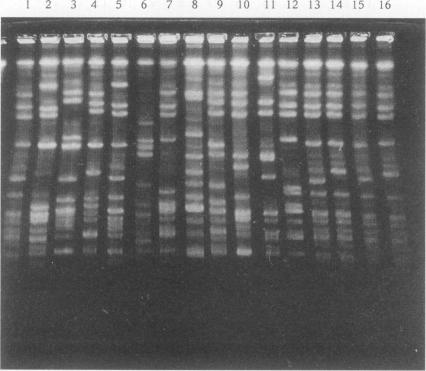
A patient with chronic myelogenous leukemia became colonized with a Staphylococcus haemolyticus strain and experienced a septic episode caused by this strain during a cytostatic course. The strain was multiply resistant to antibiotics; the MIC and MBC of vancomycin were 2 and 4 mg/liter, and the MIC and MBC of teicoplanin were 4 and 16 mg/liter, respectively. We performed a surveillance study on the carriage of S. haemolyticus in medical and nursing staff of the hospital ward where the patient was treated. S. haemolyticus was isolated from 18 sites on 12 of the 39 people tested. A number of typing methods were performed in order to investigate the possible relationships among the isolates. Methods used were immunoblotting of staphylococcal peptides, plasmid analysis, restriction fragment length polymorphism of chromosomal DNA, and pulsed-field gel electrophoresis of total DNA. Compared with the immunoblotting technique, the molecular methods were more discriminative. The strain colonizing the patient showed a consistent pattern by all typing methods during isolation. When the immunoblot technique was used, similar patterns were found with isolates from hospital staff and isolates from unrelated sources. With the molecular techniques, no evidence of a local spread of the patient's strain was found. However, plasmid profiles and restriction fragment length polymorphism and pulsed-field gel electrophoresis patterns showed that S. haemolyticus isolates collected from hospital ward personnel were related, which was not the case with isolates collected from unrelated sources. Restriction fragment length polymorphism analysis was more discriminative when IS431 was used as a DNA probe instead of a probe based on the 16S rRNA gene. S. haemolyticus, as in this case, may develop resistance to vancomycin and teicoplanin. These antibiotics are considered the last-resort drugs for the therapy of nosocomial gram-positive infections. Thus, local spread of staphylococci resistant to these drugs is an important problem, which should be prevented by strict hygienic measures and antibiotic policy.
一名慢性粒细胞白血病患者感染了一株溶血葡萄球菌,并在进行细胞毒性治疗期间因该菌株引发了败血症。该菌株对多种抗生素耐药;万古霉素的 MIC 和 MBC 分别为 2 和 4 毫克/升,替考拉宁的 MIC 和 MBC 分别为 4 和 16 毫克/升。我们对收治该患者的医院病房医护人员携带溶血葡萄球菌的情况进行了监测研究。在 39 名接受检测的人员中,有 12 人在 18 个部位分离出了溶血葡萄球菌。为了研究分离株之间可能的关系,采用了多种分型方法。使用的方法包括葡萄球菌肽的免疫印迹、质粒分析、染色体 DNA 的限制性片段长度多态性分析以及总 DNA 的脉冲场凝胶电泳。与免疫印迹技术相比,分子方法具有更高的鉴别力。在分离期间,定植于患者体内的菌株通过所有分型方法都显示出一致的模式。当使用免疫印迹技术时,在医院工作人员分离株和无关来源分离株中发现了相似的模式。使用分子技术时,未发现患者菌株有局部传播的证据。然而,质粒图谱、限制性片段长度多态性和脉冲场凝胶电泳图谱显示,从医院病房人员分离出的溶血葡萄球菌分离株之间存在相关性,而从无关来源分离出的菌株并非如此。当使用 IS431 作为 DNA 探针而非基于 16S rRNA 基因的探针时,限制性片段长度多态性分析具有更高的鉴别力。如本例所示,溶血葡萄球菌可能对万古霉素和替考拉宁产生耐药性。这些抗生素被认为是治疗医院内革兰氏阳性菌感染的最后手段药物。因此,对这些药物耐药的葡萄球菌的局部传播是一个重要问题,应通过严格的卫生措施和抗生素政策加以预防。