Kobayashi N, McEntee K
Department of Biological Chemistry, University of California Los Angeles, School of Medicine 90024.
Mol Cell Biol. 1993 Jan;13(1):248-56. doi: 10.1128/mcb.13.1.248-256.1993.
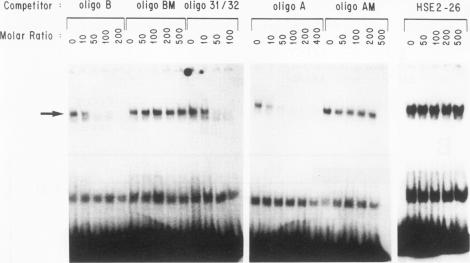
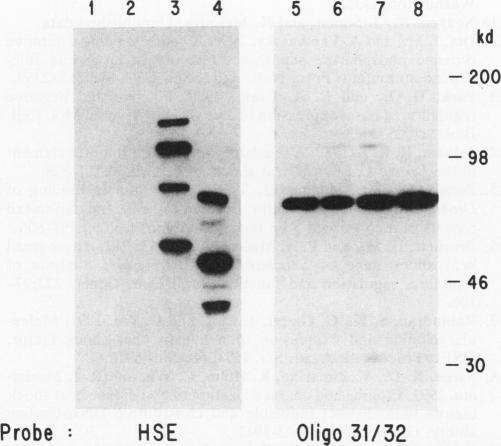
The stress-responsive DDR2 gene (previously called DDRA2) of Saccharomyces cerevisiae is transcribed at elevated levels following stress caused by heat shock or DNA damage. Previously, we identified a 51-bp promoter fragment, oligo31/32, which conferred heat shock inducibility on the heterologous CYC1-lacZ reporter gene in S. cerevisiae (N. Kobayashi and K. McEntee, Proc. Natl. Acad. Sci. USA 87:6550-6554, 1990). Using a series of synthetic oligonucleotides, we have identified a pentanucleotide, CCCCT (C4T), as an essential component of this stress response sequence. This element is not a binding site for the well-characterized heat shock transcription factor which recognizes a distinct cis-acting heat shock element in the promoters of many heat shock genes. Here we demonstrate the ability of oligonucleotides containing the C4T sequence to confer heat shock inducibility on the reporter gene and show that the presence of two such elements produces more than additive effects on induction. Gel retardation experiments have been used to demonstrate specific complex formation between C4T-containing fragments and one or more yeast proteins. Formation of these complexes was not competed by fragments containing mutations in the C4T sequence nor by heat shock element-containing competitor DNAs. Fragments containing the C4T element bound to a single 140-kDa polypeptide, distinct from heat shock transcription factors in yeast crude extracts. These experiments identify key cis- and trans-acting components of a novel heat shock stress response pathway in S. cerevisiae.
酿酒酵母的应激反应性DDR2基因(以前称为DDRA2)在热休克或DNA损伤引起的应激后转录水平升高。此前,我们鉴定出一个51bp的启动子片段oligo31/32,它赋予酿酒酵母中异源CYC1-lacZ报告基因热休克诱导性(N. 小林和K. 麦肯蒂,《美国国家科学院院刊》87:6550 - 6554,1990)。使用一系列合成寡核苷酸,我们确定了一个五核苷酸CCCCT(C4T)作为该应激反应序列的一个必需成分。这个元件不是已充分表征的热休克转录因子的结合位点,该转录因子识别许多热休克基因启动子中一个不同的顺式作用热休克元件。在这里,我们证明了含有C4T序列的寡核苷酸赋予报告基因热休克诱导性的能力,并表明两个这样的元件的存在对诱导产生的效应大于相加效应。凝胶阻滞实验已用于证明含C4T的片段与一种或多种酵母蛋白之间形成特异性复合物。这些复合物的形成既不被C4T序列中含有突变的片段竞争,也不被含热休克元件的竞争DNA竞争。含有C4T元件的片段与一种单一的140kDa多肽结合,该多肽不同于酵母粗提物中的热休克转录因子。这些实验确定了酿酒酵母中一条新型热休克应激反应途径的关键顺式和反式作用成分。