Song Joon Young, Chun Byung Chul, Kim Soon Duck, Baek Luck Ju, Kim Sang-Hoon, Sohn Jang Wook, Cheong Hee Jin, Kim Woo Joo, Park Seung Chul, Kim Min Ja
Division of Infectious Diseases, Korea University, College of Medicine, Seongbuk-gu, Seoul, Korea.
J Korean Med Sci. 2006 Aug;21(4):614-20. doi: 10.3346/jkms.2006.21.4.614.
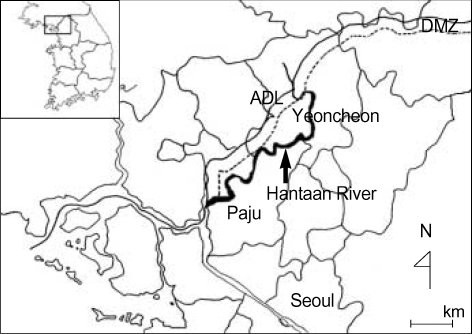
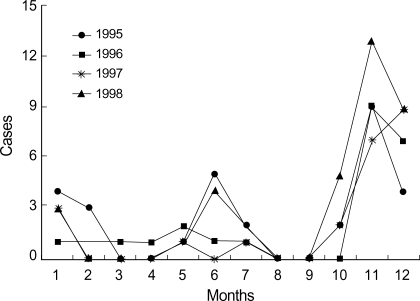
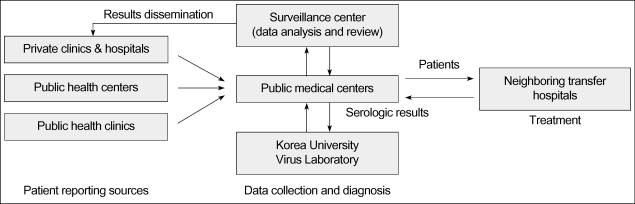
We conducted an epidemiologic study to understand temporal and spatial patterns of hemorrhagic fever with renal syndrome (HFRS) in the Republic of Korea (ROK). We estimated the incidence among civilians in endemic areas through the active surveillance system during the major epidemic periods, from September to December, between 1996 and 1998. We also estimated the prevalence among Korean military personnel from 1995 to 1998. In addition, we assessed seroprevalence, subclinical infection rate, and vaccination rates in both civilians and military personnel. The incidence in civilians ranged from 2.1 to 6.6 per 100, 000 person-months. The annual prevalence in the military personnel was 40-64 per 100, 000 military populations, and remained generally constant throughout the study period with seasonal variation. This is the prospective epidemiologic data set on HFRS in the ROK since the inactivated Hantaan virus vaccine was licensed for use in the late 1990s. These results will be invaluable in establishing a national immunization program against HFRS.
我们开展了一项流行病学研究,以了解韩国肾综合征出血热(HFRS)的时间和空间分布模式。我们通过主动监测系统,对1996年至1998年9月至12月主要流行期间疫区平民的发病率进行了估算。我们还估算了1995年至1998年韩国军人的患病率。此外,我们评估了平民和军人的血清阳性率、亚临床感染率和疫苗接种率。平民的发病率为每10万人月2.1至6.6例。军人的年患病率为每10万军人40 - 64例,在整个研究期间总体保持稳定,但存在季节性变化。这是自20世纪90年代末灭活汉坦病毒疫苗获批使用以来,韩国关于HFRS的前瞻性流行病学数据集。这些结果对于建立全国性的HFRS免疫规划将具有极高的价值。