Department of Genetics, Forestry and Agricultural Biotechnology Institute (FABI), University of Pretoria, Pretoria, 0002, South Africa.
Stud Mycol. 2006;55:75-97. doi: 10.3114/sim.55.1.75.
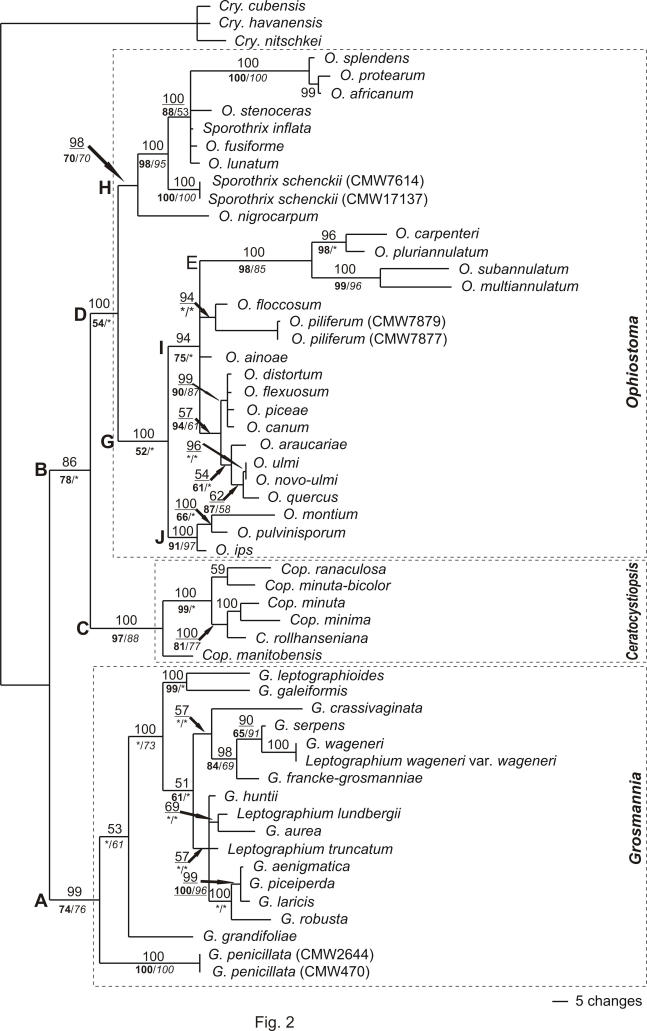
Ophiostoma species have diverse morphological features and are found in a large variety of ecological niches. Many different classification schemes have been applied to these fungi in the past based on teleomorph and anamorph features. More recently, studies based on DNA sequence comparisions have shown that Ophiostoma consists of different phylogenetic groups, but the data have not been sufficient to define clear monophyletic lineages represented by practical taxonomic units. We used DNA sequence data from combined partial nuclear LSU and beta-tubulin genes to consider the phylogenetic relationships of 50 Ophiostoma species, representing all the major morphological groups in the genus. Our data showed three well-supported, monophyletic lineages in Ophiostoma. Species with Leptographium anamorphs grouped together and to accommodate these species the teleomorph-genus Grosmannia (type species G. penicillata), including 27 species and 24 new combinations, is re-instated. Another well-defined lineage includes species that are cycloheximide-sensitive with short perithecial necks, falcate ascospores and Hyalorhinocladiella anamorphs. For these species, the teleomorph-genus Ceratocystiopsis (type species O. minuta), including 11 species and three new combinations, is re-instated. A third group of species with either Sporothrix or Pesotum anamorphs includes species from various ecological niches such as Protea infructescences in South Africa. This group also includes O. piliferum, the type species of Ophiostoma, and these species are retained in that genus. Ophiostoma is redefined to reflect the changes resulting from new combinations in Grosmannia and Ceratocystiopsis. Our data have revealed additional lineages in Ophiostoma linked to morphological characters. However, these species are retained in Ophiostoma until further data for a larger number of species can be obtained to confirm monophyly of the apparent lineages.
奥氏蜜环菌的种类具有多样化的形态特征,存在于多种生态小生境中。过去,根据有性型和无性型特征,曾应用多种不同的分类方案对这些真菌进行分类。最近,基于 DNA 序列比较的研究表明,奥氏蜜环菌由不同的系统发育群组成,但这些数据还不足以定义由实际分类单位代表的明确单系谱系。我们使用来自核 LSU 和β-微管蛋白基因的组合部分 DNA 序列数据,来考虑 50 种奥氏蜜环菌的系统发育关系,这些种代表了该属中的主要形态群。我们的数据显示,奥氏蜜环菌有三个得到很好支持的单系谱系。具有 Leptographium 无性型的种聚为一组,为了容纳这些种,将有性型属 Grosmannia(模式种 G. penicillata),包括 27 个种和 24 个新组合,重新设立。另一个明确界定的谱系包括对环己酰亚胺敏感、具有短的子囊壳颈、镰刀形子囊孢子和 Hyalorhinocladiella 无性型的种。对于这些种,将有性型属 Ceratocystiopsis(模式种 O. minuta),包括 11 个种和三个新组合,重新设立。第三个具有 Sporothrix 或 Pesotum 无性型的种的群组包括来自各种生态小生境的种,如南非的 Protea 花序。该组还包括 O. piliferum,它是奥氏蜜环菌的模式种,这些种保留在该属中。奥氏蜜环菌被重新定义,以反映 Grosmannia 和 Ceratocystiopsis 中新组合产生的变化。我们的数据揭示了奥氏蜜环菌中与形态特征相关的其他谱系。然而,在获得更多种的更大数据以确认明显谱系的单系性之前,这些种保留在奥氏蜜环菌中。