Pandya Shruti, Chaudhary Ajay Kumar, Singh Mamta, Singh Mangal, Mehrotra Ravi
Department of Pathology, Moti Lal Nehru Medical College, Allahabad, India.
Head Neck Oncol. 2009 May 2;1:10. doi: 10.1186/1758-3284-1-10.
Oral submucous fibrosis is a common oral health problem in India. This study was conducted to correlate the histopathological diagnosis with habits and clinical findings in patients suffering from oral submucous fibrosis (OSF).
Patients suffering from oral submucous fibrosis from the Departments of Otorhinolaryngology and Pathology, Moti Lal Nehru Medical College, Allahabad, India were studied from 2004-2008. Detailed information was gathered in a pretested proforma. Emphasis was given to the various addictions, clinical findings and histological examination was done.
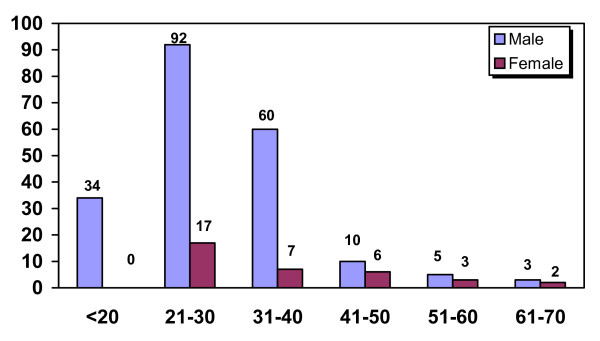
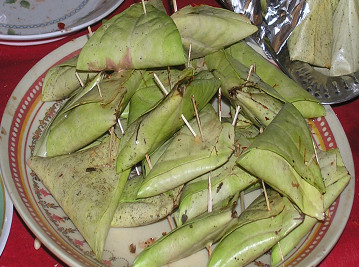
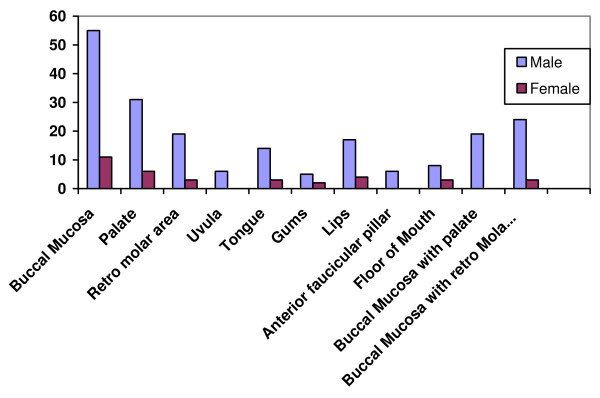
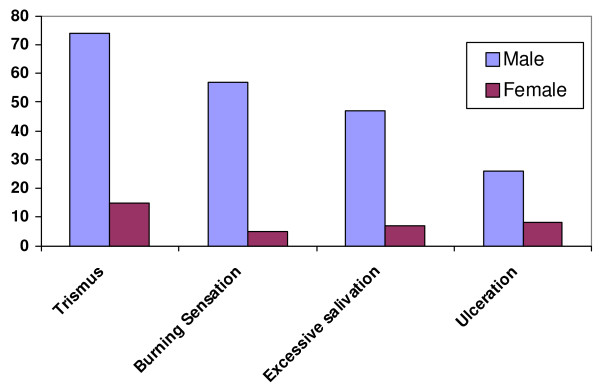
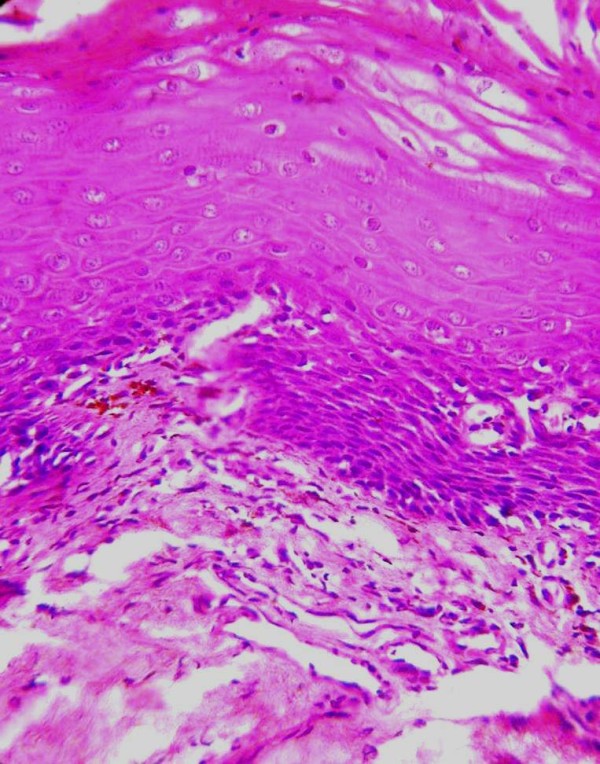
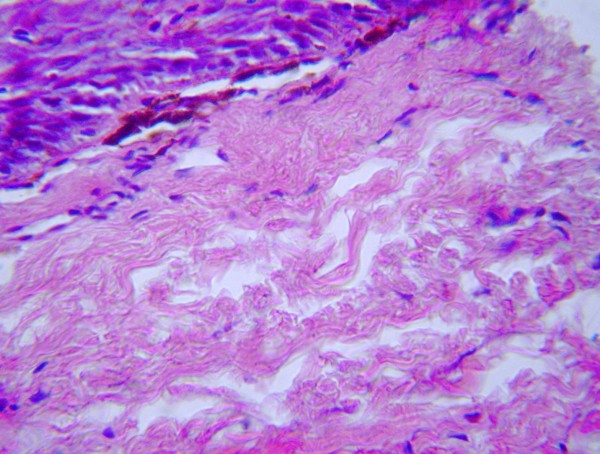
Two hundred and thirty nine patients were studied, yielding a male to female ratio of 6.8:1. Maximum patients were in the 21-30 years age group with a marked male predominance. Of these, 197 (82.4%) patients chewed areca nut/dohra, 14 (5.8%) were smokers and 2 (0.8%) patients were habituated to alcohol. 89 (37.2%) patients reported difficulty in opening of the mouth (trismus). 51 (57.4%) patients were found to have stage II (2-3 cm) trismus while rest had stage I and III. The buccal mucosa was found to be the most commonly involved site. On the basis of histopathological examination, 52 (21.7%) were classified as OSF grade I, 75 (31.3%) patients as grade II and 112 (46.8%) had grade III disease.
The widespread habit of chewing dohra/paan masala is a major risk factor of OSF, especially in the younger age group. In this study, an increase in histopathological grading was found with severity and duration of addiction habit. However no significant correlation was found between clinical staging and histopathological grading.
口腔黏膜下纤维化是印度常见的口腔健康问题。本研究旨在探讨口腔黏膜下纤维化(OSF)患者的组织病理学诊断与习惯和临床发现之间的相关性。
对印度阿拉哈巴德莫蒂拉尔·尼赫鲁医学院耳鼻喉科和病理科的口腔黏膜下纤维化患者进行了2004年至2008年的研究。通过预先测试的表格收集详细信息。重点关注各种成瘾情况、临床发现并进行组织学检查。
共研究了239例患者,男女比例为6.8:1。最大患者群体在21 - 30岁年龄组,男性占明显优势。其中,197例(82.4%)患者咀嚼槟榔/多赫拉,14例(5.8%)为吸烟者,2例(0.8%)患者有饮酒习惯。89例(37.2%)患者报告张口困难(牙关紧闭)。51例(57.4%)患者牙关紧闭程度为II期(2 - 3厘米),其余为I期和III期。颊黏膜是最常受累的部位。根据组织病理学检查,52例(21.7%)被分类为OSF I级,75例(31.3%)患者为II级,112例(46.8%)患有III级疾病。
咀嚼多赫拉/槟榔玛萨拉的广泛习惯是OSF的主要危险因素,尤其是在年轻年龄组。在本研究中,发现组织病理学分级随着成瘾习惯的严重程度和持续时间增加。然而,临床分期与组织病理学分级之间未发现显著相关性。