Metapopulation Research Group, Department of Biosciences, University of Helsinki, , PO Box 65, 00014 Helsinki, Finland.
Philos Trans R Soc Lond B Biol Sci. 2011 Sep 27;366(1578):2661-9. doi: 10.1098/rstb.2011.0114.
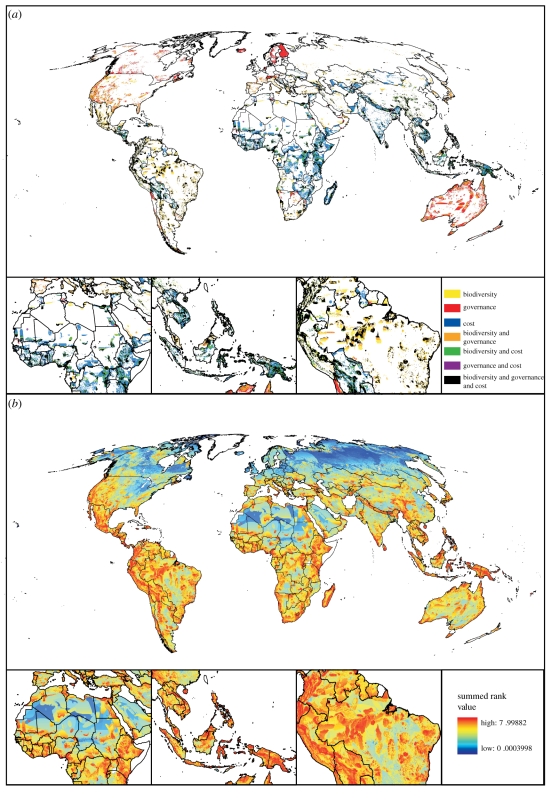
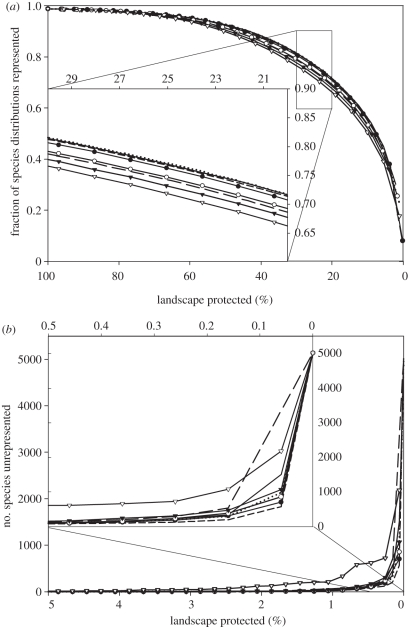
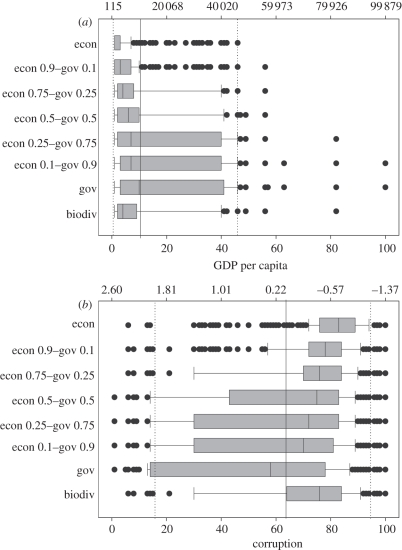
Global conservation priorities have often been identified based on the combination of species richness and threat information. With the development of the field of systematic conservation planning, more attention has been given to conservation costs. This leads to prioritizing developing countries, where costs are generally low and biodiversity is high. But many of these countries have poor governance, which may result in ineffective conservation or in larger costs than initially expected. We explore how the consideration of governance affects the selection of global conservation priorities for the world's mammals in a complementarity-based conservation prioritization. We use data on Control of Corruption (Worldwide Governance Indicators project) as an indicator of governance effectiveness, and gross domestic product per capita as an indicator of cost. We show that, while core areas with high levels of endemism are always selected as important regardless of governance and cost values, there are clear regional differences in selected sites when biodiversity, cost or governance are taken into account separately. Overall, the analysis supports the concentration of conservation efforts in most of the regions generally considered of high priority, but stresses the need for different conservation approaches in different continents owing to spatial patterns of governance and economic development.
全球保护重点通常是根据物种丰富度和威胁信息的组合来确定的。随着系统保护规划领域的发展,人们越来越关注保护成本。这导致了发展中国家的优先级更高,因为这些国家的成本通常较低,生物多样性较高。但是,许多发展中国家的治理不善,这可能导致保护效果不佳,或者成本超出最初预期。我们探讨了在基于互补性的保护优先级制定中,考虑治理如何影响全球哺乳动物保护重点的选择。我们使用腐败控制数据(世界治理指标项目)作为治理有效性的指标,以及人均国内生产总值作为成本的指标。我们表明,尽管无论治理和成本值如何,具有高特有物种水平的核心区域总是被选为重要区域,但当分别考虑生物多样性、成本或治理时,选定区域存在明显的区域差异。总体而言,该分析支持将保护工作集中在大多数通常被认为是高度优先的区域,但由于治理和经济发展的空间模式,强调需要在不同的大陆采取不同的保护方法。