Hofer Heidi, Sredar Nripun, Queener Hope, Li Chaohong, Porter Jason
College of Optometry, University of Houston, Houston Texas 77204, USA.
Opt Express. 2011 Jul 18;19(15):14160-71. doi: 10.1364/OE.19.014160.
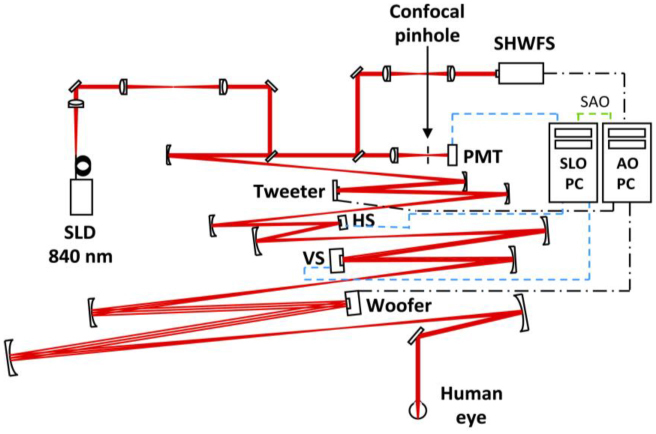
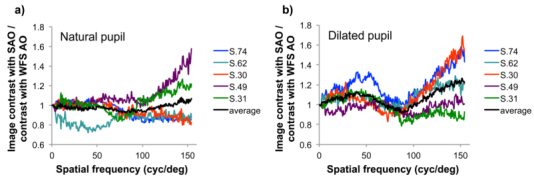
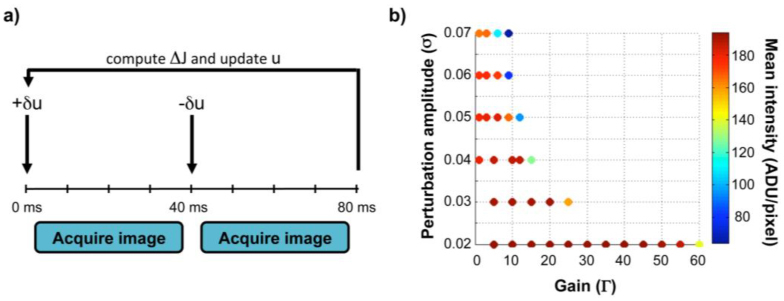
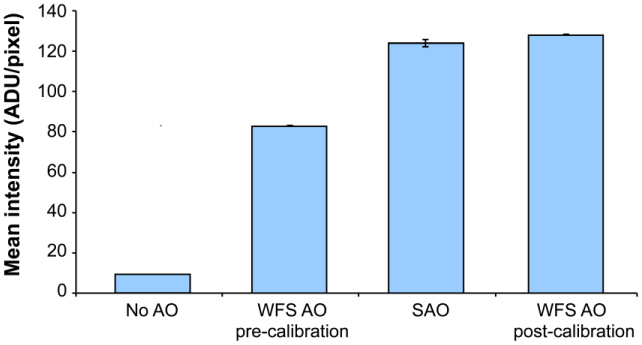
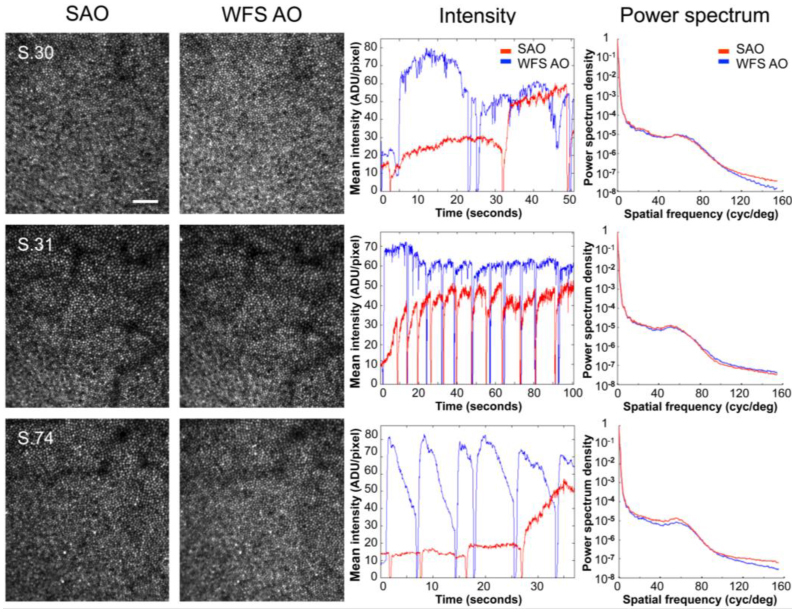
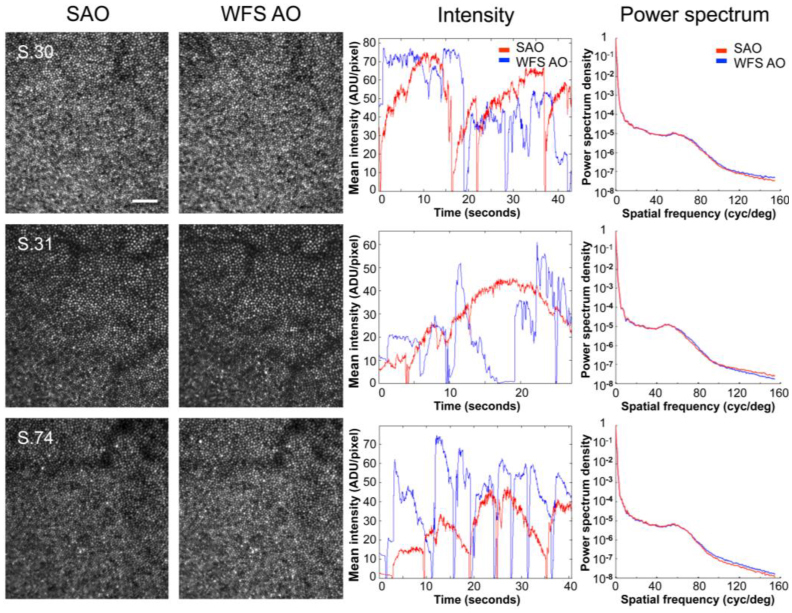
Wavefront sensor noise and fidelity place a fundamental limit on achievable image quality in current adaptive optics ophthalmoscopes. Additionally, the wavefront sensor 'beacon' can interfere with visual experiments. We demonstrate real-time (25 Hz), wavefront sensorless adaptive optics imaging in the living human eye with image quality rivaling that of wavefront sensor based control in the same system. A stochastic parallel gradient descent algorithm directly optimized the mean intensity in retinal image frames acquired with a confocal adaptive optics scanning laser ophthalmoscope (AOSLO). When imaging through natural, undilated pupils, both control methods resulted in comparable mean image intensities. However, when imaging through dilated pupils, image intensity was generally higher following wavefront sensor-based control. Despite the typically reduced intensity, image contrast was higher, on average, with sensorless control. Wavefront sensorless control is a viable option for imaging the living human eye and future refinements of this technique may result in even greater optical gains.
波前传感器的噪声和保真度对当前自适应光学检眼镜可实现的图像质量构成了基本限制。此外,波前传感器“信标”会干扰视觉实验。我们展示了在活体人眼中的实时(25赫兹)、无波前传感器的自适应光学成像,其图像质量可与同一系统中基于波前传感器的控制相媲美。一种随机并行梯度下降算法直接优化了使用共焦自适应光学扫描激光检眼镜(AOSLO)采集的视网膜图像帧中的平均强度。当通过自然、未散瞳的瞳孔进行成像时,两种控制方法产生的平均图像强度相当。然而,当通过散瞳的瞳孔进行成像时,基于波前传感器的控制之后图像强度通常更高。尽管强度通常降低,但无传感器控制的图像对比度平均更高。无波前传感器控制是对活体人眼进行成像的一种可行选择,并且该技术未来的改进可能会带来更大的光学增益。