Laboratory of Entomology, Department of Zoology, Jahangirnagar University, Savar, Dhaka, Bangladesh.
Parasit Vectors. 2012 Feb 15;5:39. doi: 10.1186/1756-3305-5-39.
Blood-feeding patterns of mosquitoes are crucial for incriminating malaria vectors. However, little information is available on the host preferences of Anopheles mosquitoes in Bangladesh. Therefore, the objective of the present study was to determine the hematophagic tendencies of the anophelines inhabiting a malaria-endemic area of Bangladesh.
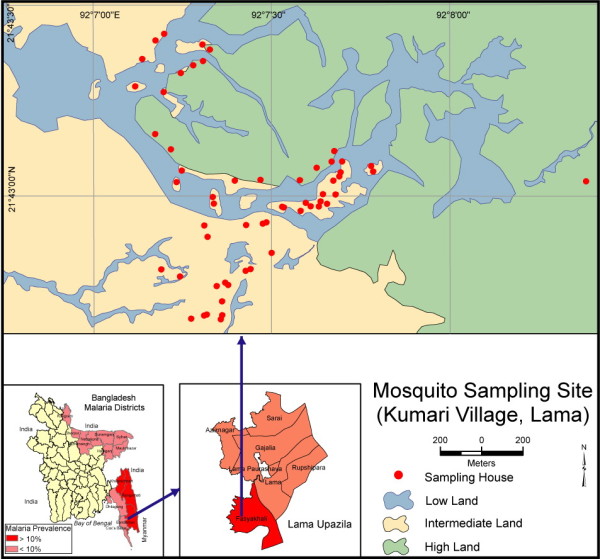
Adult Anopheles mosquitoes were collected using light traps (LTs), pyrethrum spray (PS), and human bait (HB) from a malaria-endemic village (Kumari, Bandarban, Bangladesh) during the peak months of malaria transmission (August-September). Enzyme-linked immunosorbent assay (ELISA) and polymerase chain reaction (PCR) were performed to identify the host blood meals of Anopheles mosquitoes.
In total, 2456 female anopheline mosquitoes representing 21 species were collected from the study area. Anopheles vagus Doenitz (35.71%) was the dominant species followed by An. philippinensis Ludlow (26.67%) and An. minimus s.l. Theobald (5.78%). All species were collected by LTs set indoors (n = 1094), 19 species were from outdoors (n = 784), whereas, six by PS (n = 549) and four species by HB (n = 29). Anopheline species composition significantly differed between every possible combination of the three collection methods (χ(2) test, P < 0.001). Host blood meals were successfully detected from 1318 (53.66%) Anopheles samples belonging to 17 species. Values of the human blood index (HBI) of anophelines collected from indoors and outdoors were 6.96% and 11.73%, respectively. The highest values of HBI were found in An. baimai Baimaii (80%), followed by An. minimus s.l. (43.64%) and An. annularis Van den Wulp (37.50%). Anopheles baimai (B(i) = 0.63) and An. minimus s.l. (B(i) = 0.24) showed strong relative preferences (B(i)) for humans among all hosts (human, bovine, goats/sheep, and others). Anopheles annularis, An. maculatus s.l. Theobald, and An. pallidus Theobald exhibited opportunistic blood-feeding behavior, in that they fed on either humans or animals, depending on whichever was accessible. The remaining 12 species preferred bovines as hosts.
The observed high anthropophilic nature of An. baimai, An. minimus s.l., and An. annularis revealed these species to be important malaria vectors in hilly areas of Bangladesh. Higher values of HBI in outdoor-resting mosquitoes indicated that indoor collection alone is not adequate for evaluating malaria transmission in the area.
蚊子的吸血模式对于疟疾病媒的定罪至关重要。然而,关于孟加拉国疟疾病媒的按蚊宿主偏好的信息很少。因此,本研究的目的是确定孟加拉国一个疟疾流行地区栖息的按蚊的嗜血性。
在疟疾传播高峰期(8 月至 9 月),使用灯诱(LT)、除虫菊喷雾(PS)和人诱饵(HB)从一个疟疾流行的村庄(班达班的库马里,孟加拉国)收集成年按蚊。酶联免疫吸附试验(ELISA)和聚合酶链反应(PCR)用于鉴定按蚊的宿主血液餐。
共收集了来自研究区域的 2456 只雌性按蚊,代表 21 个种。占优势的物种是淡色库蚊(Doenitz)(35.71%),其次是菲律宾按蚊(Ludlow)(26.67%)和微小按蚊复合体(Theobald)(5.78%)。所有物种均由室内设置的 LT 收集(n=1094),19 种来自室外(n=784),6 种由 PS 收集(n=549),4 种由 HB 收集(n=29)。按蚊种类组成在三种采集方法的每一种可能组合之间均存在显著差异(χ²检验,P<0.001)。成功从 17 种属的 1318 只(53.66%)按蚊样本中检测到宿主血液餐。室内和室外采集的按蚊的人血指数(HBI)分别为 6.96%和 11.73%。最高的 HBI 值见于嗜人按蚊(Baimaii)(80%),其次是微小按蚊复合体(43.64%)和喜山库蚊(Van den Wulp)(37.50%)。嗜人按蚊(B(i)=0.63)和微小按蚊复合体(B(i)=0.24)对人类表现出强烈的相对偏好(B(i)),而所有宿主(人类、牛、山羊/绵羊和其他)中,这两种按蚊都是首选。喜山库蚊、淡色库蚊复合体和苍白库蚊表现出机会性吸血行为,它们会根据可获得性,选择人类或动物作为血液来源。其余 12 种物种更喜欢牛作为宿主。
观察到嗜人按蚊、微小按蚊复合体和喜山库蚊的高度嗜人特性,表明这些物种是孟加拉国丘陵地区重要的疟疾媒介。户外栖息的按蚊中较高的 HBI 值表明,仅进行室内采集不足以评估该地区的疟疾传播。