IRCCyN (Institut de Recherche en Communication et en Cybernétique de Nantes), LUNAM Université and CNRS, Nantes, France.
PLoS One. 2012;7(8):e43858. doi: 10.1371/journal.pone.0043858. Epub 2012 Aug 22.
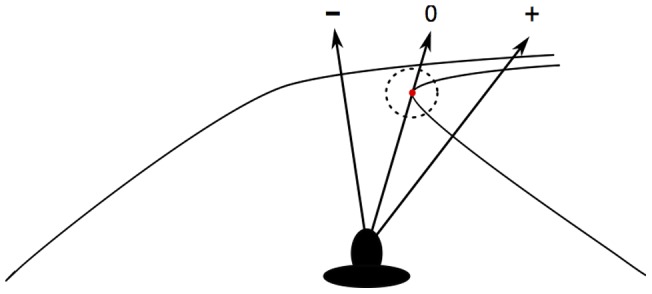
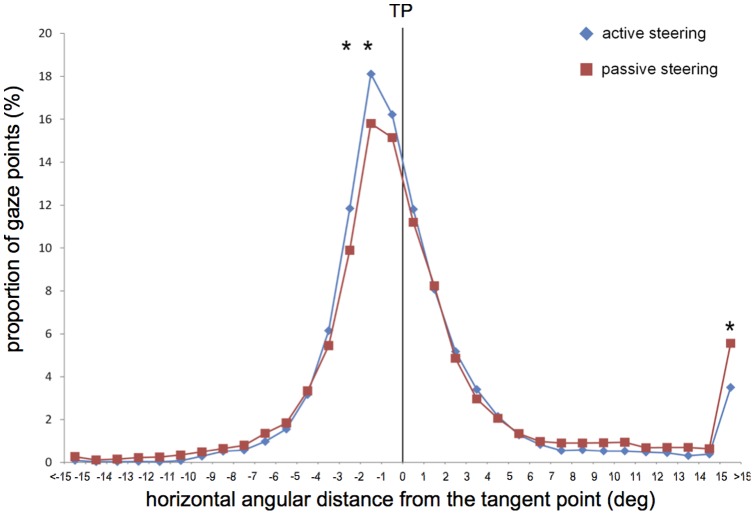
Current theories on the role of visuomotor coordination in driving agree that active sampling of the road by the driver informs the arm-motor system in charge of performing actions on the steering wheel. Still under debate, however, is the nature of visual cues and gaze strategies used by drivers. In particular, the tangent point hypothesis, which states that drivers look at a specific point on the inside edge line, has recently become the object of controversy. An alternative hypothesis proposes that drivers orient gaze toward the desired future path, which happens to be often situated in the vicinity of the tangent point. The present study contributed to this debate through the analyses of the distribution of gaze orientation with respect to the tangent point. The results revealed that drivers sampled the roadway in the close vicinity of the tangent point rather than the tangent point proper. This supports the idea that drivers look at the boundary of a safe trajectory envelop near the inside edge line. Furthermore, the study investigated for the first time the reciprocal influence of manual control on gaze control in the context of driving. This was achieved through the comparison of gaze behavior when drivers actively steered the vehicle or when steering was performed by an automatic controller. The results showed an increase in look-ahead fixations in the direction of the bend exit and a small but consistent reduction in the time spent looking in the area of the tangent point when steering was passive. This may be the consequence of a change in the balance between cognitive and sensorimotor anticipatory gaze strategies. It might also reflect bidirectional coordination control between the eye and arm-motor systems, which goes beyond the common assumption that the eyes lead the hands when driving.
当前关于视动协调在驾驶中的作用的理论认为,驾驶员主动观察道路情况会向负责操纵方向盘的手臂运动系统提供信息。然而,驾驶员使用的视觉线索和注视策略的性质仍存在争议。特别是,最近有一个切线点假说引起了争议,该假说指出驾驶员会注视内边缘线的一个特定点。另一个假说则提出,驾驶员的注视方向会朝向期望的未来路径,而这个路径往往位于切线点附近。本研究通过分析注视方向相对于切线点的分布,对这一争论做出了贡献。结果表明,驾驶员在靠近切线点的地方观察道路,而不是直接注视切线点。这支持了驾驶员观察内边缘线附近安全轨迹边界的观点。此外,该研究首次研究了在驾驶环境中手动控制对视动控制的反向影响。这是通过比较驾驶员主动驾驶车辆和自动控制器执行转向时的注视行为来实现的。结果显示,在弯道出口方向上的前视注视增加,而当转向是被动时,在切线点区域的注视时间略有减少。这可能是认知和运动感觉预测性注视策略之间平衡变化的结果。它也可能反映了眼睛和手臂运动系统之间的双向协调控制,这超出了眼睛在驾驶时领先于手的常见假设。