Companhia Ambiental do Estado de São Paulo , Sao Paulo, SP , Brasil.
Braz J Microbiol. 2012 Apr;43(2):675-81. doi: 10.1590/S1517-83822012000200032. Epub 2012 Jun 1.
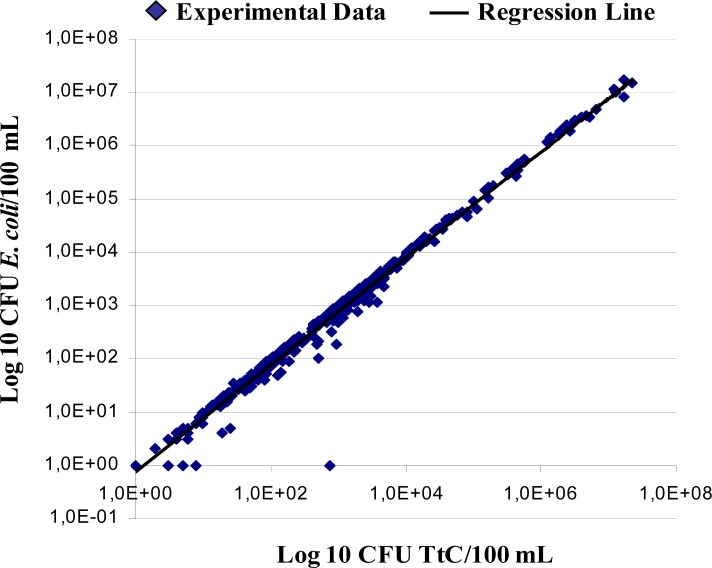
Fecal bacterial indicator analyses have been widely used for monitoring the water quality. This study was designed to determine the ratio between the density of Escherichia coli and other Thermotolerant Coliforms (TtC) bacteria from freshwater samples collected for a two-year period of monitoring. TtC were enumerated by membrane filtration on mFC agar. E. coli enumeration was done by two methods: TtC colonies identified in mFC were inoculated in EC-MUG or water samples were filtered and inoculated in modified mTEC agar media, and both methods were compared for quantitative recovery of E. coli. The results pointed out a mean percentage of E. coli among other thermotolerant coliforms (E. coli/TtC ratio) of 84.3% in mFC media. Taking these results into account, a mandatory standard of 1000 thermotolerant coliforms would correspond to 800 E. coli and the adoption of these E. coli based standards will represent a major improvement for the monitoring of freshwater quality.
粪便细菌指标分析已广泛应用于水质监测。本研究旨在确定在为期两年的监测期间从淡水样本中收集的大肠杆菌和其他耐热大肠菌群(TtC)细菌密度之间的比例。TtC 通过 mFC 琼脂上的膜过滤进行计数。大肠杆菌的计数通过两种方法进行:在 mFC 中鉴定的 TtC 菌落接种于 EC-MUG 或过滤水样并接种于改良的 mTEC 琼脂培养基中,比较两种方法对大肠杆菌的定量回收。结果表明,在 mFC 培养基中,其他耐热大肠菌群(大肠杆菌/TtC 比值)中大肠杆菌的平均百分比为 84.3%。考虑到这些结果,1000 个耐热大肠菌群的强制标准将相当于 800 个大肠杆菌,采用这些基于大肠杆菌的标准将代表对淡水质量监测的重大改进。