Bleakley Chris M, Bieuzen François, Davison Gareth W, Costello Joseph T
Sport and Exercise Science Research Institute, Faculty of Life and Health Sciences, University of Ulster, Newtownabbey, Northern Ireland.
Research Department, Laboratory of Sport, Expertise and Performance, French National Institute of Sport (INSEP), Paris, France.
Open Access J Sports Med. 2014 Mar 10;5:25-36. doi: 10.2147/OAJSM.S41655. eCollection 2014.
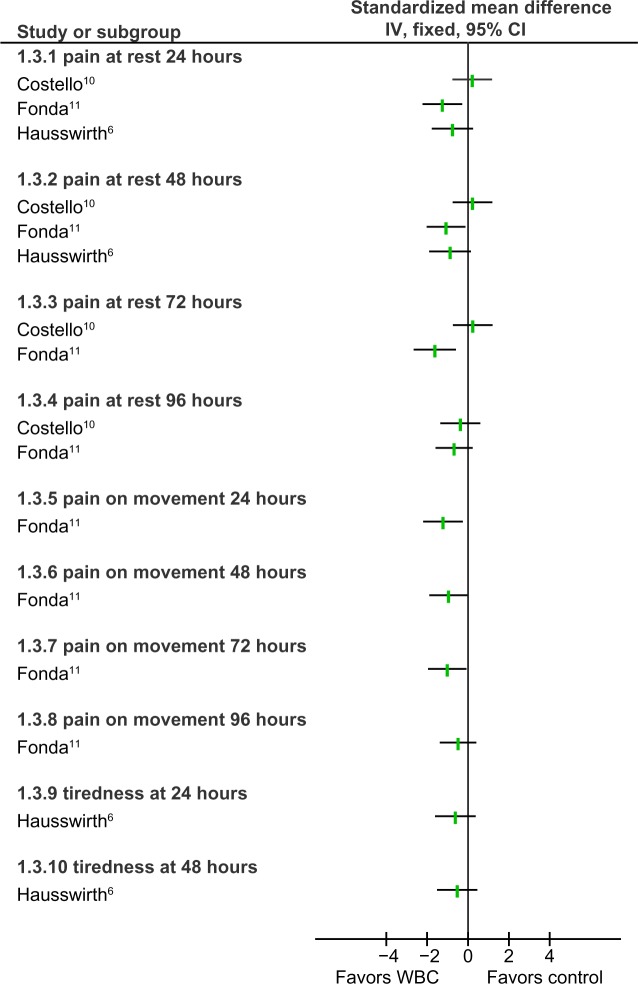
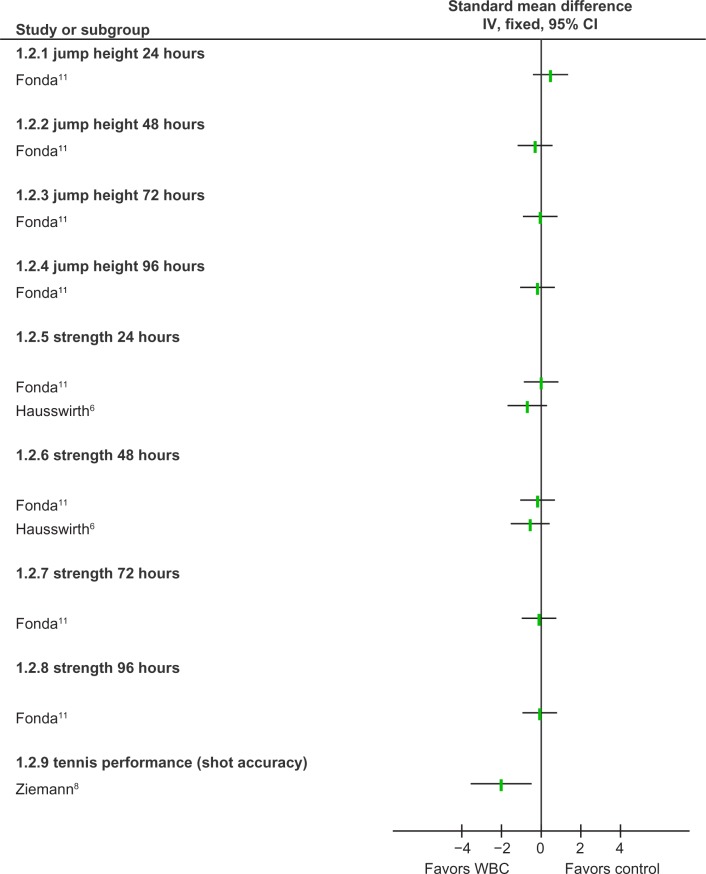
Whole-body cryotherapy (WBC) involves short exposures to air temperatures below -100°C. WBC is increasingly accessible to athletes, and is purported to enhance recovery after exercise and facilitate rehabilitation postinjury. Our objective was to review the efficacy and effectiveness of WBC using empirical evidence from controlled trials. We found ten relevant reports; the majority were based on small numbers of active athletes aged less than 35 years. Although WBC produces a large temperature gradient for tissue cooling, the relatively poor thermal conductivity of air prevents significant subcutaneous and core body cooling. There is weak evidence from controlled studies that WBC enhances antioxidant capacity and parasympathetic reactivation, and alters inflammatory pathways relevant to sports recovery. A series of small randomized studies found WBC offers improvements in subjective recovery and muscle soreness following metabolic or mechanical overload, but little benefit towards functional recovery. There is evidence from one study only that WBC may assist rehabilitation for adhesive capsulitis of the shoulder. There were no adverse events associated with WBC; however, studies did not seem to undertake active surveillance of predefined adverse events. Until further research is available, athletes should remain cognizant that less expensive modes of cryotherapy, such as local ice-pack application or cold-water immersion, offer comparable physiological and clinical effects to WBC.
全身冷冻疗法(WBC)是指短时间暴露于低于-100°C的空气温度中。运动员越来越容易接触到全身冷冻疗法,据称该疗法能促进运动后的恢复并有助于损伤后的康复。我们的目的是利用对照试验的经验证据来综述全身冷冻疗法的疗效和效果。我们找到了十份相关报告;大多数报告基于少量年龄小于35岁的活跃运动员。尽管全身冷冻疗法会产生较大的组织冷却温度梯度,但空气相对较差的热导率会阻止皮下和核心体温的显著降低。对照研究的证据薄弱,表明全身冷冻疗法可增强抗氧化能力和副交感神经再激活,并改变与运动恢复相关的炎症途径。一系列小型随机研究发现,全身冷冻疗法可改善代谢或机械过载后的主观恢复和肌肉酸痛,但对功能恢复几乎没有益处。仅有一项研究的证据表明,全身冷冻疗法可能有助于肩周炎的康复。全身冷冻疗法未出现不良事件;然而,研究似乎并未对预先定义的不良事件进行主动监测。在有进一步研究之前,运动员应认识到,成本较低的冷冻疗法模式,如局部冰敷或冷水浸泡,与全身冷冻疗法具有相当的生理和临床效果。