Department of Orthodontics, University of Northern Parana, Londrina, PR, Brazil.
Harvard School of Dental Medicine, Boston, MA, USA.
J Appl Oral Sci. 2015 Jan-Feb;23(1):56-63. doi: 10.1590/1678-775720130445. Epub 2014 Jul 4.
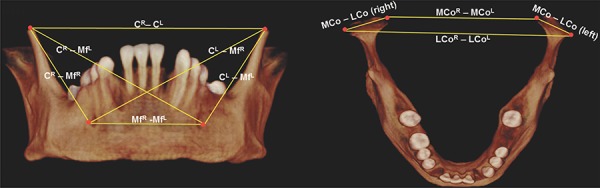
The purpose of this study was to determine the accuracy and reliability of two methods of measurements of linear distances (multiplanar 2D and tridimensional reconstruction 3D) obtained from cone-beam computed tomography (CBCT) with different voxel sizes.
Ten dry human mandibles were scanned at voxel sizes of 0.2 and 0.4 mm. Craniometric anatomical landmarks were identified twice by two independent operators on the multiplanar reconstructed and on volume rendering images that were generated by the software Dolphin®. Subsequently, physical measurements were performed using a digital caliper. Analysis of variance (ANOVA), intraclass correlation coefficient (ICC) and Bland-Altman were used for evaluating accuracy and reliability (p<0.05).
Excellent intraobserver reliability and good to high precision interobserver reliability values were found for linear measurements from CBCT 3D and multiplanar images. Measurements performed on multiplanar reconstructed images were more accurate than measurements in volume rendering compared with the gold standard. No statistically significant difference was found between voxel protocols, independently of the measurement method.
Linear measurements on multiplanar images of 0.2 and 0.4 voxel are reliable and accurate when compared with direct caliper measurements. Caution should be taken in the volume rendering measurements, because the measurements were reliable, but not accurate for all variables. An increased voxel resolution did not result in greater accuracy of mandible measurements and would potentially provide increased patient radiation exposure.
本研究旨在确定两种不同体素大小的锥形束 CT(CBCT)线性距离测量方法(多平面 2D 和三维重建 3D)的准确性和可靠性。
对 10 个干燥的人类下颌骨以 0.2 和 0.4mm 的体素大小进行扫描。由两名独立操作人员在多平面重建图像和 Dolphin®软件生成的容积再现图像上两次识别颅测量解剖学标志。然后使用数字卡尺进行物理测量。使用方差分析(ANOVA)、组内相关系数(ICC)和 Bland-Altman 评估准确性和可靠性(p<0.05)。
来自 CBCT 3D 和多平面图像的线性测量显示出良好的观察者内可靠性和良好到高度精确的观察者间可靠性值。与金标准相比,多平面重建图像上的测量比容积再现图像上的测量更准确。无论测量方法如何,体素方案之间均未发现统计学差异。
与直接卡尺测量相比,0.2 和 0.4 体素的多平面图像上的线性测量具有可靠性和准确性。在容积再现测量中应谨慎,因为所有变量的测量虽然可靠,但并不准确。体素分辨率的增加并未导致下颌骨测量的准确性提高,反而可能会增加患者的辐射暴露。