Gjorgjieva Julijana, Mease Rebecca A, Moody William J, Fairhall Adrienne L
Center for Brain Science, Harvard University, Cambridge, Massachusetts, United States of America.
Institute of Neuroscience, Technische Universität München, Munich, Germany.
PLoS Comput Biol. 2014 Dec 4;10(12):e1003962. doi: 10.1371/journal.pcbi.1003962. eCollection 2014 Dec.
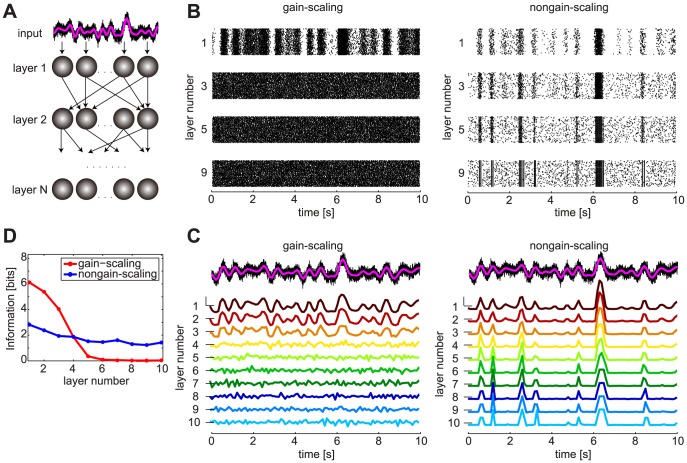
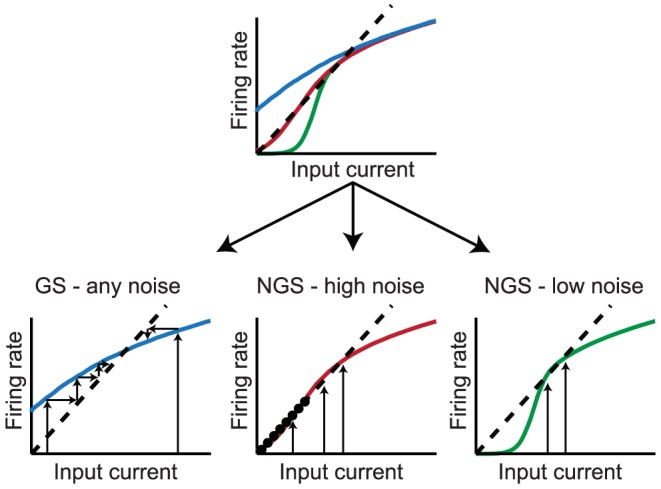
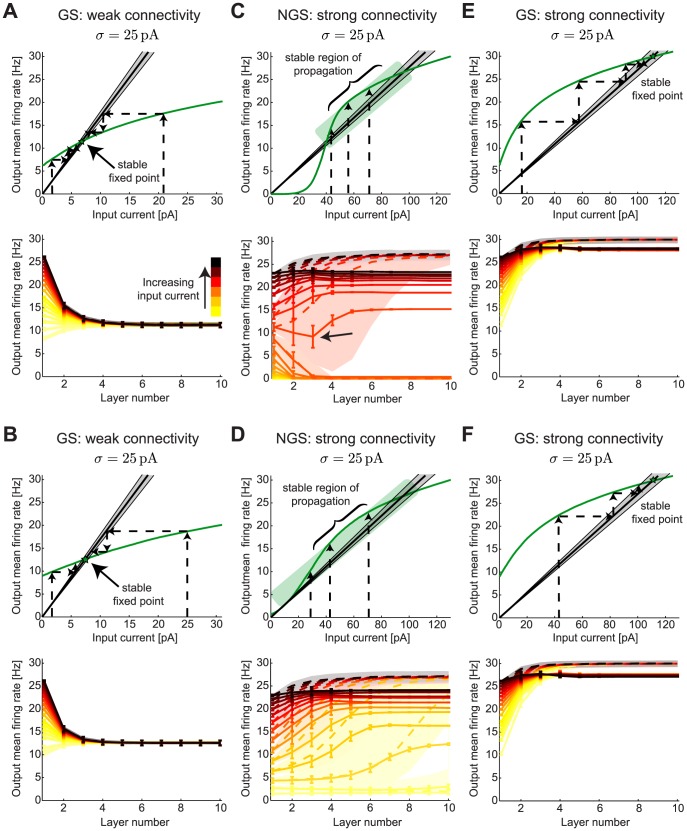
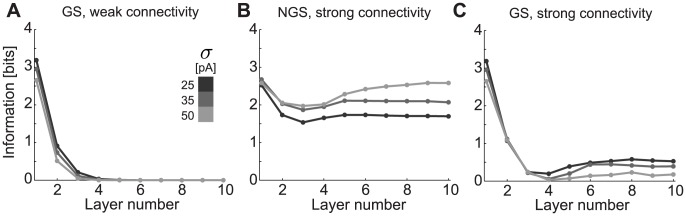
Diverse ion channels and their dynamics endow single neurons with complex biophysical properties. These properties determine the heterogeneity of cell types that make up the brain, as constituents of neural circuits tuned to perform highly specific computations. How do biophysical properties of single neurons impact network function? We study a set of biophysical properties that emerge in cortical neurons during the first week of development, eventually allowing these neurons to adaptively scale the gain of their response to the amplitude of the fluctuations they encounter. During the same time period, these same neurons participate in large-scale waves of spontaneously generated electrical activity. We investigate the potential role of experimentally observed changes in intrinsic neuronal properties in determining the ability of cortical networks to propagate waves of activity. We show that such changes can strongly affect the ability of multi-layered feedforward networks to represent and transmit information on multiple timescales. With properties modeled on those observed at early stages of development, neurons are relatively insensitive to rapid fluctuations and tend to fire synchronously in response to wave-like events of large amplitude. Following developmental changes in voltage-dependent conductances, these same neurons become efficient encoders of fast input fluctuations over few layers, but lose the ability to transmit slower, population-wide input variations across many layers. Depending on the neurons' intrinsic properties, noise plays different roles in modulating neuronal input-output curves, which can dramatically impact network transmission. The developmental change in intrinsic properties supports a transformation of a networks function from the propagation of network-wide information to one in which computations are scaled to local activity. This work underscores the significance of simple changes in conductance parameters in governing how neurons represent and propagate information, and suggests a role for background synaptic noise in switching the mode of information transmission.
多种离子通道及其动力学赋予单个神经元复杂的生物物理特性。这些特性决定了构成大脑的细胞类型的异质性,作为神经回路的组成部分,它们被调整以执行高度特定的计算。单个神经元的生物物理特性如何影响网络功能?我们研究了一组在发育第一周出现在皮层神经元中的生物物理特性,最终使这些神经元能够根据它们遇到的波动幅度自适应地调整其反应增益。在同一时期,这些相同的神经元参与自发产生的电活动的大规模波动。我们研究了实验观察到的内在神经元特性变化在决定皮层网络传播活动波能力方面的潜在作用。我们表明,这种变化会强烈影响多层前馈网络在多个时间尺度上表示和传输信息的能力。以发育早期观察到的特性为模型,神经元对快速波动相对不敏感,并且倾向于在对大幅度的波状事件做出反应时同步放电。随着电压依赖性电导的发育变化,这些相同的神经元在少数几层上成为快速输入波动的有效编码器,但失去了在许多层上传输较慢的、全群体输入变化的能力。根据神经元的内在特性,噪声在调节神经元输入 - 输出曲线中起着不同的作用,这可能会极大地影响网络传输。内在特性的发育变化支持网络功能从全网络信息传播转变为一种将计算按比例调整到局部活动的功能。这项工作强调了电导参数的简单变化在控制神经元如何表示和传播信息方面的重要性,并暗示了背景突触噪声在切换信息传输模式中的作用。