Li Wei, Cao Peng, Zhao Dazhe, Wang Junbo
Medical Image Computing Laboratory of Ministry of Education, Northeastern University, Shenyang 110819, China; College of Computer Science and Engineering, Northeastern University, Shenyang 110819, China.
Neusoft Research Institute, Neusoft Corporation, Shenyang 110179, China.
Comput Math Methods Med. 2016;2016:6215085. doi: 10.1155/2016/6215085. Epub 2016 Dec 14.
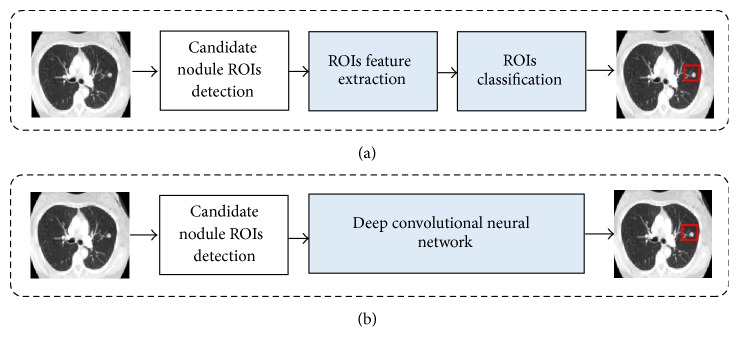
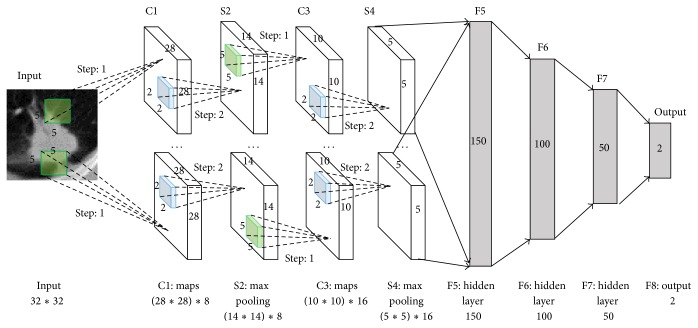
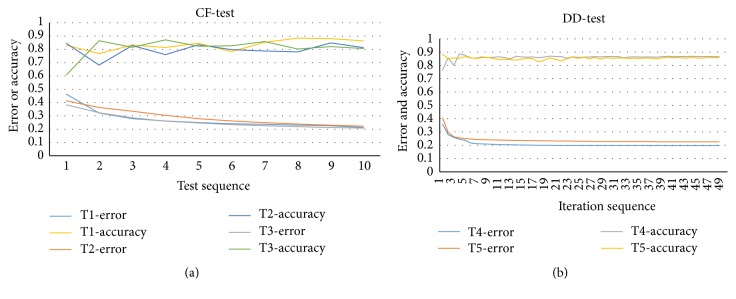
Computer aided detection (CAD) systems can assist radiologists by offering a second opinion on early diagnosis of lung cancer. Classification and feature representation play critical roles in false-positive reduction (FPR) in lung nodule CAD. We design a deep convolutional neural networks method for nodule classification, which has an advantage of autolearning representation and strong generalization ability. A specified network structure for nodule images is proposed to solve the recognition of three types of nodules, that is, solid, semisolid, and ground glass opacity (GGO). Deep convolutional neural networks are trained by 62,492 regions-of-interest (ROIs) samples including 40,772 nodules and 21,720 nonnodules from the Lung Image Database Consortium (LIDC) database. Experimental results demonstrate the effectiveness of the proposed method in terms of sensitivity and overall accuracy and that it consistently outperforms the competing methods.
计算机辅助检测(CAD)系统可以通过对肺癌早期诊断提供第二种观点来协助放射科医生。分类和特征表示在肺结节CAD的假阳性减少(FPR)中起着关键作用。我们设计了一种用于结节分类的深度卷积神经网络方法,该方法具有自动学习表示和强大泛化能力的优势。提出了一种针对结节图像的特定网络结构,以解决对三种类型结节的识别问题,即实性、半实性和磨玻璃密度(GGO)结节。深度卷积神经网络由来自肺影像数据库联盟(LIDC)数据库的62492个感兴趣区域(ROI)样本进行训练,其中包括40772个结节和21720个非结节。实验结果证明了所提方法在灵敏度和总体准确率方面的有效性,并且它始终优于竞争方法。