Fischer S Taylor, Lili Loukia N, Li Shuzhao, Tran ViLinh T, Stewart Kim B, Schwartz Charles E, Jones Dean P, Sherman Stephanie L, Fridovich-Keil Judith L
Department of Biostatistics and Bioinformatics, Rollins School of Public Health, Emory University, Grace Crum Rollins Building, 1518 Clifton Road, Atlanta, GA 30322, USA; Department of Human Genetics, School of Medicine, Emory University, Whitehead Biomedical Research Building, Suite 301, 615 Michael Street, Atlanta, GA 30322, USA.
Clinical Biomarkers Laboratory, Division of Pulmonary, Allergy, Critical Care, and Sleep Medicine, Department of Medicine, Emory University, Whitehead Biomedical Research Building, Suite 225, 615 Michael Street, Atlanta, GA 30322, USA.
Environ Int. 2017 Oct;107:227-234. doi: 10.1016/j.envint.2017.07.019. Epub 2017 Jul 30.
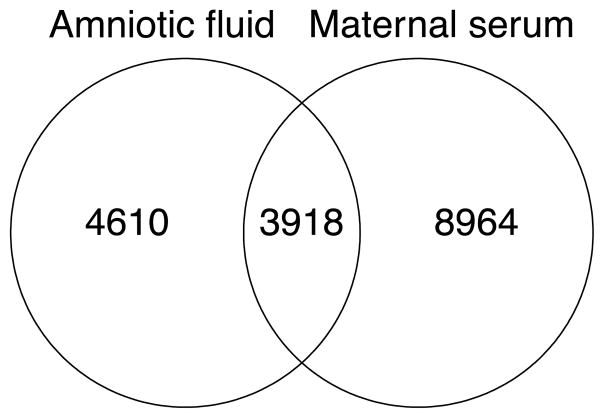
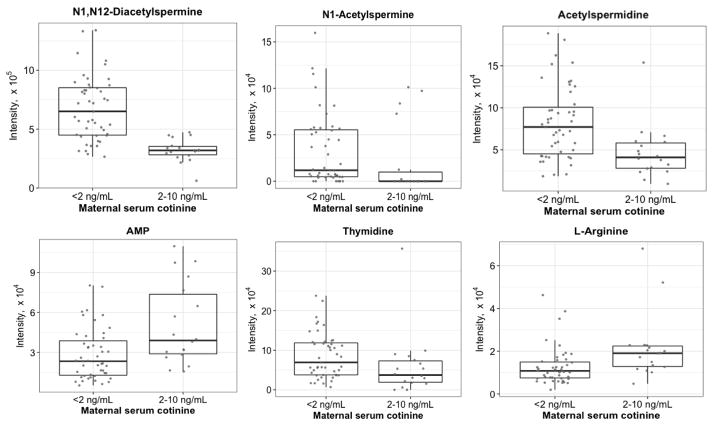
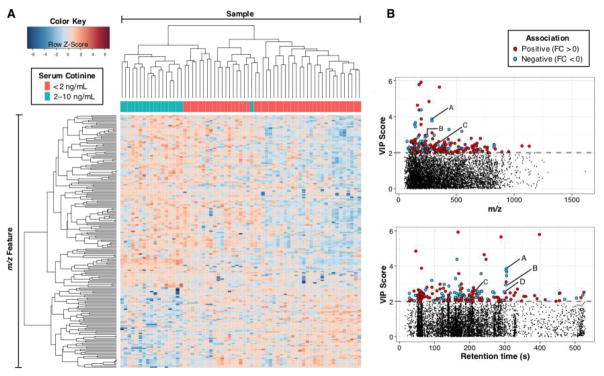
Decades of public health research have documented that smoking in pregnancy poses significant health risks to both mother and child. More recent studies have shown that even passive maternal exposure to secondhand smoke associates with negative birth outcomes. However, the mechanisms linking exposure to outcomes have remained obscure. As a first step toward defining the metabolic consequence of low-level nicotine exposure on fetal development, we conducted an untargeted metabolomic analysis of 81 paired samples of maternal serum and amniotic fluid collected from karyotypically normal pregnancies in the second trimester. By comparing the m/z and retention times of our mass spectral features with confirmed standards, we identified cotinine, a nicotine derivative, and used the calculated cotinine concentrations to classify our maternal serum samples into exposure groups using previously defined cut-offs. We found that cotinine levels consistent with low-level maternal exposure to nicotine associated with distinct metabolic perturbations, particularly in amniotic fluid. In fact, the metabolic effects in amniotic fluid of ostensibly low-level exposed mothers showed greater overlap with perturbations previously observed in the sera of adult smokers than did the perturbations observed in the corresponding maternal sera. Dysregulated fetal pathways included aspartate and asparagine metabolism, pyrimidine metabolism, and metabolism of other amino acids. We also observed a strong negative association between level of maternal serum cotinine and acetylated polyamines in the amniotic fluid. Combined, these results confirm that low-level maternal nicotine exposure, indicated by a maternal serum cotinine level of 2-10ng/mL, is associated with striking metabolic consequences in the fetal compartment, and that the affected pathways overlap those perturbed in the sera of adult smokers.
数十年的公共卫生研究已证明,孕期吸烟会对母亲和孩子都造成重大健康风险。最近的研究表明,即使母亲被动接触二手烟也与不良出生结局有关。然而,接触与结局之间的关联机制仍不明确。作为确定低水平尼古丁暴露对胎儿发育的代谢后果的第一步,我们对孕中期核型正常的孕妇采集的81对母血和羊水样本进行了非靶向代谢组学分析。通过将我们质谱特征的质荷比和保留时间与已确认的标准进行比较,我们鉴定出了可替宁(一种尼古丁衍生物),并使用计算出的可替宁浓度,根据先前定义的临界值将我们的母血样本分为暴露组。我们发现,与母亲低水平接触尼古丁相一致的可替宁水平与明显的代谢紊乱有关,尤其是在羊水中。事实上,表面上低水平暴露母亲的羊水代谢效应与先前在成年吸烟者血清中观察到的紊乱有更大的重叠,比在相应母血中观察到的紊乱更大。胎儿失调的代谢途径包括天冬氨酸和天冬酰胺代谢、嘧啶代谢以及其他氨基酸代谢。我们还观察到母血可替宁水平与羊水中乙酰化多胺水平之间存在强烈的负相关。综合来看,这些结果证实,母血可替宁水平为2-10ng/mL表明母亲低水平接触尼古丁与胎儿体内显著的代谢后果有关,且受影响的途径与成年吸烟者血清中受干扰的途径重叠。