Department of Ophthalmology & Vision Science, University of California, Davis, Sacramento, California, USA.
Department of Surgical and Radiological Sciences, School of Veterinary Medicine, University of California, Davis, Davis, California, USA.
Sci Rep. 2017 Nov 3;7(1):15013. doi: 10.1038/s41598-017-14715-z.
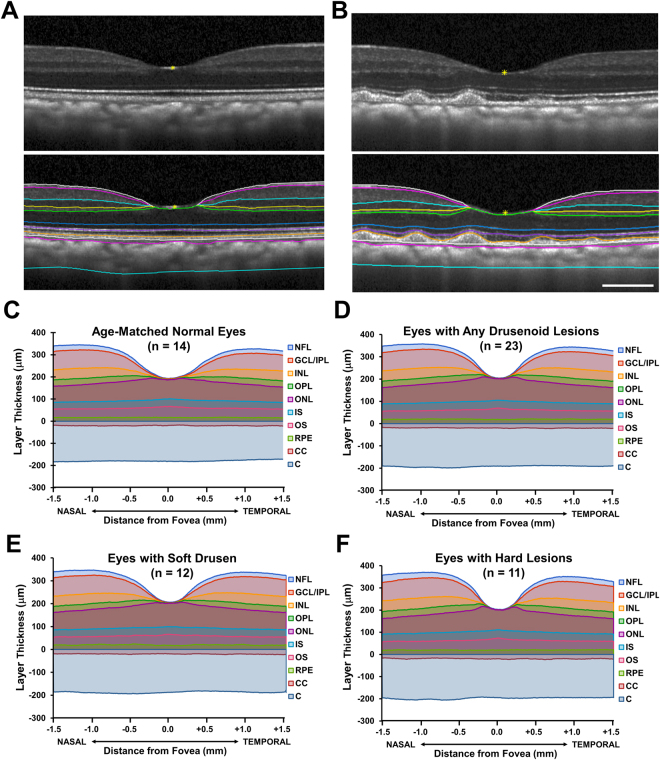
Nonhuman primates are the only mammals to possess a true macula similar to humans, and spontaneously develop drusenoid lesions which are hallmarks of age-related macular degeneration (AMD). Prior studies demonstrated similarities between human and nonhuman primate drusen based on clinical appearance and histopathology. Here, we employed fundus photography, spectral domain optical coherence tomography (SD-OCT), fundus autofluorescence (FAF), and infrared reflectance (IR) to characterize drusenoid lesions in aged rhesus macaques. Of 65 animals evaluated, we identified lesions in 20 animals (30.7%). Using the Age-Related Eye Disease Study 2 (AREDS2) grading system and multimodal imaging, we identified two distinct drusen phenotypes - 1) soft drusen that are larger and appear as hyperreflective deposits between the retinal pigment epithelium (RPE) and Bruch's membrane on SD-OCT, and 2) hard, punctate lesions that are smaller and undetectable on SD-OCT. Both exhibit variable FAF intensities and are poorly visualized on IR. Eyes with drusen exhibited a slightly thicker RPE compared with control eyes (+3.4 μm, P=0.012). Genetic polymorphisms associated with drusenoid lesions in rhesus monkeys in ARMS2 and HTRA1 were similar in frequency between the two phenotypes. These results refine our understanding of drusen development, and provide insight into the absence of advanced AMD in nonhuman primates.
非人类灵长类动物是唯一拥有与人相似的真正黄斑的哺乳动物,并且会自发地形成黄斑病变,这是与年龄相关的黄斑变性(AMD)的标志。先前的研究表明,基于临床外观和组织病理学,人类和非人类灵长类动物的玻璃膜疣具有相似性。在这里,我们采用眼底照相、谱域光相干断层扫描(SD-OCT)、眼底自发荧光(FAF)和红外反射(IR)来描述老年恒河猴的玻璃膜疣病变。在评估的 65 只动物中,我们在 20 只动物(30.7%)中发现了病变。使用年龄相关性眼病研究 2(AREDS2)分级系统和多模态成像,我们确定了两种不同的玻璃膜疣表型-1)软性玻璃膜疣,在 SD-OCT 上表现为视网膜色素上皮(RPE)和布鲁赫膜之间较大的、呈高反射性沉积物;2)硬性、点状病变较小,在 SD-OCT 上不可检测。两者的 FAF 强度不同,在 IR 上显示不佳。与对照眼相比,有玻璃膜疣的眼睛的 RPE 略厚(+3.4 μm,P=0.012)。与 ARMS2 和 HTRA1 中恒河猴玻璃膜疣相关的遗传多态性在两种表型之间的频率相似。这些结果细化了我们对玻璃膜疣发展的理解,并深入了解了非人类灵长类动物中晚期 AMD 的缺失。