Max Planck Institute for Polymer Research, Ackermannweg 10, 55128, Mainz, Germany.
Ulm University, Albert-Einstein-Allee 11, 89081, Ulm, Germany.
Angew Chem Int Ed Engl. 2018 Feb 5;57(6):1587-1591. doi: 10.1002/anie.201711560. Epub 2018 Jan 15.
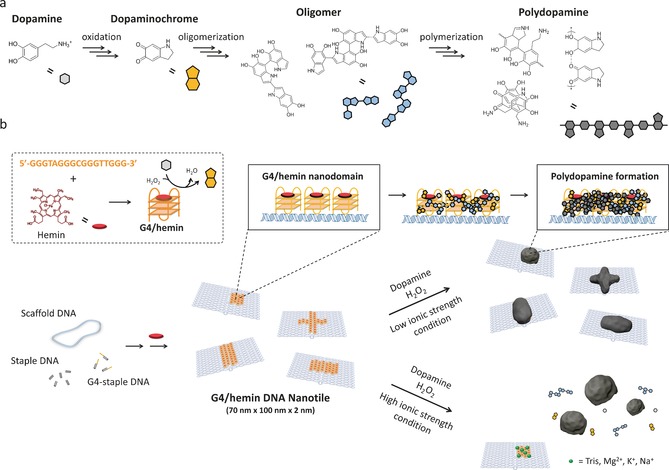
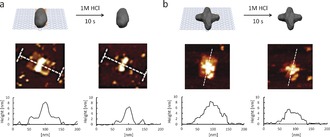
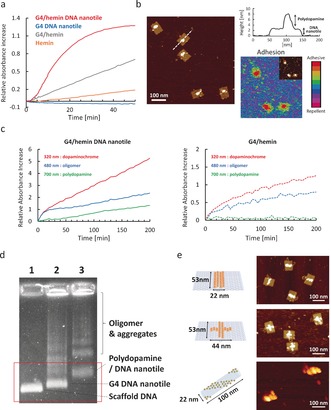
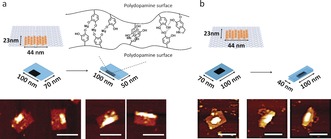
A versatile, bottom-up approach allows the controlled fabrication of polydopamine (PD) nanostructures on DNA origami. PD is a biosynthetic polymer that has been investigated as an adhesive and promising surface coating material. However, the control of dopamine polymerization is challenged by the multistage-mediated reaction mechanism and diverse chemical structures in PD. DNA origami decorated with multiple horseradish peroxidase-mimicking DNAzyme motifs was used to control the shape and size of PD formation with nanometer resolution. These fabricated PD nanostructures can serve as "supramolecular glue" for controlling DNA origami conformations. Facile liberation of the PD nanostructures from the DNA origami templates has been achieved in acidic medium. This presented DNA origami-controlled polymerization of a highly crosslinked polymer provides a unique access towards anisotropic PD architectures with distinct shapes that were retained even in the absence of the DNA origami template.
一种通用的自下而上的方法允许在 DNA 折纸(origami)上控制聚多巴胺(PD)纳米结构的制造。PD 是一种生物合成聚合物,已被研究作为一种有前途的黏附剂和表面涂层材料。然而,由于 PD 中的多阶段介导反应机制和多种化学结构,多巴胺聚合的控制具有挑战性。使用 DNA 折纸(origami)装饰有多个辣根过氧化物酶模拟 DNA 酶基序,以纳米分辨率控制 PD 形成的形状和大小。这些制造的 PD 纳米结构可以用作“超分子胶”,用于控制 DNA 折纸(origami)构象。在酸性介质中,很容易将 PD 纳米结构从 DNA 折纸(origami)模板中释放出来。这种高度交联聚合物的 DNA 折纸(origami)控制聚合提供了一种独特的方法,可以获得具有独特形状的各向异性 PD 结构,即使在没有 DNA 折纸(origami)模板的情况下,这些形状也能保留。