Hong Joon Ki, Jeong Yong Dae, Cho Eun Seok, Choi Tae Jeong, Kim Yong Min, Cho Kyu Ho, Lee Jae Bong, Lim Hyun Tae, Lee Deuk Hwan
Swine Science Division, National Institute of Animal Science, Rural Development Administration, Cheonan 31000, Korea.
Institute of Agriculture and Life Science, Gyeongsang National University, Jinju 52828, Korea.
Asian-Australas J Anim Sci. 2018 Jun;31(6):784-790. doi: 10.5713/ajas.17.0440. Epub 2017 Dec 19.
The genetic effects of an individual on the phenotypes of its social partners, such as its pen mates, are known as social genetic effects. This study aims to identify the candidate genes for social (pen-mates') average daily gain (ADG) in pigs by using the genome-wide association approach.
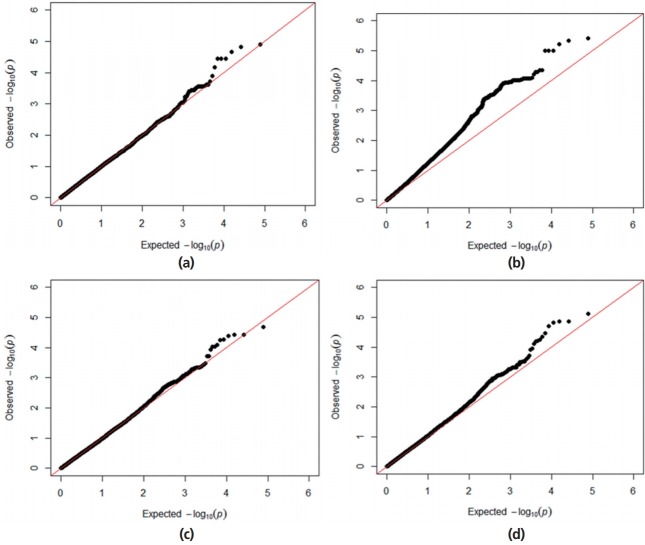
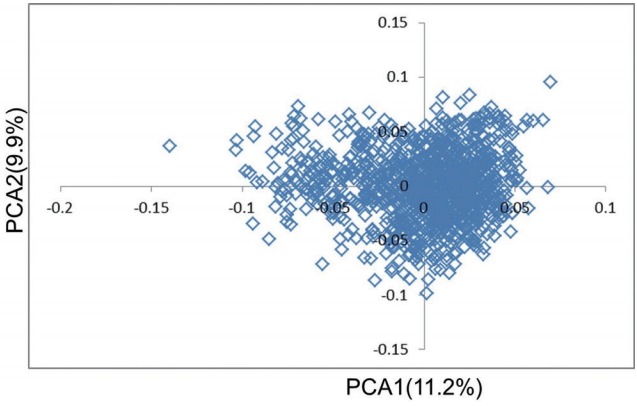
Social ADG (sADG) was the average ADG of unrelated pen-mates (strangers). We used the phenotype data (16,802 records) after correcting for batch (week), sex, pen, number of strangers (1 to 7 pigs) in the pen, full-sib rate (0% to 80%) within pen, and age at the end of the test. A total of 1,041 pigs from Landrace breeds were genotyped using the Illumina PorcineSNP60 v2 BeadChip panel, which comprised 61,565 single nucleotide polymorphism (SNP) markers. After quality control, 909 individuals and 39,837 markers remained for sADG in genome-wide association study.
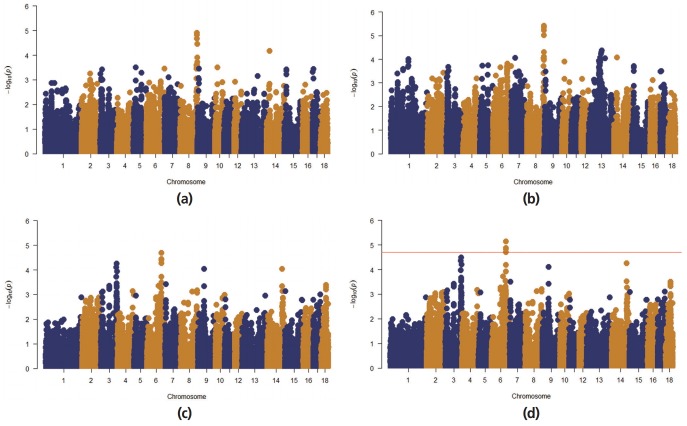
We detected five new SNPs, all on chromosome 6, which have not been associated with social ADG or other growth traits to date. One SNP was inside the prostaglandin F2α receptor () gene, another SNP was located 22 kb upstream of gene interferon-induced protein 44 (), and the last three SNPs were between 161 kb and 191 kb upstream of the EGF latrophilin and seven transmembrane domain-containing protein 1 () gene. PTGFR, IFI44, and ELTD1 were never associated with social interaction and social genetic effects in any of the previous studies.
The identification of several genomic regions, and candidate genes associated with social genetic effects reported here, could contribute to a better understanding of the genetic basis of interaction traits for ADG. In conclusion, we suggest that the PTGFR, IFI44, and ELTD1 may be used as a molecular marker for sADG, although their functional effect was not defined yet. Thus, it will be of interest to execute association studies in those genes.
个体对其社交伙伴(如同栏伙伴)表型的遗传效应被称为社会遗传效应。本研究旨在通过全基因组关联方法鉴定猪社会(同栏伙伴)平均日增重(ADG)的候选基因。
社会ADG(sADG)是无关同栏伙伴(陌生人)的平均ADG。我们使用了校正批次(周)、性别、栏位、栏内陌生人数量(1至7头猪)、栏内全同胞率(0%至80%)以及试验结束时年龄后的表型数据(16,802条记录)。使用Illumina PorcineSNP60 v2 BeadChip芯片对总共1,041头长白猪进行基因分型,该芯片包含61,565个单核苷酸多态性(SNP)标记。经过质量控制后,在全基因组关联研究中,剩余909个个体和39,837个标记用于sADG分析。
我们检测到五个新的SNP,均位于6号染色体上,迄今为止它们尚未与社会ADG或其他生长性状相关联。一个SNP位于前列腺素F2α受体()基因内部,另一个SNP位于干扰素诱导蛋白44()基因上游22 kb处,最后三个SNP位于表皮生长因子亲嗜性蛋白和含七个跨膜结构域蛋白1()基因上游161 kb至191 kb之间。在以往的任何研究中,PTGFR、IFI44和ELTD1从未与社会互动和社会遗传效应相关联。
本文报道的几个与社会遗传效应相关的基因组区域和候选基因的鉴定,有助于更好地理解ADG相互作用性状的遗传基础。总之,我们建议PTGFR、IFI44和ELTD1可作为sADG的分子标记,尽管它们的功能效应尚未明确。因此,对这些基因进行关联研究将很有意义。