Jankowiak Katarzyna, Korpal Paweł
Faculty of English, Adam Mickiewicz University in Poznań, al. Niepodległości 4, 61-874, Poznan, Poland.
J Psycholinguist Res. 2018 Jun;47(3):663-677. doi: 10.1007/s10936-017-9552-5.
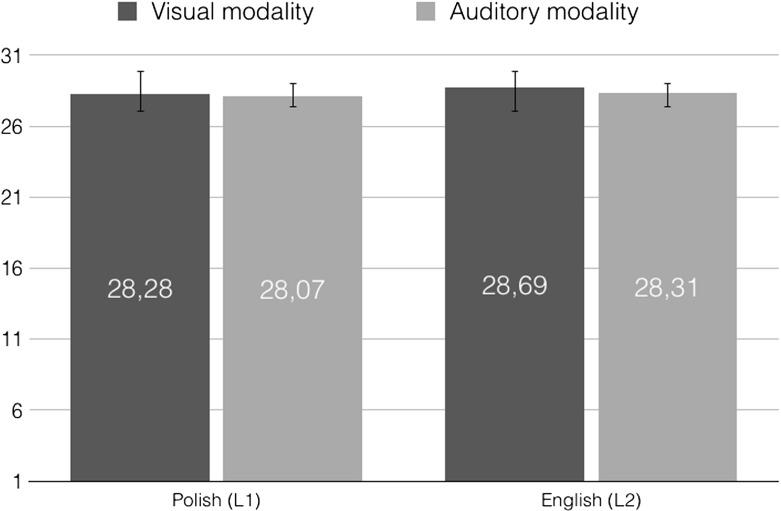
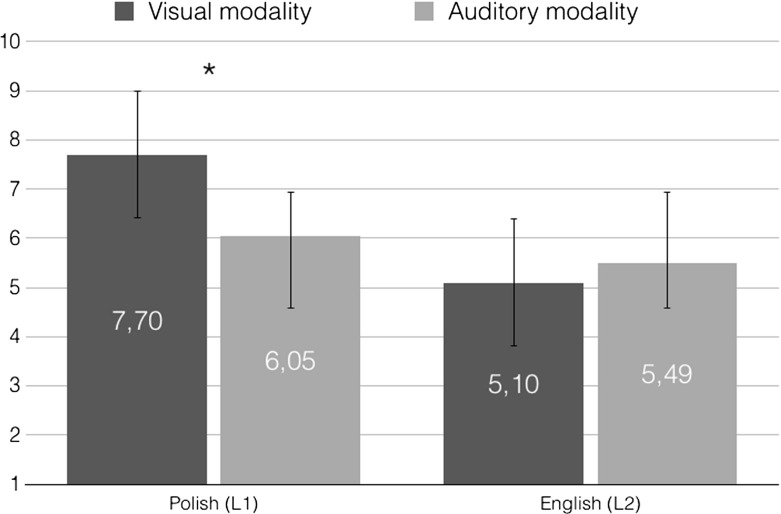
Though previous research has shown a decreased sensitivity to emotionally-laden linguistic stimuli presented in the non-native (L2) compared to the native language (L1), studies conducted thus far have not examined how different modalities influence bilingual emotional language processing. The present experiment was therefore aimed at investigating how late proficient Polish (L1)-English (L2) bilinguals process emotionally-laden narratives presented in L1 and L2, in the visual and auditory modality. To this aim, we employed the galvanic skin response (GSR) method and a self-report measure (Polish adaptation of the PANAS questionnaire). The GSR findings showed a reduced galvanic skin response to L2 relative to L1, thus suggesting a decreased reactivity to emotional stimuli in L2. Additionally, we observed a more pronounced skin conductance level to visual than auditory stimuli, yet only in L1, which might be accounted for by a self-reference effect that may have been modulated by both language and modality.
尽管先前的研究表明,与母语(L1)相比,非母语(L2)呈现的带有情感色彩的语言刺激的敏感性有所降低,但迄今为止进行的研究尚未考察不同模态如何影响双语情感语言处理。因此,本实验旨在研究熟练的波兰语(L1)-英语(L2)双语者如何在视觉和听觉模态下处理用L1和L2呈现的带有情感色彩的叙述。为此,我们采用了皮肤电反应(GSR)方法和一种自我报告测量方法(波兰语版的PANAS问卷)。GSR研究结果表明,相对于L1,对L2的皮肤电反应降低,因此表明对L2中情感刺激的反应性降低。此外,我们观察到,仅在L1中,视觉刺激比听觉刺激引起的皮肤电导水平更明显,这可能是由一种自我参照效应所导致的,这种效应可能受到语言和模态的调节。