Ramakrishnan Saminathan, Ijäs Heini, Linko Veikko, Keller Adrian
Technical and Macromolecular Chemistry, Paderborn University, Warburger Str. 100, 33098 Paderborn, Germany.
Biohybrid Materials, Department of Bioproducts and Biosystems, Aalto University, P. O. Box 16100, FI-00076 Aalto, Finland.
Comput Struct Biotechnol J. 2018 Sep 18;16:342-349. doi: 10.1016/j.csbj.2018.09.002. eCollection 2018.
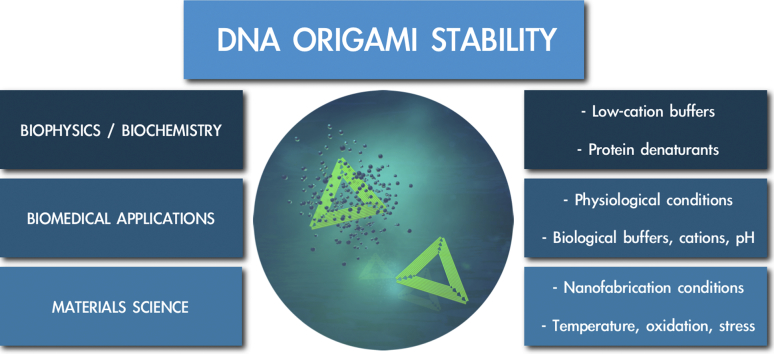
With the introduction of the DNA origami technique, it became possible to rapidly synthesize almost arbitrarily shaped molecular nanostructures at nearly stoichiometric yields. The technique furthermore provides absolute addressability in the sub-nm range, rendering DNA origami nanostructures highly attractive substrates for the controlled arrangement of functional species such as proteins, dyes, and nanoparticles. Consequently, DNAorigami nanostructures have found applications in numerous areas of fundamental and applied research, ranging from drug delivery to biosensing to plasmonics to inorganic materials synthesis. Since many of those applications rely on structurally intact, well-definedDNA origami shapes, the issue of DNA origami stability under numerous application-relevant environmental conditions has received increasing interest in the past few years. In this mini-review we discuss the structural stability, denaturation, and degradation of DNA origami nanostructures under different conditions relevant to the fields of biophysics and biochemistry, biomedicine, and materials science, and the methods to improve their stability for desired applications.
随着DNA折纸技术的引入,几乎可以以接近化学计量产率快速合成几乎任意形状的分子纳米结构。此外,该技术在亚纳米范围内提供了绝对的可寻址性,使DNA折纸纳米结构成为用于蛋白质、染料和纳米颗粒等功能物种可控排列的极具吸引力的底物。因此,DNA折纸纳米结构已在从药物递送、生物传感、等离子体学到无机材料合成等众多基础研究和应用研究领域得到应用。由于其中许多应用依赖于结构完整、定义明确的DNA折纸形状,在过去几年中,DNA折纸在众多与应用相关的环境条件下的稳定性问题受到了越来越多的关注。在本综述中,我们讨论了DNA折纸纳米结构在与生物物理学、生物化学、生物医学和材料科学领域相关的不同条件下的结构稳定性、变性和降解,以及提高其在所需应用中的稳定性的方法。